
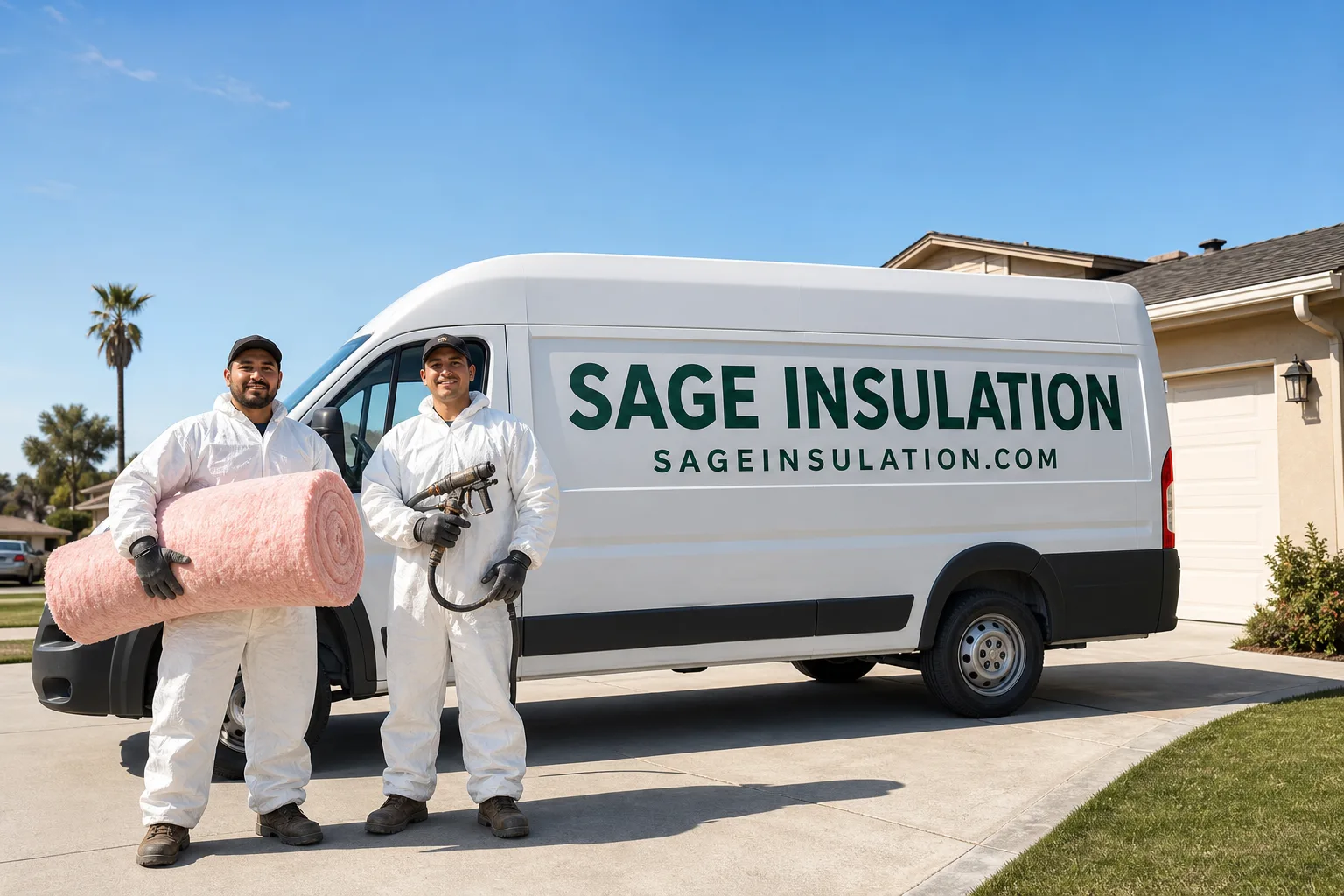
Fast, Reliable Attic Insulation Across Hacienda Heights
If your Hacienda Heights home was built between the 1950s and 1970s, the insulation in your attic is almost certainly not doing what it did when it was installed. Most of the ranches and split-levels across the Puente Hills slopes still have their original fiberglass batts, and after decades of intense inland sun and hot-roof cycling, those batts have settled, compressed, and lost most of their effective R-value. The result is an attic that traps heat, forces your AC to run constantly from June through October, and leaves rooms on the west side of the house noticeably warmer by late afternoon.
Sage Insulation works in Hacienda Heights every week, and we know these houses. We know the shallow attics off Hacienda Boulevard, the low-pitch roofs with 2×4 rafters and no baffling, and the crawlspaces that follow the grade of the hillside. Call (855) 360-9333 for a free attic inspection and an honest recommendation, not a sales pitch.
Why Sage Insulation Is Hacienda Heights’s Preferred Attic Insulation Company
Our reputation in Hacienda Heights comes from one thing: we don’t carry a single insulation product and then try to make it fit every home. We carry eight brands across all three major installation methods, so when we look at a 1963 ranch on a graded lot near the foothills, we’re matching the material to what that attic actually needs, not working through whatever inventory we happen to have on the truck. That brand-agnostic approach matters here because Hacienda Heights homes are inconsistent. A tract-built split-level from 1972 needs something different than a custom hillside ranch from 1958.
Homeowners across the 91745 zip code call us because their neighbors did. We respond to Hacienda Heights service calls same-day in most cases, and our crews are familiar with the specific access problems these older sloped-lot houses create. When Alan Herrera walks an attic here, he’s looking at more than R-value. He’s checking rafter depth, soffit ventilation, baffle placement, and whether the original framing can support the insulation method we’re recommending.
Attic Ventilation in Hacienda Heights
Attic Ventilation in Hacienda Heights is the difference between an attic that breathes and an attic that cooks. Most original 1950s-1970s ranches here were built with low-pitch roofs and shallow attic cavities, and the builders in those decades rarely installed rafter baffles. Soffit vents get covered when insulation is pushed to the eaves, and once that airflow chokes off, the attic becomes a heat trap. On a 95-degree August afternoon with the sun hammering a west-facing roof over the 91745 area, the air inside an unventilated attic can hit 140 degrees or more. That heat conducts through the ceiling into the living space, and it also radiates back down long after sunset.
When a Hacienda Heights homeowner needs attic ventilation work, it typically means installing rafter baffles before insulating so the soffit intake path stays open, and often adding or upgrading passive roof vents or a solar-powered exhaust fan. The cost for baffle installation paired with a new insulation top-up in this area generally runs $1,200-$2,800 depending on attic size and access. Ventilation retrofits alone, including baffles and additional venting, usually fall between $800 and $1,900.
Baffle Installation in Low-Clearance Attics
This is the single most common correction we make in Hacienda Heights. The original insulation was pushed right to the eaves, blocking soffit airflow and trapping heat against the roof deck. We install baffles between the rafters to keep that intake path clear before any new insulation goes in.
When Ventilation Fails First
We regularly see attics where the insulation isn’t the first problem, the airflow is. Roof decks get brittle from overheating, shingles age faster, and the insulation itself holds heat. Fix the ventilation path first, then add insulation. Doing it in that order saves money twice: once in material waste and again in cooling load.
Radiant Barrier in Hacienda Heights
Radiant Barrier in Hacienda Heights is one of the highest-return upgrades for these specific houses. A radiant barrier is a reflective foil layer stapled to the underside of the roof rafters that reflects radiant heat back out through the roof deck before it can radiate into the attic space. In the inland Puente Hills climate, where summer afternoons deliver direct, intense sun for six straight months, that reflective layer cuts attic temperatures meaningfully, sometimes by 20 to 30 degrees on peak days.
For a hillside ranch with a low-pitch roof and a shallow attic, a radiant barrier makes particular sense. Those attics don’t have the volume of air that a taller attic provides, so every degree of heat you keep out of the cavity translates directly into cooler ceiling surfaces and a reduced load on the HVAC system. Radiant barrier installation in Hacienda Heights typically runs $0.80-$1.50 per square foot for a standard retrofit, so a 1,200-square-foot attic usually lands between $960 and $1,800 depending on rafter spacing and accessibility.
Radiant Barrier Under Low-Pitch Roofs
The challenge on older Hacienda Heights houses is working in tight clearance. Our crews staple the reflective material directly to the rafter undersides, but we first confirm there’s enough room to work safely and that the barrier won’t impinge on the baffle path. The result is a sealed, reflective ceiling over the entire attic floor area.
Pairing Barriers With Reflective Attic Insulation
A radiant barrier works best when the attic floor is also properly insulated. The barrier stops radiant heat from entering the cavity, the floor insulation slows conductive heat from what does get through. On Hacienda Heights slopes where late-afternoon sun hits the roof directly, that pairing is what finally keeps upstairs rooms comfortable.
Trusted Brands We Service in Hacienda Heights
We’re a material-agnostic Attic Insulation contractor, which means we don’t have a single brand program that dictates what gets installed in your home. For Hacienda Heights attics, that usually means spec’ing Knauf batt insulation for standard open cavities, Rockwool mineral wool when fire resistance matters near the hill edges, and CertainTeed blown-in fiberglass for dense-pack retrofits. For homes where air sealing is the priority and a spray-applied barrier makes sense, we also install Icynene open- and closed-cell foam systems. We stock these product lines specifically so Hacienda Heights customers get the right material for their attic, not the material we’re incentivized to sell this quarter.
Common Attic Insulation Problems We See in Hacienda Heights Homes
- Settled and compressed original fiberglass batts: The 1950s-1970s ranches here were insulated once, at construction, with whatever R-value was cheap that year. After decades of hot-roof cycling in the Puente Hills heat, those batts have compacted to a fraction of their original loft. What was R-19 in 1965 is often closer to R-8 now.
- No soffit baffling in shallow 2×4 rafter attics: The original crews pushed insulation to the eaves and called it done. That closed off the soffit intake path entirely. Airflow dies, heat builds, and the attic becomes a convection oven over your ceiling.
- Uneven or missing subfloor insulation on sloped lots: Hillside grading means crawlspaces follow the slope, and original subfloor insulation often hangs loose, sags, or was never installed on the downhill side. We find entire rooms with unconditioned air leaking up through the floor every winter night.
- Ember-vulnerable material choices near the hill edges: For homes on the wildland boundary near the Puente Hills open space, standard materials aren’t always the right call. Rockwool mineral wool has a higher fire resistance rating and doesn’t need to be replaced if it gets wet, which is why we lean on it for edge-of-hill retrofit projects.
Pricing for Attic Insulation in Hacienda Heights, CA
Attic insulation in Hacienda Heights runs on real, local market numbers. A blown-in insulation top-up over existing settled batts on a standard 1,200-square-foot ranch typically costs $1,100-$2,400. Full replacement, including removal of old compressed material and new air sealing, usually lands between $2,500 and $4,800. Attic batt insulation for new construction or a gutted attic space runs $1.25-$2.75 per square foot installed. If you need baffle installation and ventilation correction first, add $800-$1,900. On sloped lots with difficult access or extra subfloor work, expect the higher end of these ranges. Call (855) 360-9333 for a free estimate, and we’ll give you a fixed number after walking the attic, not a calculator range with fine print.
We Also Serve Cities Near Hacienda Heights
Sage Insulation works throughout the San Gabriel Valley, and we run crews to Attic Insulation in Hacienda Heights and the surrounding communities on a regular schedule. We also serve La Puente, Valinda, Avocado Heights, and West Puente Valley. If you’re in any of these neighboring areas, you’re getting the same crew, the same brands, and the same brand-agnostic approach.
Serving Hacienda Heights, CA — Our Local Coverage Area
We’re based in the Hacienda Heights area and know this community well. Use the map below to see our service coverage — if you’re nearby, we can almost certainly help.
FAQs About Attic Insulation in Hacienda Heights
Because Hacienda Heights is unincorporated Los Angeles County, there is no city hall building department. Insulation projects that pull permits go through County Building & Safety, which means the scope has to be written for a County inspector, not a city counter. Our team handles that documentation for you, including low-clearance attic and crawlspace access notes and baffle placement details, so the sign-off is clean on the first visit. If your job doesn’t need a permit, we’ll tell you that too. Call (855) 360-9333 and we’ll walk you through what applies to your property.
Yes. We insulate shallow, low-clearance attics in Hacienda Heights all the time, including ones with 2×4 rafters and pitches under 4:12. The method changes: blown-in cellulose or fiberglass through a hose works where batt installation is impossible, and we use rafter baffles to preserve the soffit path even in tight spaces. On a split-level ranch off Hacienda Boulevard, we once opened a shallow attic and found the original batts compressed to about two inches. Our crew raked it all out, installed baffles, sealed the air barrier, and blew in fresh material. The attic still breathes, and the upstairs finally holds temperature.
It usually does. Low-pitch roofs have less attic volume, so the air inside heats up fast and stays hot. A radiant barrier stapled to the rafter undersides reflects a significant share of that solar heat back out through the deck before it sits in the attic. For Hacienda Heights houses with west-facing roofs and six months of direct sun, that’s one of the most cost-effective upgrades we install. Pair it with sealed attic floor insulation for the best result.
If your Hacienda Heights home is 40 to 70 years old and you’ve never had the attic insulation touched, almost certainly not. Fiberglass batts lose loft over time as gravity settles the material and years of hot-roof cycling bake the binder. What’s installed in most of these ranches is now performing at half its original R-value or less. The only way to know is to look. We’ll open the hatch and show you exactly what’s up there before recommending anything.
For homes on the wildland boundary along the Puente Hills edges, material selection matters. Rockwool mineral wool has a high fire resistance rating, doesn’t need to be replaced after getting wet, and is a smart choice where ember exposure is a realistic concern. We stock Rockwool specifically for these Hacienda Heights hillside jobs. If your home is on the edge of the open space, we’ll factor fire resistance into the recommendation from the start. Call (855) 360-9333 to talk through your specific property.
Contact Sage Insulation for Attic Insulation in Hacienda Heights
We work in the 91745 area every week, and our crews know these houses. If your Hacienda Heights attic hasn’t been touched since the day it was built, let’s open the hatch and see what’s actually up there. Alan Herrera and the Sage Insulation team will give you a straight answer about what needs to happen, what it costs, and what you can skip. We’re licensed, insured, and we carry the full range of insulation methods so the recommendation fits your home, not our inventory. Call (855) 360-9333 for a free estimate.
Written by Alan Herrera, Owner at Sage Insulation, serving Hacienda Heights and the San Gabriel Valley.