
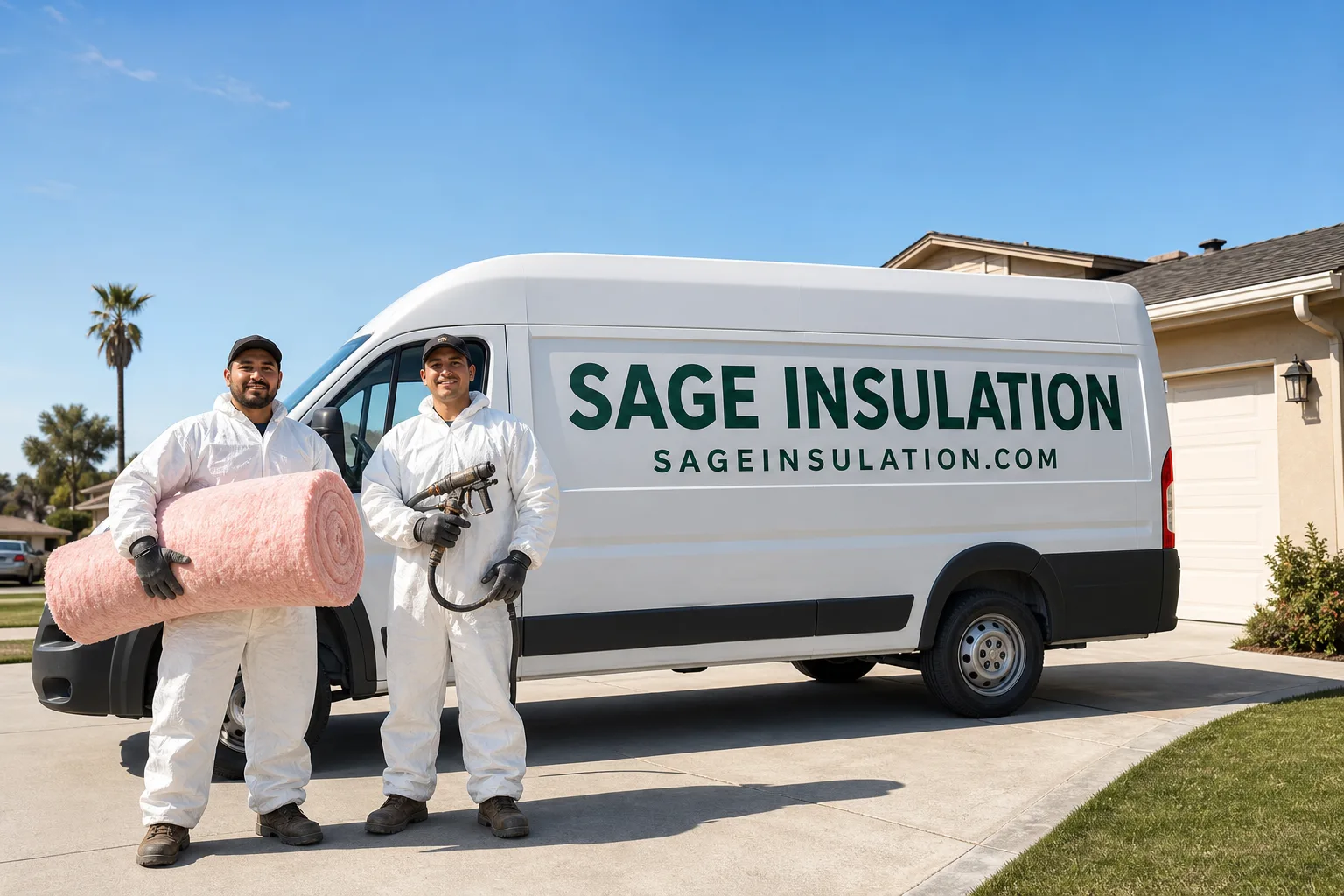
Fast, Reliable Attic Insulation Across Montebello
Attic insulation in Montebello usually costs between $1,800 and $4,600 for a full retrofit on the typical 900 – 1,300 square-foot stucco bungalow, with most jobs completed in a single day. The biggest cost driver here isn’t square footage, it’s access: many Montebello homes built between the 1920s and 1960s have attic hatches too small to work through, and the shallow pitch leaves 16 to 24 inches of clearance at best. That’s the reality we plan for on every job in the 90640 ZIP code. You’ll need a crew that’s done this before, not one that discovers the problem after the blower hose is already in the driveway. Call (855) 360-9333 and we’ll have someone at your Montebello home within 24 to 48 hours to assess the attic and give you a written, line-item quote.
We know Montebello’s streets, from the blocks off Whittier Boulevard up to the hills near Grant Rea Park. We know the difference between a 1930s bungalow near the golf course and a 1950s tract home off Montebello Boulevard. That matters when the attic access is in a hallway closet, or when the roof pitch is so low the crew is working on their stomachs for four hours straight. This isn’t a suburb of open attics and walk-up staircases. It’s dense, older housing, and it rewards a crew that treats every job as a retrofit, not a standard install.
Why Sage Insulation Is Montebello’s Preferred Attic Insulation Company
Homeowners across Montebello call us for one reason that keeps repeating: we don’t flinch at the attics other contractors walk away from. A single-story 1940s home off Via Acosta with a 14-inch peak and no access panel doesn’t scare us. It’s Tuesday. Sage Insulation, led by Alan Herrera, has built our reputation in neighborhoods like Montebello by treating every retrofit as a diagnostic project first. We assess the roof structure, the wiring, the venting, the existing insulation depth, and the hatch placement before we quote a dollar amount. That approach is why our Montebello customers tell us the quote felt honest, not salesy.
Our crews reach most Montebello addresses within one business day for an estimate. That’s not a marketing line; it’s a function of how close we are and how well we know the route from Downey up the 60 or across Washington Boulevard. We’ve worked on homes near the Montebello Town Center, in the residential grid south of Beverly Boulevard, and along the streets that climb toward the Whittier Narrows. Each one has taught us something about how these old stucco shells hold heat, and how to get insulation into them without tearing the ceiling apart.
Attic Insulation Removal in Montebello
Attic insulation removal in Montebello is frequently the first step before any new insulation goes in, because the material sitting in these attics is often 40 to 70 years old and has failed. We charge $1.50 to $3.00 per square foot for removal, which on a typical 1,000-square-foot Montebello attic runs $1,500 to $3,000. That includes vacuum extraction, bagging, and haul-away. What it also includes, and what most homeowners don’t know to ask about, is the inspection we do once the old material is out and the framing is exposed. That’s when we find things the old insulation was hiding.
In Montebello’s older housing stock, removal isn’t optional in two clear situations. The first is settling: original cellulose or rock wool installed decades ago compresses over time, dropping from R-30 to R-7 or R-9. You can’t fix that by blowing more on top; the compressed layer still acts as a thermal bridge. The second is contamination, which we see regularly in homes where a roof leak went unnoticed, or where rodents found a way in through the venting. Pigeon droppings, nesting material, and urine-soaked fiberglass all require full removal before anything new goes in.
Hatch Cutting and Access Work
Many Montebello bungalows were built with no permanent attic access at all, just a scuttle hole in a closet ceiling that’s 18 inches square. You can’t fit a removal vacuum hose through that easily, and you certainly can’t install batts. We cut new 24×24 hatches in a location that won’t compromise the roof framing, frame them out, and finish them with an insulated, weather-stripped cover. On a recent removal near Maple Avenue and Lincoln Avenue, the original access was in a back bedroom closet with a light fixture directly above it, so we relocated the hatch to a hallway with clear access to the ridge line.
Knob-and-Tube Discovery
Here’s the part that matters most in Montebello specifically. A meaningful share of homes built before about 1950 still have active or abandoned knob-and-tube wiring running through the attic. When we remove old insulation, we see what’s underneath. Covering knob-and-tube with new insulation is a fire hazard because the wiring relies on open air to dissipate heat. If we find it during removal, we stop and flag it. The wiring needs to be evaluated and typically replaced or decommissioned before insulation goes back in. Any contractor who doesn’t mention this is either not looking or not telling you.
Insulation Contractors in Montebello
Insulation contractors in Montebello are not all the same, and the difference shows up fastest in how they handle the constraints of this city’s housing stock. Sage Insulation quotes every Montebello job after a physical attic inspection, never over the phone based on square footage alone. For a full attic insulation retrofit including removal, air sealing, and new material, expect to pay $2,800 to $5,500 depending on access difficulty and the condition of what’s already up there. A simple top-up on a clean attic runs less: $1,200 to $2,000 for blown-in fiberglass or cellulose over an existing, viable base layer.
What you’re paying for with a contractor who knows Montebello is the planning time that happens before the blower ever turns on. Where does the hatch go? Is the roof framing 24-inch on center or the older 16-inch spacing that changes batt sizing? Does the venting actually draw air from the soffits to the ridge? These old bungalows were built tight and often have no soffit vents at all, which means we plan baffle installation and sometimes need to add eave vents. That’s not an upsell, it’s the difference between insulation that performs and insulation that traps moisture.
Material Selection for Shallow Attics
In a Montebello attic with 18 inches of clearance, not every material makes sense. Loose-fill blown-in fiberglass or cellulose works well in shallow spaces because it conforms to the framing and fills irregular cavities. We carry Johns Manville and Knauf blown-in products that install cleanly at depths from R-30 to R-49. For attics where we need to preserve access for future work, Rockwool or CertainTeed batts laid between and across the joists give similar R-values without the depth issues of trying to achieve R-49 with blown-in alone.
Working in Occupied Homes
Most Montebello jobs happen in homes where people are living their normal lives: kids home from school, someone working in the next room, a dog that doesn’t like strangers. We run HEPA-filtered vacuum equipment during removal, keep the work contained to the attic and the immediate hatch area, and leave the house cleaner than we found it. The crew lays down floor protection from the entry to the hatch, and we schedule the work so the noisiest phases don’t stretch into evening hours.
Trusted Brands We Service in Montebello
Sage Insulation is brand-agnostic by design, not by accident. We stock and install Johns Manville, Knauf, Rockwool, and CertainTeed products because each one solves different problems in different Montebello attics. Johns Manville and Knauf give us high-quality blown-in options for shallow, irregular cavities. Rockwool mineral wool offers fire resistance and moisture handling that matters in old homes with questionable venting. CertainTeed batts give us a clean, consistent product for accessible attics where a homeowner might want to use the space later. We don’t push one brand, because no single brand fits every one of the homes we see. We recommend the material that matches the attic, the roof, and the homeowner’s priorities. That’s the whole job.
Because we install these products regularly and not as a special order, turnaround for Montebello customers is fast. We don’t wait on a distributor truck from Riverside; the material is in our Downey yard and it goes on the truck the morning of your job. For a city where nobody has attic space to waste and everyone wants the work done before the first heat wave, that speed matters as much as the R-value.
Common Attic Insulation Problems We See in Montebello Homes
- Shallow roof pitch with no real attic access. Homes built along streets like Maple Avenue and Lincoln Avenue often have less than 24 inches of clearance at the ridge, and the original access was an afterthought. We routinely cut new hatches just to make the work physically possible, and we frame them properly so the roof structure isn’t weakened.
- Settled insulation that’s lost its R-value. Original cellulose or rock wool from the 1950s compresses to a fraction of its original depth. We’ve measured settled material in Montebello attics that was supposed to be R-30 and tested at R-7. You can’t fix that with a top-up. It needs removal.
- Knob-and-tube wiring hidden under old insulation. This is the one we take most seriously. Homes from the 1920s through the 1940s in Montebello still have this wiring in attic cavities, and covering it with new insulation can create a genuine fire hazard. We inspect for it during removal and flag anything we find before proceeding.
- Poor venting that traps heat and moisture. The dense stucco construction and plaster-and-lath walls on Montebello’s older homes make it hard to move air through the attic. Add hot San Gabriel Valley summers and occasional winter rain, and you get moisture problems that degrade insulation and can rot roof decking. Baffles and vent upgrades are part of nearly every job we quote here.
Pricing for Attic Insulation in Montebello, CA
Attic insulation pricing in Montebello breaks down into ranges you can plan around. Removal of old insulation runs $1.50 to $3.00 per square foot. A new blown-in installation on a clean, accessible attic runs $1,800 to $3,200 for a typical 1,000-square-foot home. A full retrofit, including removal, air sealing, baffle installation, and new R-49 material, runs $2,800 to $5,500. The variables are access difficulty, hatch cutting, wiring complications, and the condition of the roof decking. What doesn’t vary is that we give you the price before work starts, in writing, and it doesn’t change unless you change the scope. Call (855) 360-9333 and we’ll send someone to your Montebello home for a free estimate. No pressure, just numbers you can use.
If you’re comparing quotes from multiple Attic Insulation contractors, ask each one whether the price includes hatch cutting and disposal. Those are the two line items that most often get added after the fact. Ours are in the quote from the beginning.
We Also Serve Cities Near Montebello
If you live just outside Montebello, we cover Pico Rivera, South San Gabriel, East Los Angeles, and Monterey Park as part of our regular service area. Many of our Montebello customers come to us through neighbors in those communities, and the route is short enough that response time stays fast across all five areas. You can also read more about our work across the full Attic Insulation in Montebello service area.
Serving Montebello, CA — Our Local Coverage Area
We’re based in the Montebello area and know this community well. Use the map below to see our service coverage — if you’re nearby, we can almost certainly help.
FAQs About Attic Insulation in Montebello
Yes, but it changes the approach. At 12 inches of peak clearance, blown-in insulation is usually the only practical option, and even then the crew works mostly on their bellies with a low-profile hose. We install both Johns Manville and Knauf blown-in fiberglass in these conditions, targeting R-30 to R-38 depending on depth. Complete air sealing is still possible, but we adjust our methods and schedule extra time in the estimate. Call (855) 360-9333 and we’ll tell you exactly what’s feasible in your attic, not a guess.
Stop. Don’t put any insulation over knob-and-tube wiring until a qualified electrician has evaluated it. Covering active knob-and-tube with new insulation creates a real fire risk because the wiring was designed to dissipate heat into open air. If we find this wiring during our initial inspection or during removal, we flag it and pause that portion of the work. Once the wiring is decommissioned or replaced, we complete the insulation installation. This sequence is standard practice in Montebello’s older housing stock, and any contractor who skips it is putting your home at risk.
We remove it with a HEPA-filtered commercial vacuum system, bag the material, and haul it away. Settled insulation that’s compressed to R-7 or R-9 comes out the same way as rodent-contaminated material: clean extraction through a hatch we’ve either enlarged or cut fresh. The process on a typical Montebello bungalow takes 4 to 6 hours including setup and cleanup. After removal, we inspect the exposed framing, wiring, and roof decking before any new material goes in. That inspection step is standard on every removal job we do in Montebello.
In most cases, no. Adding insulation to an existing attic in Montebello is considered a minor upgrade and doesn’t require a city permit under California’s standard building code provisions for like-for-like work. However, if we’re cutting a new access hatch, relocating framing, or doing other structural modifications, the scope may trigger a permit requirement. We tell you during the estimate if your specific job needs one, and we handle the paperwork. What’s more important to understand is that work quality still needs to meet code even when no permit is pulled, and our installations are done to current California Title 24 energy standards.
Montebello sits on the inland edge of the San Gabriel Valley, which means long, hot summers where attic temperatures routinely hit 140°F or higher. That reality pushes us toward higher R-values and materials that resist heat transfer effectively over long hot days. For most Montebello attics, we recommend R-49 as the target, achieved with blown-in fiberglass or cellulose in accessible spaces, or Rockwool batts where the attic is too shallow for deep loose-fill. The mild winters here mean heating performance is secondary; the goal is cutting the cooling load and reducing how hard your HVAC system works from June through September. On that recent job near Maple and Lincoln, our R-49 installation dropped attic temperature by 30 degrees during a July afternoon, which translates directly to shorter AC cycles and a lower bill. Call (855) 360-9333 for a free insulation assessment and we’ll measure what you have now against what your attic should be doing for you.
Written by Alan Herrera, Owner at Sage Insulation, serving Montebello and surrounding communities.