
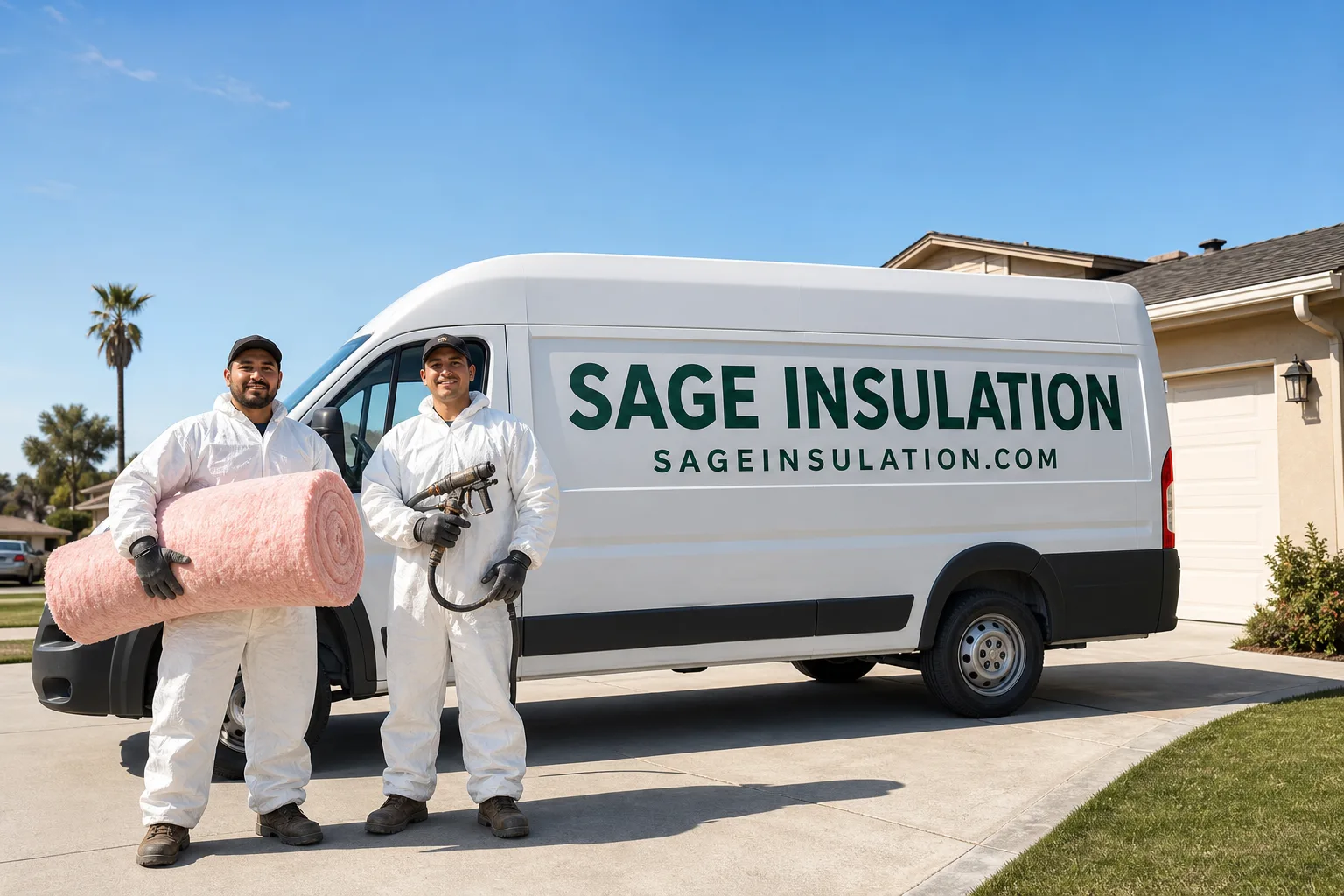
Fast, Reliable Spray Foam Insulation Across Baldwin Park
Baldwin Park’s 1950s and 60s tract homes were built fast and light, and most of their attics still have little or no insulation. Closed-cell spray foam applied to the roof deck is the most effective fix we know for these houses, because it seals air leaks and stops radiant heat at the same time. We run crews into Baldwin Park weekly from our Downey shop, and a standard attic job in the 91706 zip code usually runs one to two days once we’re on site. Call (855) 360-9333 and we’ll give you a straight read on what your attic actually needs before any hose comes off the truck.
Why Sage Insulation Is Baldwin Park’s Preferred Spray Foam Insulation Company
We’ve worked enough Baldwin Park houses to know the pattern: a stucco exterior, a low-pitch roof, and an attic that’s doing almost nothing to slow down the San Gabriel Valley sun. Alan Herrera started Sage Insulation to solve that exact problem without pushing one brand or one method on every home we see. Our crews describe what’s in the attic, explain what open-cell or closed-cell foam can and can’t do for the specific structure, and then let the house tell us what it needs. That’s why the bulk of our Baldwin Park work comes from neighbors telling neighbors.
Response time to Baldwin Park is usually same-week for inspections, and because we’re based just down the 605 in Downey, a crew can be at a home near Maine Avenue or Ramona Boulevard without a half-day drive. We’re licensed and insured, estimate visits are free, and the price we quote is the price on the invoice unless we uncover something structural that changes the scope.
Spray Foam Insulation Contractors in Baldwin Park
Spray Foam Insulation Contractors in Baldwin Park need to understand something most generic crews miss: in these mid-century tract homes, the prep work matters as much as the foam. A typical open-cell wall cavity job in Baldwin Park runs $1.50 – $2.20 per board foot, while closed-cell roof deck applications are usually $2.50 – $3.80 per board foot depending on depth and access. But spraying foam is rarely the first step. Before we spray, we air-seal top plates, check for outdated wiring, and confirm the attic can breathe when the job is done.
Open-Cell Cavity Fill
Open-cell foam expands into wall and ceiling cavities with enough give to accommodate older framing that’s shifted over 60 years. It’s the right call for interior walls, rim joists, and garage ceilings where sound dampening matters more than moisture blocking. The cost in Baldwin Park typically lands between $1.50 and $2.20 per board foot installed.
Closed-Cell Roof Decks
Closed-cell is the workhorse for unvented attic assemblies and roof decks, adding R-value per inch and acting as a vapor barrier. At $2.50 – $3.80 per board foot, it’s a bigger line item, but for a Baldwin Park house with an uninsulated attic and a central AC working against 150-degree attic air, it’s often the only fix that changes the indoor numbers quickly.
Spray Foam Attic Insulation in Baldwin Park
Spray Foam Attic Insulation in Baldwin Park almost always begins with a discovery walk: we open the hatch, climb up, and find what the 1958 build crew left, which is often bare rafters and an air gap you could read by. Sealing and spraying a standard 1,200-square-foot attic in Baldwin Park ranges from $5,500 to $9,800 all-in for closed-cell foam applied to the roof deck. The final number hinges on how much air-sealing the existing top plates require and whether ventilation needs upgrading first.
Air-Sealing Before Foam
In these older tracts around Foster Park and Morgan Park, the gaps around wiring penetrations and top plates add up to the equivalent of an open window in the attic. We seal those first. Foam without air-sealing just locks the leaks in place.
Radiant Heat Management
Baldwin Park’s summer highs in the high 90s mean the roof itself becomes a heat radiator. Closed-cell foam slows conductive heat gain, but pairing it with adequate soffit and ridge venting is what actually reduces the load on the AC. Our scope always includes a venting read before any foam goes on.
Trusted Brands We Service in Baldwin Park
Sage Insulation carries both Icynene and Demilec spray foam systems, which means we can choose between open- and closed-cell chemistries based on what the Baldwin Park house needs rather than what our warehouse happens to stock. For jobs where blown-in or batt materials round out the project, we also work with Owens Corning, Johns Manville, Knauf, and Rockwool. Every product is covered by the manufacturer’s own warranty. Because we carry these brands as standard inventory, a Baldwin Park homeowner doesn’t wait on a special order when a project needs to move this season.
Common Spray Foam Insulation Problems We See in Baldwin Park Homes
- Spraying over knob-and-tube wiring. In pre-1965 Baldwin Park tract homes, original knob-and-tube is still common in attics. Closed-cell foam sprayed over live knob-and-tube without rewiring or an ignition barrier is a fire hazard, and any contractor who skips this step isn’t doing the job safely. We check the attic wiring before any foam goes down.
- Trapping heat with undersized ventilation. The original 1960s gable vents in these homes were sized for a cooler climate and no foam. When you seal the roof deck without adding ridge and soffit venting, you trap latent heat and moisture. We treat ventilation as part of the same job, not an add-on line item.
- Ignoring radiant heat from the roof. Foam slows conduction, but it doesn’t eliminate the radiant load of a San Gabriel Valley sun on an unshaded roof. We check for attic temperature issues before quoting a foam depth, because spraying more inches without addressing venting doesn’t solve the afternoon heat problem.
- Foam over an existing rodent or water issue. Old attics in Baldwin Park often have evidence of past roof leaks or rodent activity. Foam locks those conditions under a seal. We look for water staining and droppings before quoting anything, and repair the source before it gets buried in foam.
Pricing for Spray Foam Insulation in Baldwin Park, CA
Closed-cell spray foam applied to a roof deck in Baldwin Park runs $5,500 – $9,800 for a typical 1,100 to 1,400-square-foot attic, including air-sealing. Open-cell cavity fill for walls and garage ceilings runs $1.50 – $2.20 per board foot installed. Rim joist work is often a half-day job at $700 – $1,400 for a standard crawl space or basement perimeter. What moves the number is prep: rewiring old knob-and-tube, adding ventilation, and repairing water damage all add cost before foam touches the deck. We quote all of that on the front end and give you a written line-item breakdown before any work starts. Call (855) 360-9333 for a free Baldwin Park estimate.
We Also Serve Cities Near Baldwin Park
We run crews to Avocado Heights, West Puente Valley, El Monte, and West Covina on the same schedule we serve Baldwin Park. If you live just outside the 91706 boundary, you’re still in our normal service radius. Learn more about our work across Baldwin Park or see the full scope of what our Spray Foam Insulation team handles across the San Gabriel Valley.
Serving Baldwin Park, CA — Our Local Coverage Area
We’re based in the Baldwin Park area and know this community well. Use the map below to see our service coverage — if you’re nearby, we can almost certainly help.
FAQs About Spray Foam Insulation in Baldwin Park
Yes. Foam slows conductive heat transfer through the roof, but the real lever in Baldwin Park homes is the combination of foam, air-sealing, and added ventilation. The San Gabriel Valley’s summer highs routinely push attic temperatures into the 140s and 150s, and closed-cell foam to the roof deck drops that dramatically. Your AC stops losing so much of its output to a superheated attic, and rooms that used to run 8 – 10 degrees hotter in the afternoon start evening out. Call (855) 360-9333 to talk about what your attic actually needs.
You should not spray closed-cell foam directly over live knob-and-tube wiring. The foam can trap heat around the old wiring, and the assembly isn’t code-clean. In Baldwin Park’s 1950s and 60s tracts, we find knob-and-tube in maybe one out of every four attics we open. The right sequence is rewiring or installing an approved ignition barrier before any foam goes near those runs. That rewiring adds cost, but skipping it creates a fire risk that no insulation upgrade is worth. We’ll tell you what’s in your attic on the first visit.
Most of the tract houses built between 1955 and 1970 in Baldwin Park have either no attic insulation or a thin original fiberglass batt that has compacted to near nothing. Many lack any vapor barrier. That’s why our first step is almost always air-sealing and a ventilation read, then the foam. The house’s age dictates the sequence more than the homeowner’s preference.
Often, yes. The original gable vents on a 1960s Baldwin Park roof were sized for a leaky, vented attic, not an air-sealed assembly with foam on the deck. If you seal the deck without upgrading to ridge and soffit venting, you trap heat and moisture the old vents can’t clear. Our scope on a typical Baldwin Park spray foam job includes a ventilation calculation, and we add ridge and soffit venting when the existing setup falls short.
Blown-in cellulose or fiberglass is cheaper, faster, and easier, but it doesn’t seal air leaks the way spray foam does, and it does almost nothing for radiant heat gain from the roof. For a Baldwin Park attic with bare rafters and 150-degree air, foam to the roof deck is the better solution. For a budget fix and some immediate improvement, blown-in is a reasonable middle step. We do both, so the recommendation comes down to what your attic and your air conditioning need, not what we have on the truck. Call us and we’ll walk you through the trade-offs for your specific house.
If your Baldwin Park home still has its original attic, the best time to act is before the next heat wave, not during it. Call Sage Insulation at (855) 360-9333 and Alan Herrera or one of our crew leads will walk the property, open the hatch, and tell you exactly what’s up there and what it’ll take to make it right. Estimates are free.
Written by Alan Herrera, Owner at Sage Insulation, serving Baldwin Park and the San Gabriel Valley.