
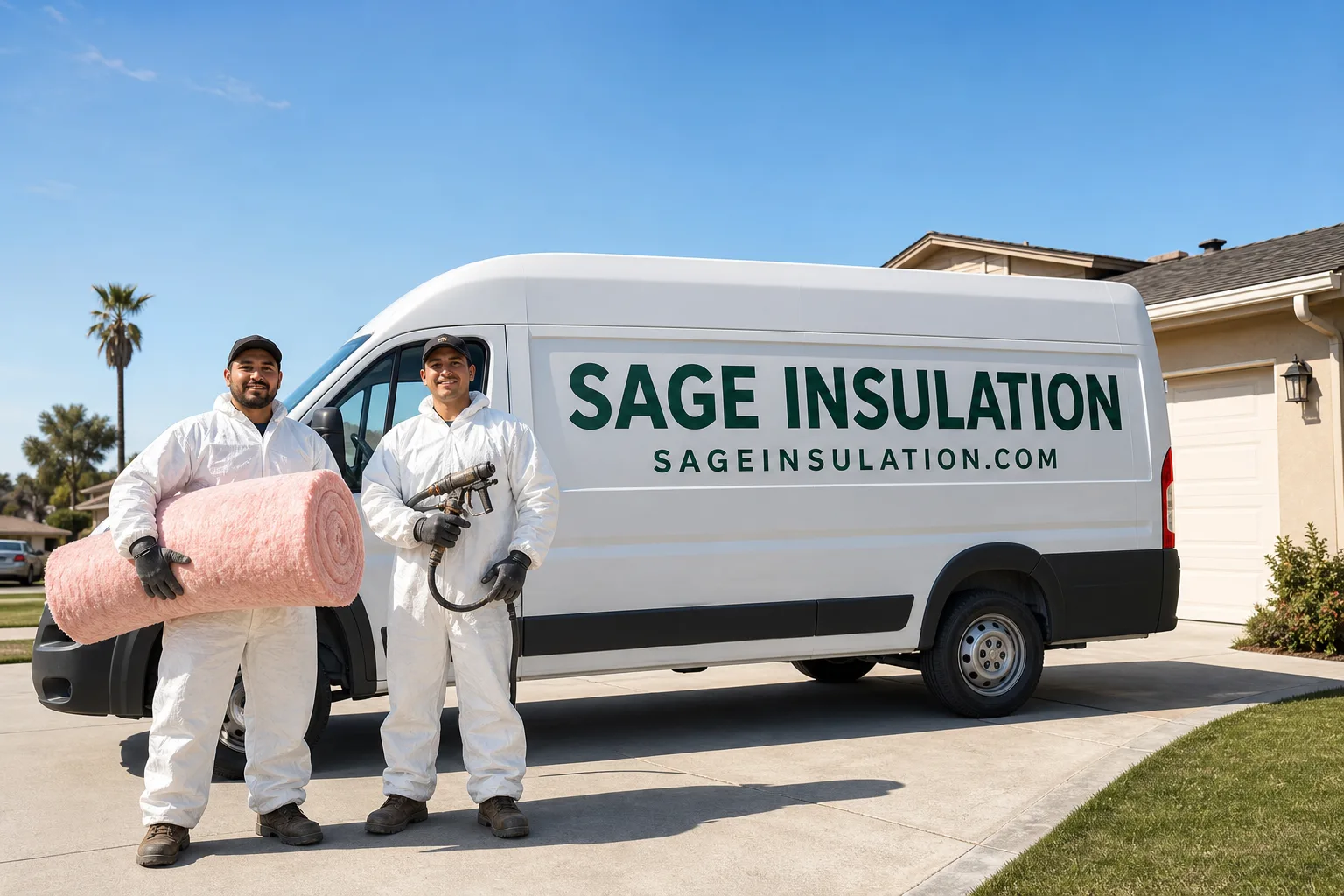
Fast, Reliable Spray Foam Insulation Across Paramount
Most Paramount homes built between the 1940s and 1960s carry the same burden: low-pitch roofs, shallow attics, and insulation that was thin on the day it went in and nearly useless now. We know because we’ve crawled through those exact attics off Paramount Boulevard, Alondra, and Somerset. When you call Sage Insulation, you reach a crew that understands the 90723 housing stock at a block-by-block level, and we can usually be at your door within a day. For a free estimate on spray foam in Paramount, call (855) 360-9333.
Why Sage Insulation Is Paramount’s Preferred Spray Foam Insulation Company
Paramount homeowners keep our number for one reason: we do not walk in with a single product and a script. Our team installs across all three major insulation methods, including open-cell and closed-cell spray foam from Icynene and Demilec, along with fiberglass and cellulose from Owens Corning, Johns Manville, Knauf, Rockwool, CertainTeed, and GreenFiber. That bandwidth matters in a city like Paramount, where every block of post-war stucco ranchers has slightly different venting, framing, and existing insulation than the block beside it. Alan Herrera built Sage Insulation on a material-agnostic approach: recommend what performs in this specific attic, not what we happen to have the most of in the truck.
We also understand that Paramount work is access work. The attics along Jefferson Street and near the 710 corridor are tight, hot, and unforgiving. Our crews crew for it. We show up with the right rigging, the right hose lengths, and patience for low-clearance conditions that other contractors decline. Homeowners in Paramount consistently tell us the same thing: the crew worked clean, explained the foam chemistry in plain English, and finished when they said they would.
Spray Foam Insulation Contractors in Paramount
Spray Foam Insulation Contractors in Paramount do more than spray product; they solve the geometry problem that defines this city’s housing. Because most homes are single-story, low-pitch stucco ranchers with shallow attic cavities, the job often starts with diagnosing what is actually in the attic right now, then deciding whether the roof deck should be brought inside the thermal envelope. That decision changes the foam chemistry, the prep work, and the cost. A typical closed-cell spray foam attic job in Paramount runs $4,800 to $11,000 depending on square footage and whether we remove old fiberglass first. Open-cell jobs run lower, generally $3,200 to $7,500 for the same footprint.
Air-Sealing Before Foam
In Paramount’s older homes, spraying foam over settled fiberglass without air-sealing top plates and lid penetrations traps heat instead of blocking it. We always seal wire chases, plumbing stacks, and the drywall-to-top-plate seam before foam touches the deck. Skilled Spray Foam Insulation work is sequencing, not just spraying.
Closed-Cell vs Open-Cell in Tight Attics
Shallow post-war attics often cannot reach code-level vented R-values with fiberglass alone. Closed-cell foam, applied to the underside of the roof deck, turns that shallow space into conditioned air without eating headroom. Open-cell is lighter on cost but wants deeper cavities to perform, which some Paramount attics simply do not have.
Spray Foam Attic Insulation in Paramount
Spray Foam Attic Insulation in Paramount is less about winter cold and more about summer heat. The South LA Basin sets the rooflines of the 90723 ZIP baking from May through October, with midday attic temperatures routinely hitting 130°F and above. That heat conducts through ceilings into living space, forcing air conditioners to run longer just to hold a setpoint. When foam seals the roof deck and brings the attic into the conditioned envelope, the HVAC system stops fighting a radiant heater sitting above every ceiling. Most Paramount customers see the difference within the first billing cycle after install, especially in west-facing bedrooms.
Conditioning the Low-Pitch Attic
Low-pitch roofs leave almost no room for conventional venting. In these attics, the practical path is to air-seal, then spray closed-cell foam to the deck so the entire cavity becomes part of the conditioned home. Fiberglass cannot do this job in a 24-inch-tall attic; spray foam can.
Neighbor Heat Gain and the Block Effect
Paramount’s lots are narrow and houses sit close enough that rooflines almost touch. One house’s attic venting and insulation choices visibly affect the stucco wall and roofline next door. We plan each foam job with an eye to that adjacency, choosing closed-cell deck application when it prevents pushing trapped heat against a neighboring wall.
Trusted Brands We Service in Paramount
We spray both Icynene and Demilec foam systems, which gives Paramount homeowners a genuine choice between competing chemistries and their specific strengths: Icynene’s open-cell for sound and air-sealing, Demilec’s closed-cell for R-value per inch in cramped attics. We also stock Knauf and CertainTeed products for the fiberglass and hybrid jobs where foam is not the right tool. Carrying multiple brands means our recommendation from the Paramount team is based on what your attic actually needs. For Paramount’s shallow, hot roof decks, closed-cell Demilec is often the answer; for wall cavities and rim joists, open-cell Icynene handles the job at lower cost. Rapid turnaround for Paramount customers is the norm because we carry the product locally rather than special-ordering week by week.
Common Spray Foam Insulation Problems We See in Paramount Homes
- Foam sprayed over settled fiberglass. Many Paramount attics still carry thin, collapsed 1950s fiberglass batts. Spraying foam over that layer without removal or at minimum air-sealing underneath it produces an attic that stays hot and a homeowner who paid for a result they did not get.
- Closed-cell on the roof deck with no venting plan. When a shallow low-pitch attic is closed off with foam, the roof must be brought inside the thermal envelope entirely. Skip that step and the shingles bake from below, shortening roof life and pushing heat into the walls.
- Ignoring the close-set rooflines. On tight Paramount blocks, sealing one attic can redirect heat gain onto the neighboring stucco wall. Good foam work here considers the block’s thermal picture, not just one house’s.
- Underestimating attic access. Low-clearance attics in post-war ranchers demand techs who can work in 100°F-plus spaces. We send crews equipped for the heat and the tight quarters, because this city’s work is as much access as it is application.
Pricing for Spray Foam Insulation in Paramount, CA
Open-cell spray foam attic work in Paramount typically runs $3,200 to $7,500. Closed-cell, which we recommend for most of the city’s shallow attics, lands between $4,800 and $11,000 on a standard 1,000 to 1,600-square-foot rancher. The spread comes from three variables: whether old fiberglass needs removal, how much of the attic area gets foam, and whether we include air-sealing (which we strongly recommend on any home older than about 1970). Rim joist spray foam on a typical Paramount crawl space runs $1,800 to $3,400. Garage ceiling foam in a detached or attached garage runs $900 to $2,600. Every quote is line-itemed so you see exactly what you are paying for. Call (855) 360-9333 for a free estimate on your specific attic.
We Also Serve Cities Near Paramount
Sage Insulation works throughout the Gateway Corridor, including Bellflower, Lynwood, East Rancho Dominguez, and our home base in Downey. If you are just across the 710 or down Alondra, we are already in your neighborhood regularly and can usually schedule Paramount-adjacent jobs within the same week.
Serving Paramount, CA — Our Local Coverage Area
We’re based in the Paramount area and know this community well. Use the map below to see our service coverage — if you’re nearby, we can almost certainly help.
FAQs About Spray Foam Insulation in Paramount
Spray foam makes more sense because Paramount’s post-war attics simply do not have the depth required for code-level vented fiberglass performance. With 18 to 30 inches of clearance at the peak, fiberglass cannot deliver enough R-value without blocking the only venting path. Closed-cell foam at 2 to 3 inches on the roof deck delivers a high R-value per inch and converts the shallow cavity into conditioned, usable air space. Fiberglass has its place in these homes, but not in a low-pitch attic deck. Call (855) 360-9333 and we will look at your actual measurements before recommending anything.
Yes, it can, and that is exactly why we assess close-set Paramount rooflines before spraying. When one attic is sealed and conditioned, trapped heat that previously escaped through its venting is no longer leaving that path, so adjacent walls and roofs can absorb a portion of that redirected load. On tight-lot blocks where stucco walls sit within a few feet of each other, we spec closed-cell deck applications and verify venting so the foam job does not push heat into the home next door. This block-level thinking is standard for us in Paramount, not an upsell.
We air-seal on every Paramount attic job where the home predates about 1970, no exceptions. Top plates, wire chases, plumbing stacks, and recessed light housings all get sealed before foam goes down. Spraying foam over an unsealed 1950s attic is like closing the windows without weatherstripping: the big leaks stay. On a tight-lot block off Paramount Boulevard, we found a rancher whose top plates had enough combined gap to equal a two-square-foot hole in the ceiling. Sealing that first is what makes the foam perform. Estimates are free; call (855) 360-9333.
We spray Icynene and Demilec systems. Icynene open-cell goes into wall cavities, rim joists, and some garage ceilings where air-sealing matters more than maximum R-value per inch. Demilec closed-cell goes onto low-pitch roof decks where Paramount’s shallow attics need density and moisture control. Carrying both gives us options. We recommend whichever formulation fits the specific cavity, not whichever we happened to have loaded that morning.
Yes, because Paramount’s problem is heat, not cold. The city’s inland-adjacent South LA Basin climate pushes summer attic temperatures past 130°F, and that heat radiates into living space every evening. Spray foam, especially closed-cell on the roof deck, blocks that radiant load at the source. Customers report back-bedroom temperatures dropping by 8 to 12 degrees through summer after we condition the attic, with air conditioning cycling less often. In this climate, that is where the bill savings come from. Call (855) 360-9333 and we will tell you honestly whether your attic will benefit.
Written by Alan Herrera, Owner at Sage Insulation, serving Paramount from our Downey headquarters.