
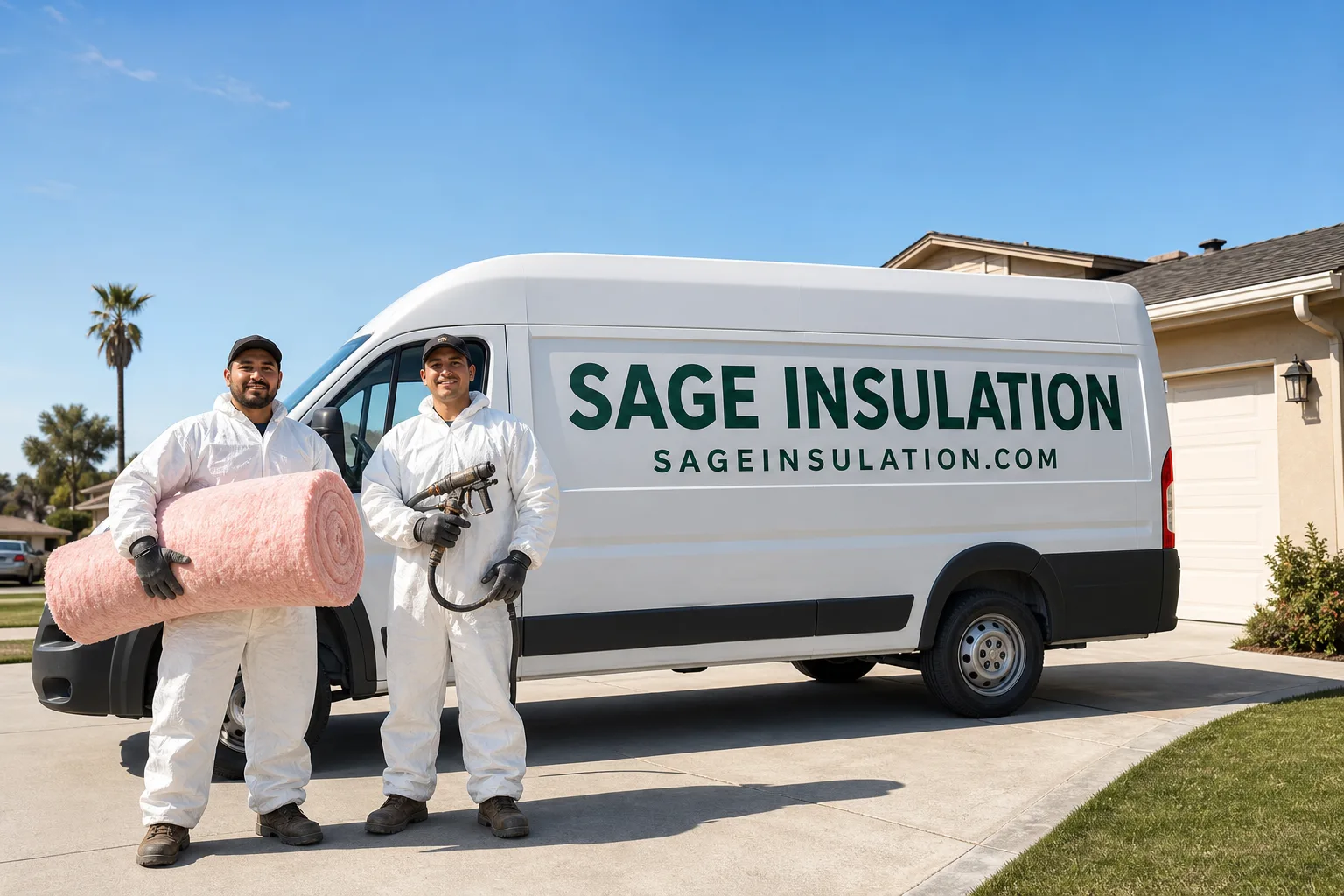
Fast, Reliable Spray Foam Insulation Across Stanton
Spray foam insulation in Stanton typically runs $1,800 to $4,200 for a full attic retrofit, with smaller jobs like rim joist sealing starting around $900. Most Stanton jobs take one day, and we can usually get a crew to your home within 48 to 72 hours. If your 1950s tract home or manufactured home is baking upstairs in summer and your AC won’t shut off, the attic is almost always where the problem lives. Call us at (855) 360-9333 and we’ll walk you through what makes sense for your specific house. Free estimates, no pressure, no product pitch you didn’t ask for.
Why Sage Insulation Is Stanton’s Preferred Spray Foam Insulation Company
Stanton is a different insulation market than the newer developments sprawling across north Orange County. Here, the homes are small-lot 1950s and 1960s tract housing, older mobile homes, and multi-unit rental properties. That means the work is almost always retrofit, not new construction. Our crews have spent enough hours in Stanton attics off Beach Blvd, Cerritos Ave, and Katella Ave to know exactly what they’ll find before they even open the hatch: compressed batts, settled rock wool, and wiring that predates modern code. We stock the materials and approaches that match those conditions, rather than pretending it’s a blank canvas.
Our customers in Stanton’s 90680 zip code consistently mention two things after the job: the attic is dramatically cooler, and the crew worked clean and fast in tight quarters. Working between closely spaced homes on narrow side yards is a real logistical problem in Stanton, and our techs plan for it before they arrive. Alan Herrera, who owns and runs Sage Insulation, built the company around that kind of preparation: knowing the housing stock, knowing the access issues, and knowing which spray foam chemistry belongs where. That’s why Stanton homeowners and the landlords who manage the city’s rental stock call us back when the next unit needs work.
Spray Foam Insulation Contractors in Stanton
Spray foam insulation contractors in Stanton need to understand what happens when 60-year-old homes get upgraded insulation. The work here isn’t spraying foam into open stud bays on a new build. It’s assessing what’s already in the cavity, deciding what needs to come out, and making sure the foam bonds correctly to surfaces that have spent decades collecting dust, settling, and degrading. Most Stanton attic retrofits we quote run $1,800 to $3,400 for open-cell, and $2,500 to $4,200 for closed-cell on a typical 900 to 1,300 square foot attic.
Retrofit Assessment and Prep
Before any foam goes in, we evaluate what’s already up there. In Stanton, that usually means a thin layer of original batt insulation, sometimes rock wool that’s settled to nearly nothing, and occasionally old wiring that needs protection. Skipping this step is how you get foam that delaminates or traps heat against wiring. We don’t skip it.
Hybrid Applications for Older Homes
Some Stanton homes do best with a hybrid approach: a flash coat of closed-cell foam against the roof deck for air sealing and radiant heat rejection, then blown-in fiberglass or cellulose over the ceiling plane for additional R-value. It’s not always the cheapest option, but it’s often the right one for homes that were never designed with modern insulation in mind.
Spray Foam Attic Insulation in Stanton
Spray foam attic insulation is the single most effective retrofit for a Stanton home because the attic is where the heat concentrates. That’s where summer attic temperatures in Stanton routinely hit 140 to 160 degrees, and that heat radiates down through the ceiling into every room below. A full open-cell attic spray in Stanton typically costs $1,800 to $3,400 for a standard tract home footprint. Closed-cell runs higher, from $2,500 to $4,200, because it delivers a higher R-value per inch and adds structural rigidity to the roof deck.
Hot-Roof Attic Sealing
When we spray the roof deck directly, we’re creating what’s called a hot-roof assembly. That means the attic becomes part of the conditioned envelope instead of being a separate, superheated space. For Stanton’s climate, with its hot, dry summers and mild winters, this approach directly cuts the cooling load on your HVAC system. Units stop running constantly in the late afternoon heat.
Attic Prep in Older Stanton Tract Homes
We typically find decades of dust and debris, old vent pipes that need sealing, and sometimes original wiring that has to be protected before foam is applied. This prep work is part of the quote, and we’ll walk you through what we found and what we’re doing about it before any material is sprayed.
Trusted Brands We Service in Stanton
We install spray foam from Icynene and Demilec, and we carry Knauf and CertainTeed for batt and blown-in applications. Why does that matter to a Stanton homeowner? Because the right foam for a 1959 stucco bungalow with original knob-and-tube wiring isn’t automatically the same as the right foam for a 2016 addition or a manufactured home belly. Our techs work with both open-cell and closed-cell chemistries, and we’ll recommend the one that fits your home’s structure and your budget, not the one we happen to have the most of in the truck. Since we stock materials for Stanton’s older housing, we can usually get started within a few days of your estimate.
Common Spray Foam Insulation Problems We See in Stanton Homes
- Foam sprayed directly over settled rock wool. This is the most common mistake we find when we follow another contractor into a Stanton attic. The old rock wool was never removed, foam was applied over it, and now there are hidden air pockets and uneven adhesion. The fix requires scraping it out and starting over properly.
- Fire risk from unprotected knob-and-tube wiring. Many 1950s Stanton homes still have original knob-and-tube circuits running through the attic. Foam sprayed directly over live vintage wiring is a genuine fire hazard and a code violation. We mask and protect all wiring before foam goes in, every single time.
- Condensation problems in manufactured home bellies. Stanton has a significant stock of mobile and manufactured homes. Foam applied to belly boards or skirting without accounting for ventilation traps moisture against the floor structure. That leads to wood rot and mold that you won’t see until it’s a serious problem.
- Tight side-yard access stopping the job before it starts. On Stanton’s small lots, neighboring homes can be six to eight feet apart. Getting a blower hose and a ladder into position isn’t trivial. We plan the hose run and staging area before we arrive, and we use equipment sized for tight spaces.
Pricing for Spray Foam Insulation in Stanton, CA
Spray foam pricing in Stanton reflects the retrofit reality of the housing stock. A typical open-cell attic spray on an 1,100 square foot tract home runs $2,200 to $3,200. Closed-cell on the same footprint runs $2,800 to $4,200. Rim joist sealing in a crawlspace or basement typically costs $900 to $1,500. Garage ceiling spray foam, which is popular in Stanton because many garages double as workshops or laundry rooms, runs $1,200 to $2,200. Manufactured home belly insulation work is quoted by linear foot and unit length, usually $1,500 to $3,000 for a full single-wide. These are real ranges based on the homes we’ve worked on here. Your exact quote depends on square footage, access, and how much prep the attic needs. Call (855) 360-9333 for a free estimate; we’ll come out, inspect, and give you a written number before you commit to anything.
We Also Serve Cities Near Stanton
While most of our days are spent in Stanton’s 90680 zip code and the neighborhoods around Stanton, we also run crews to Cypress, Westminster, Buena Park, and Rossmoor. Each has its own housing quirks, but the retrofit math is similar: older homes, hot attics, and energy bills that don’t make sense. If you’re in one of those cities, the same Spray Foam Insulation team serves you.
Serving Stanton, CA — Our Local Coverage Area
We’re based in the Stanton area and know this community well. Use the map below to see our service coverage — if you’re nearby, we can almost certainly help.
FAQs About Spray Foam Insulation in Stanton
No, and any contractor who tells you otherwise is setting you up for adhesion failure. The original batts in Stanton’s 1950s and 1960s tract homes are usually compressed, dust-caked, and degraded to near-zero R-value. They have to come out before foam goes in. We remove them, clean the surface, and then spray. The only common exception is when we do a flash-and-fill hybrid: a thin flash coat of foam against the roof deck to air seal, then blown-in insulation over the ceiling plane on top of existing batts that are still in acceptable condition. We’ll tell you which applies after we look in the attic. Call (855) 360-9333 for an inspection.
We mask and shield it before any foam is applied. Knob-and-tube wiring generates heat at connection points, and encasing live vintage wiring in spray foam creates a recognized fire hazard. Our standard protocol is to identify all active knob-and-tube circuits in the attic, protect them with non-combustible barriers or conduit sleeves where needed, and work around them during application. We’ll never spray over live, unshielded vintage wiring, full stop. If your home has knob-and-tube, mention it when you call so we can plan for it.
Yes, but it’s a different application than a site-built home. The biggest risk in manufactured homes is spraying foam against the belly board or skirting in a way that traps condensation against the floor framing. That’s how you get silent wood rot. The correct approach is to leave or create ventilation at the belly and focus foam on the rim joist perimeter and duct sealing, not encasing the entire underfloor. We’ve worked on enough manufactured units in Stanton that we quote these jobs with the right scope from the start, not as an afterthought.
Equipment access. Homes in Stanton’s older tracts sit close together, sometimes with only a narrow side yard and no rear access. That constrains where we can stage the rig, run the hose, and place ladders. We handle it by doing a site walk before the job, planning the hose run to minimize footprint, and using smaller handheld spray equipment when full-size rig access isn’t feasible. It adds prep time, but it prevents damage to your neighbor’s landscaping and keeps the job moving.
Stanton’s low humidity is actually favorable for foam application. Spray foam cures best in dry conditions, and Stanton’s climate rarely gives us the moisture-related cure problems you see in coastal or humid markets. The tradeoff is dust: attics in Stanton’s older homes hold decades of fine, settled particulate that has to be removed or contained before spraying, or the foam won’t bond cleanly to the substrate. Our prep process accounts for that. The dry air also makes air sealing more impactful here, because the main concern is radiant heat and cooling load, not moisture infiltration.
Written by Alan Herrera, Owner at Sage Insulation, serving Stanton and Orange County since the company’s founding.