
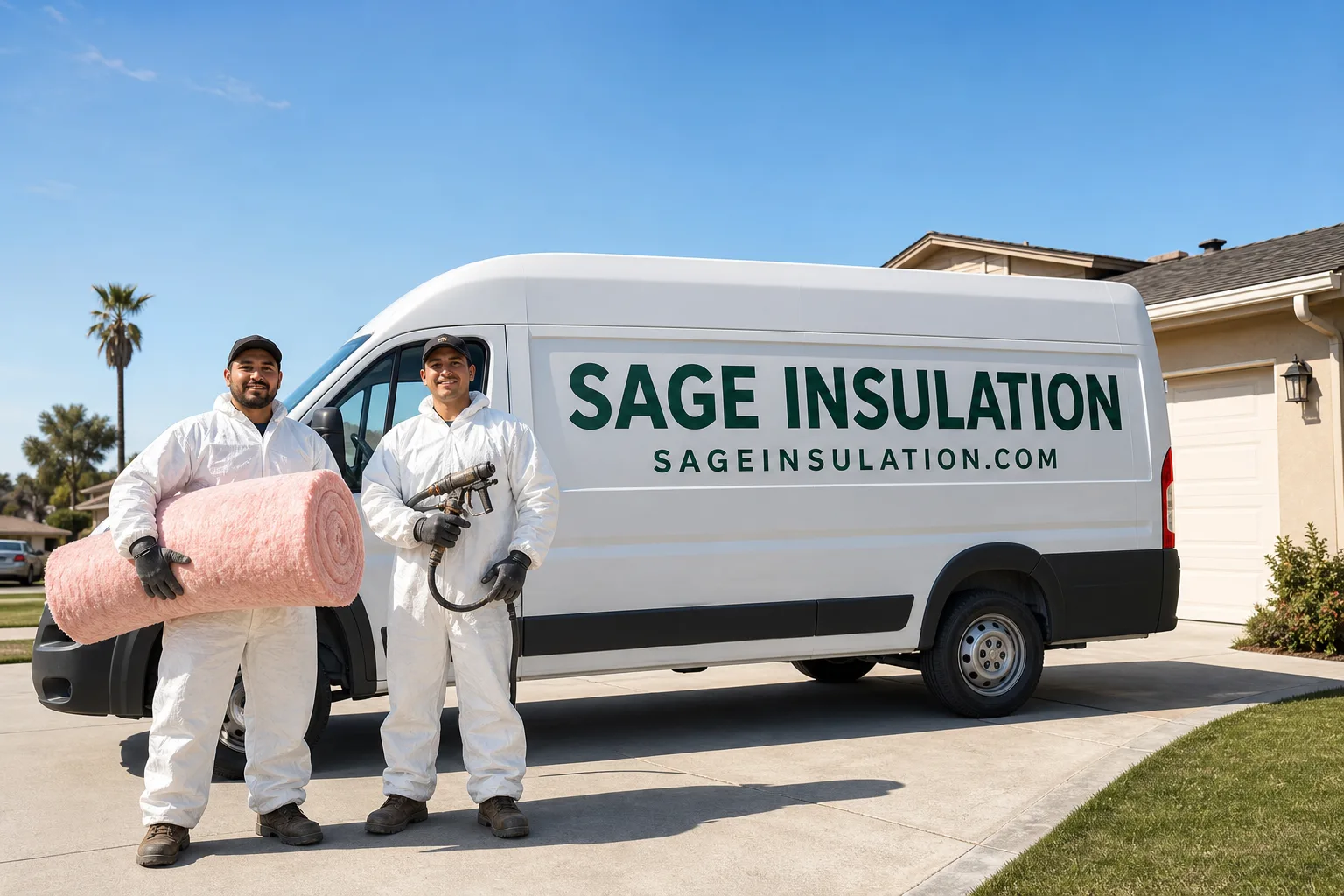
Fast, Reliable Spray Foam Insulation Across Valinda
Spray foam insulation in Valinda usually costs between $2,100 and $6,800 depending on whether we’re sealing an attic, rim joists, or a garage ceiling. Most Valinda jobs finish in a single day because our crews work the same tract-home layouts constantly. We’re based in Downey and can reach any Valinda address off Amar Road or Temple Avenue within about 35 minutes. If you want a straight answer on whether spray foam is right for your home, call (855) 360-9333.
Valinda is unincorporated San Gabriel Valley, and the homes here share a specific profile: single-story, stucco, built between the 1950s and 1970s, and almost always without original wall or attic insulation. That’s not a generalization. It’s what we see every time we open a hatch in this area. Our Spray Foam Insulation team has worked enough Valinda attics to know exactly what’s waiting up there before we even climb the ladder.
Why Sage Insulation Is Valinda’s Preferred Spray Foam Insulation Company
Ranch-style homes on streets like Wing Lane and Del Valle Avenue share a construction era, which means they share failure modes. Original knob-and-tube wiring, uninsulated exterior walls, and attic hatches barely wide enough for a shoulder. We know these houses, and that matters when you’re spraying two-part foam against 60-year-old roof sheathing.
Alan Herrera, who leads Sage Insulation, set the company up to be material-agnostic from day one. We carry Icynene and Demilec foam systems side by side because some Valinda attics need open-cell for sound and some need closed-cell for structural strength and moisture resistance. A single-line contractor can’t offer that choice. We can. That’s why homeowners here call us after another company gave them one option and a hard close.
Our response time to Valinda runs same-day for estimates in most cases, and we schedule installation within the week during peak summer months. The 91744 zip code is familiar territory, not a service-map afterthought.
Spray Foam Insulation Contractors in Valinda
Spray foam insulation contractors in Valinda do different work than contractors in newer subdivisions. Here, the job is almost always retrofit: drilling into old stucco walls or crawling through a small hallway hatch into an attic that has never held insulation. A typical open-cell attic spray in Valinda runs $2,400 to $4,200. Closed-cell, which adds vapor barrier performance, lands closer to $3,800 to $6,800 for comparable square footage.
One-Trip Retrofit Specialists
Valinda homeowners tend to be self-reliant. They want the job done right the first time, in one trip, without a salesperson measuring rooms and then a different crew showing up with a different product. Our process puts the tech, the foam rig, and the decision-making on site together. The same person who inspects the attic is the one spraying it.
Open-Cell vs Closed-Cell for Tract Homes
For most Valinda attics, open-cell Icynene does the cooling-season work well: it seals air gaps, adds R-value, and keeps the west-facing bedrooms from overheating. Closed-cell Demilec earns its higher price when the attic becomes a conditioned space or when original sheathing needs the added rigidity. We’ll tell you which one your roof deck actually needs, and why.
Spray Foam Attic Insulation in Valinda
Spray foam attic insulation in Valinda usually means spraying directly onto the underside of original roof sheathing, because the attic has no existing insulation to remove or top off. That changes the job. Surface prep matters more than it does anywhere else: dust from 60 years of San Gabriel Valley air settles on the bare wood, and foam won’t bond to dust. A typical direct-to-deck spray runs $2,800 to $5,400 for a Valinda ranch home.
Sealing the Hatch, Not Just the Roof
The hallway hatch in a Valinda home isn’t just the access point; it’s a leak. If the attic becomes conditioned space and the hatch stays unsealed, the entire air barrier has a hole in it. We treat the hatch as part of the thermal boundary, adding weatherstripping or a foam lid so the back bedrooms actually hold their temperature. This detail gets skipped by crews who don’t do much work in older tract homes.
Prep and Cure in Never-Insulated Attics
Foam applied over dusty, bare sheathing won’t adhere properly. We vacuum, inspect the deck for old water stains, and verify the roof has no active leaks before spraying. In Valinda attics where the only ventilation is the hatch itself, we also stage the cure sequence carefully so homeowners aren’t walking back into an off-gassing cloud because someone rushed the ratios or sprayed too thick in one pass.
Trusted Brands We Service in Valinda
We stock Icynene and Demilec spray foam systems for Valinda work, and we also carry Owens Corning and Johns Manville for any batts or board stock a job calls for. Having multiple manufacturers on hand means we match the chemistry to the task. A closed-cell job on original 1950s sheathing might call for Demilec. An open-cell sound-dampening wall in a bedroom shared with a home office might call for Icynene. We carry both so the recommendation comes from the house, not from our inventory.
Common Spray Foam Insulation Problems We See in Valinda Homes
- Delamination from dusty sheathing. Bare roof decking that’s never been insulated has decades of dust and debris on it. Foam sprayed over that without proper cleaning peels away within months, and the homeowner only finds out when the ceiling starts sweating in July.
- Odor from improper ratio mixing. In older Valinda homes, the attic hatch is often the only ventilation during application. If a contractor rushes the job and mixes off-ratio, the foam off-gasses for weeks. Homeowners re-enter too soon because nobody told them how long cure actually takes.
- Blistered foam from over-application. Spraying too thick in a single pass on original 1950s roof sheathing traps heat. That lumber wasn’t kiln-dried to modern standards, and foam can blister when it goes on too heavy too fast. We control pass depth and check deck temperature before and during the spray.
- Unsealed hatch defeats the air barrier. The spray job looks great, but the hallway hatch leaks like a window left open. In a tract home with no wall insulation, that one gap undermines the cooling savings the foam was supposed to deliver.
Pricing for Spray Foam Insulation in Valinda, CA
A standard open-cell attic spray in a 1,100 to 1,400 square foot Valinda ranch home runs $2,400 to $4,200. Closed-cell direct-to-deck work lands between $3,800 and $6,800. Rim joist spray foam for a crawl space foundation runs $900 to $1,800 depending on joist count. Garage ceiling spray foam usually comes in at $1,500 to $2,800. These ranges reflect what we’ve quoted in 91744 over the past year. Your exact price depends on square footage, access difficulty, and whether we’re spraying the roof deck, walls, or both. Estimates are free. Call (855) 360-9333 and Alan’s team will give you a number before we leave the driveway.
We also serve Spray Foam Insulation in Valinda neighbors across the nearby cities. La Puente, West Covina, South San Jose Hills, and Hacienda Heights all share the same San Gabriel Valley heat load and the same era of tract construction, so if you’re in one of those communities, our crews know your walls and attics too.
Serving Valinda, CA — Our Local Coverage Area
We’re based in the Valinda area and know this community well. Use the map below to see our service coverage — if you’re nearby, we can almost certainly help.
FAQs About Spray Foam Insulation in Valinda
Yes, and it’s actually the most common job we do here. Spray foam bonds directly to the original roof deck, provided the surface is cleaned first. On a ranch-style home off Amar Road, our tech opened the small hallway hatch and found bare wood sheathing and dust, no insulation had ever been installed. We sprayed 2 inches of closed-cell Icynene directly to the roof deck, sealed the attic as a conditioned space, and brought the ceiling assembly up to code without adding venting. The homeowner noticed the back bedrooms, which face full afternoon sun, held their temperature through a 100°F afternoon instead of spiking by 5 p.m. Call (855) 360-9333 for a free inspection of your specific roof deck.
Yes, sealing the hatch is part of the job when the attic becomes conditioned space. We add weatherstripping or a foam cover so the hatch stops leaking conditioned air into the living space. Skipping this leaves a hole in the air barrier that undoes much of the cooling benefit. Tell us about your hatch when you call, and we’ll factor it into the quote upfront.
Spray foam air-seals while it insulates, so it stops the stack effect that pulls hot attic air into the house through gaps in the ceiling, wiring penetrations, and the hatch itself. Blown-in insulation adds R-value but doesn’t seal those leaks. In Valinda’s inland valley heat, sealing the air path matters as much as the R-value. That’s why homeowners who spray the roof deck instead of just topping off the attic see back bedrooms stay closer to the thermostat setting through the hottest part of the day.
Both. We carry Icynene for open-cell applications and Demilec for closed-cell jobs, plus Owens Corning and Johns Manville for batts and board stock. The choice depends on the roof deck condition, whether the attic stays vented or becomes conditioned, and the moisture profile of the space. We’ll show you the reasoning for whichever one we recommend, and the estimate is free either way. Call (855) 360-9333.
One trip, in most cases. The tech who inspects the attic is the same person who runs the spray rig. For a typical 1,100 to 1,400 square foot ranch home, expect the crew to arrive in the morning, prep the attic, spray the foam, seal the hatch, and be packed up by late afternoon. Cure time before re-entry is part of the plan, and we’ll tell you exactly when it’s safe to go back upstairs before we start. No separate sales visit, no second crew showing up a week later.
Written by Alan Herrera, Owner at Sage Insulation, serving Valinda and the San Gabriel Valley.