
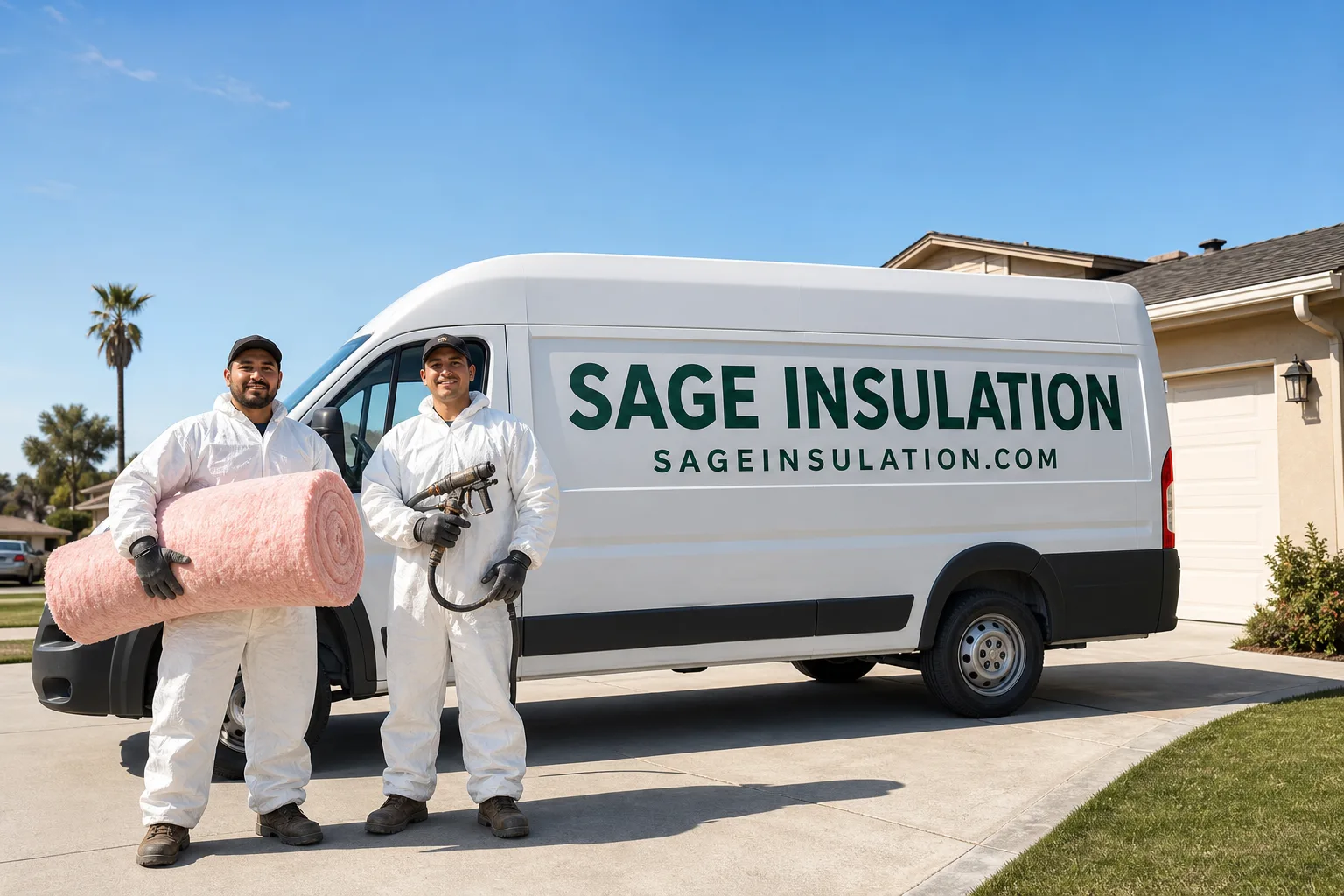
Fast, Reliable Spray Foam Insulation Across Whittier
Spray foam insulation in Whittier costs roughly $1.50 to $4.50 per board foot installed, which translates to $1,800 to $5,500 for a typical attic and $4,000 to $12,000 for full wall retrofits, depending on whether you go open-cell or closed-cell. Most Whittier homes we see run 950 to 1,600 square feet with pre-1978 construction, so the real variable here isn’t square footage. It’s what we find when we open the attic hatch. We’ve been in and out of attics across Whittier for years now, from the 1920s bungalows near Uptown to the 1960s stucco tracts through 90603 and 90604, and we always send a two-person crew with a same-day diagnostic if you call us at (855) 360-9333.
Our Spray Foam Insulation team knows Whitter’s older housing stock better than any single-product outfit ever will. We stock both open-cell Icynene and closed-cell Demilec systems, and we carry CertainTeed and Knauf for when a hybrid approach, meaning foam plus a membrane or batt in select cavities, is actually the smarter call. That’s the difference with Sage. We’re material-agnostic, so the recommendation you get is based on your wall assembly and your attic’s specific condition, not on whatever we have the most of in the truck.
Why Sage Insulation Is Whittier’s Preferred Spray Foam Insulation Company
Alan Herrera founded Sage Insulation on a simple principle: install the right insulation for the building, not the insulation that’s easiest to sell. That principle matters more in Whittier than almost anywhere else in the metro. The city’s housing stock is split cleanly between pre-1940 plaster-and-lath construction and post-1950 tract framing, and the two require genuinely different spray foam strategies. Crews that treat a 1938 bungalow on Philadelphia Street the same way they treat a 1963 stucco box off Colima Road end up with callbacks. We don’t do callbacks.
Our customers in the 90601 and 90602 zip codes know we’ve shielded more exposed knob-and-tube wiring in Uptown attics than we can count. Customers east of the 605 in 90603 and 90604 know we understand balloon-framed wall cavities and the ventilation problems that come with foaming the underside of a hot tract roof deck. We get to Whittier within about an hour for diagnostics from our Downey base. Emergency calls for sudden foam delamination or moisture intrusion in a Santa Ana heat spike get priority scheduling. It’s local knowledge that can’t be faked by a flashy website.
Spray Foam Attic Insulation in Whittier
Spray foam attic insulation in Whittier is the single highest-impact upgrade we do, because the city’s cooling load dominates year-round and attic temperatures in July regularly climb past 120°F in the older bungalow stock. The job involves air-sealing the attic floor or underside of the roof deck, then applying open-cell or closed-cell foam to a target depth that stops heat migration through the ceiling plane. Most Whittier homes we work on were built with zero attic insulation or a thin layer of 1960s-era fiberglass batts that have settled to near zero R-value. Expect $1,800 to $5,500 for a typical attic retrofit, with closed-cell running higher because of density and R-value per inch.
Knob-and-Tube Prep Before Foam Goes Down
In Uptown Whittier and the older pockets of 90602, we routinely find original 1920s attics with exposed knob-and-tube wiring still live and running across the joists. That’s not a dealbreaker, but it’s also not something you want a crew to foam over without prep. We map the conductors, verify what’s energized, and shield the runs before any foam touches the deck. This adds a prep step and sometimes an hour or two, but it’s the difference between a safe retrofit and a latent fire hazard wrapped in foam.
Hot Roof Decks and Ventilation
On the east side, in 90603 and 90604, the dominant issue is foam applied to the underside of a 1950s-60s roof deck without addressing ventilation. During Santa Ana events and August heat spikes, those deck temperatures get high enough to cook old fiberglass. Closed-cell foam on an unventilated deck can trap moisture if the assembly wasn’t designed for it. We check the existing venting and roof age before recommending a full deck foam. In some cases, the smarter play is a vented attic with foam at the ceiling line and air-sealed can lights.
Spray Foam Wall Insulation in Whittier
Spray foam wall insulation in Whittier is where the city’s split housing stock really changes the game. On 1920s-40s California bungalows and Spanish-revival homes near Uptown and the Whittier College area, the walls are plaster-and-lath over balloon framing. That means open wall cavities that run continuously from crawlspace to attic. Foam, especially open-cell, can be injected or sprayed into those cavities to create an air and thermal barrier no batt ever could. On the 1950s-70s tract homes east of the 605, walls are stucco-over-wood-frame with varying cavity depths, often with nothing but a thin fiberglass batt that’s slid down the wall. Full wall foam on those runs $4,000 to $12,000 depending on closed-cell versus open-cell and total wall area.
Dense-Pack Cavity Sealing for Old Plaster Walls
For the pre-war bungalows around Uptown Whittier, we often recommend a dense-pack approach using open-cell foam rather than a full tear-out. The key is getting the foam to fill the entire balloon chase, especially the top plates where warm air exits into the attic. Partial fills do almost nothing. Our crews air-seal and foam the top plate in the attic, then fill the wall from either the interior or exterior depending on access. Homeowners notice the difference in how long the house holds its temperature, not just the bill.
Retrofit vs. Tear-Out Decisions
Some Whittier homeowners assume old plaster walls mean a full gut to get insulation in. That’s true if you’re doing a remodel anyway, but for occupied homes we can often inject foam through small holes and patch them. The deciding factors are the condition of the plaster, the presence of old electrical, and whether the wall cavities have blocking we need to work around. Alan has walked hundreds of these attics and wall cavities across Whittier, and he’ll tell you straight what’s feasible and what isn’t, often on the first visit.
Trusted Brands We Service in Whittier
We service Icynene open-cell and closed-cell spray foam systems as well as Demilec closed-cell formulations, which means we’re not tied to one manufacturer’s chemistry. That matters in Whittier because a 1930s bungalow with plaster walls wants a different foam than a 1970s tract home with a hot stucco exterior. We also carry Knauf and CertainTeed products for hybrid jobs where a foam-plus-batt or foam-plus-membrane approach is genuinely better. No ucharge for eco-conscious options like Icynene low-GWP foam or Rockwool mineral wool. If you’re in 90609, 90610, 90612, or 90601, we stock what we need locally and can usually start within a few days of diagnosis.
Common Spray Foam Insulation Problems We See in Whittier Homes
- Foam over live knob-and-tube in Uptown attics (90601/90602). Previous contractors or DIY jobs sprayed foam directly over original 1920s wiring that was never de-energized or shielded. We see this constantly. It’s a fire risk that needs either removal and re-insulation or careful remediation before new foam goes in.
- Closed-cell foam on unventilated east-side roof decks (90603/90604). Hot 1950s-60s tract roof decks in Whittier’s Santa Ana heat spikes create the exact conditions for trapped moisture. If ventilation was skipped and the deck wasn’t prepped, the foam degrades and the assembly suffers. We diagnose this by looking at roof age, existing vents, and foam condition.
- Partial wall cavity fills in pre-1940s balloon-framed homes. Foam that only fills part of the chase does almost nothing. Warm air just moves around it. The top plates must be air-sealed and the cavity fully filled, especially in the older cores around Uptown and the College area. We find half-done jobs routinely where someone cut corners on the chase.
- Spray foam over settled 1960s fiberglass batts without removal. In tracts across 90603, 90604, and 90605, we see attics where someone sprayed foam right over old, settled, dusty fiberglass. The original batts were already cooked from years of 100°F attic heat. Foam over degraded batts doesn’t fix the problem; you have to remove or properly isolate the old material first.
Pricing for Spray Foam Insulation in Whittier, CA
Real numbers for Whittier: attic spray foam runs $1,800 to $5,500 depending on open-cell versus closed-cell, attic size, and whether we’re dealing with knob-and-tube prep in the older homes. Wall retrofits run $4,000 to $12,000 based on total wall area, cavity depth, and access conditions. Rim joist sealing, which matters in raised-foundation Whittier homes, is $800 to $1,800. Garage ceiling foam runs $1,200 to $2,800. Roof deck applications run $3,500 to $9,000. These are honest ranges based on the housing stock in Whittier, not generic national numbers. Call (855) 360-9333 and we’ll give you an exact quote after a diagnostic visit. Estimates are free, and we’ll tell you if foam isn’t the right call for your home.
We Also Serve Cities Near Whittier
Sage Insulation covers all of Whittier plus the surrounding communities. We’re regularly in South Whittier, West Whittier-Los Nietos, East La Mirada, and Santa Fe Springs. Same crews, same diagnostic-first approach. If you’re just outside the city line, the drive time doesn’t change how we quote or how we prep the job.
Serving Whittier, CA — Our Local Coverage Area
We’re based in the Whittier area and know this community well. Use the map below to see our service coverage — if you’re nearby, we can almost certainly help.
FAQs About Spray Foam Insulation in Whittier
Yes, but the wiring must be mapped and shielded first. Most Uptown bungalows (90601/90602) still have live knob-and-tube in the attic, and you cannot foam over energized conductors. Our crew identifies what’s live, shields the runs, and only then insulates. It adds a prep step, but skipping it creates a serious fire hazard. Call (855) 360-9333 if you suspect your attic has original wiring and you want it evaluated before you insulate.
Plaster-and-lath walls with balloon framing have continuous open cavities from crawlspace to attic, and blown-in insulation, especially cellulose, can settle and leave the top plate unsealed. Spray foam expands to fill the entire cavity and air-seals the chase, which is critical in Whittier’s pre-war homes where summer heat rises through the wall cavities into the upper floor. The difference is air sealing, not just R-value.
Yes. Whittier operates its own municipal utility, WMLP (Whittier Municipal Light & Power), not Southern California Edison. Rebate paperwork, qualifying thresholds, and program timelines go through WMLP, not SCE. That’s a specific routing detail most Los Angeles area contractors don’t handle correctly, and it can delay your rebate if filed with the wrong agency. We’ve worked with WMLP programs in Whittier for years.
It can, if the attic isn’t ventilated and closed-cell foam is applied directly to the roof deck without proper assembly design. Whittier’s east side (90603/90604) sees roof deck temperatures hot enough during Santa Ana heat spikes to degrade old insulation and trap moisture under improperly applied foam. We check your existing venting and roof condition first, and in many cases recommend a vented attic with foam at the ceiling line instead. It’s the safer assembly for older tract homes.
Usually yes, if the batts are original or more than 15 to 20 years old. Whittier’s attic heat cooks fiberglass batts over time, and once they’ve settled or compressed they lose most of their R-value. Overlaying foam on top doesn’t fix the old material. We remove the degraded batts, air-seal the attic floor, and then apply foam. The comfort difference, especially in July and August when attic temps regularly exceed 120°F, is immediate.
If you’re in Whittier and your rooms won’t hold temperature, your bill keeps climbing, or you suspect your attic has nothing but original 1930s air up there, call (855) 360-9333. We’ll come out, look at what you actually have, and tell you what’s worth doing. No pressure, just a straight answer from someone who knows Whittier attics.
Written by Alan Herrera, Owner at Sage Insulation, serving Whittier and the surrounding communities across Los Angeles County.