
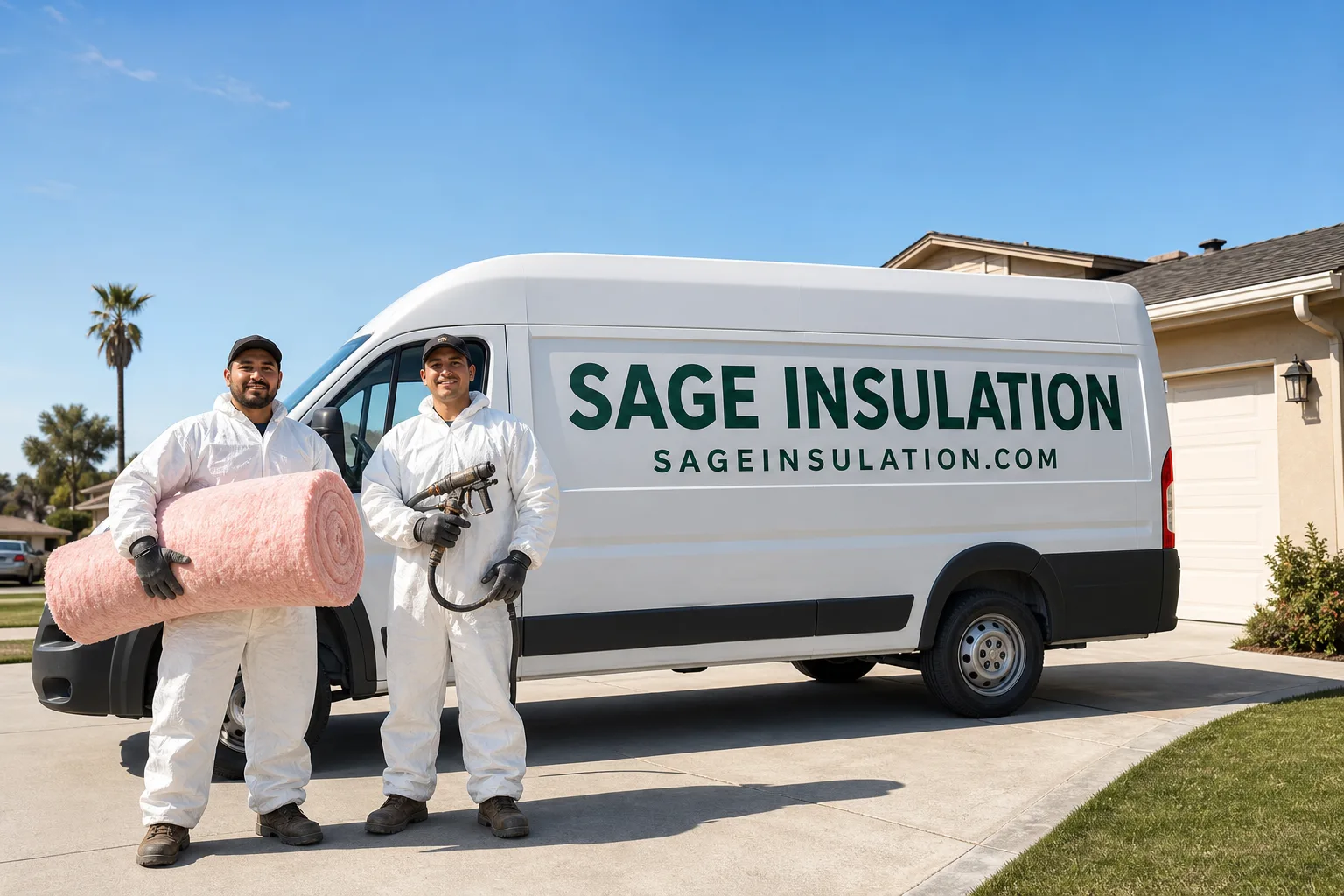
Fast, Reliable Attic Insulation Across Bell
Attic insulation in Bell, CA typically runs $1,900 – $4,600 for a full blow-in on a 1,000 – 1,400 sq ft bungalow, with top-ups starting around $900. Most jobs on Bell’s 1920s – 1960s housing stock are retrofit blow-ins and dense-packs in occupied homes, and we schedule Bell appointments within 3 – 5 business days of your call. Our crews know the shallow, low-pitch attics off Florence and Gage Avenues better than any contractor driving in from the Valley. Call (855) 360-9333 for a free estimate, and we’ll come measure your attic, inspect your ventilation, and tell you honestly what’s worth doing and what isn’t.
Why Sage Insulation Is Bell’s Preferred Attic Insulation Company
Sage Insulation isn’t a single-product shop. We install across all three major residential insulation methods: Attic Insulation, spray foam insulation, and blown-in insulation. That matters in Bell, where the housing stock spans 1920s stucco bungalows, 1940s party-wall duplexes, and 1960s multi-unit rentals. Each of those needs a different approach. A material-agnostic contractor actually recommends what fits the home, not what’s already loaded on the truck.
Our owner, Alan Herrera, has built Sage Insulation around honest diagnostics. That means air-sealing top plates and old vent penetrations before blowing, checking shared party walls before dense-packing, and never promising a specific R-value outcome or savings percentage we can’t verify from your actual attic conditions. We carry eight manufacturer lines, including Knauf, Rockwool, CertainTeed, and Icynene, so the recommendation is driven by the house, not by a vendor program.
Bell customers routinely mention two things after we finish: the crew worked around their household without shutting down the home, and the upstairs or front rooms finally hold temperature. Because we serve Bell consistently, our techs arrive already knowing that compact attic hatches, tight lot lines, and stucco exterior walls are the norm here. That local familiarity saves you time on every job.
Attic Ventilation in Bell
Attic Ventilation in Bell’s shallow, low-pitch bungalow attics is the difference between an attic that breathes and an attic that turns into a 140-degree oven under September sun. The job here means evaluating existing soffit or gable vents, installing baffles where the roof meets the exterior wall so blown-in material doesn’t block airflow, and sometimes adding ridge or box vents for cross-ventilation. In a Bell stucco home from the 1930s or 1940s, ventilation often wasn’t designed for modern insulation depth at all.
Most Bell homeowners need ventilation work addressed at the same time as insulation. Blowing 15 inches of loose-fill over a vent-starved attic traps heat against the ceiling below. You’ll feel it in August, when rooms facing Gage Avenue or Florence stay hot hours after sundown.
Ventilation prep on a Bell retrofit typically runs $350 – $900 depending on how many baffles are installed, vent type, and whether old vents need correction. It’s the most common companion job we quote alongside a blow-in or top-up.
Baffle Installation at the Eaves
Baffles keep blown-in insulation from spilling into the soffit and blocking the only intake air path. In Bell’s older attics, original baffles are often missing entirely, or crushed flat from decades of settlement. We install poly or foam baffles in every rafter bay where soffit vents exist, then blow insulation up to but never over the baffle line.
Vent Correction and Airflow Assessment
Some Bell attics have gable vents only, with no soffit intake at all. Those attics don’t move air; they just collect it. We measure the existing net-free vent area against attic square footage, identify dead zones, and recommend the smallest change that actually restores airflow. That might be adding a box vent, it might mean clearing blocked gable louvers. It’s rarely dramatic and it’s always specific.
Radiant Barrier in Bell
Radiant Barrier in Bell’s hot, dry climate is one of the most effective summer cooling measures available for a low-pitch stucco roof. A radiant barrier is a foil-faced material installed against the underside of the roof deck, and it reflects radiant heat away from the attic space instead of letting the deck radiate it downward into your insulation and ceiling—similar to how Reflectix repair in Bell uses reflective materials to manage heat. In Bell, where July and August afternoons push roof deck temperatures well past 140°F, that reflection directly cuts heat gain into the conditioned rooms below.
Bell homeowners on Florence, Gage, and the surrounding residential blocks deal with intense afternoon sun on masonry and stucco walls. The attic gets the worst of it. Radiant barrier installation typically runs $1,200 – $2,800 for an average Bell attic, depending on roof geometry and access. For homes with shallow attics and occupied living space, it’s one of the few retrofits that delivers measurable summer relief without adding insulation depth.
Foil Deck Installation Over Existing Insulation
We staple or fasten perforated radiant barrier foil directly to the underside of the rafters. Perforation lets moisture escape so you don’t trap condensation. This works in attics with or without existing insulation, and Bell’s low-pitch roofs with limited crawl space are often easier candidates than steep roof planes.
Radiant Barrier for Ductwork and Knee Walls
In some Bell bungalows, HVAC ducts run through the attic itself. When ducts sit in a superheated attic, the air coming out of your registers starts warmer than it should. Radiant barrier above the duct runs cools the attic air around them. On homes with knee walls or half-story additions, foil-facing those vertical surfaces cuts the same radiant load.
Trusted Brands We Service in Bell
Sage Insulation stocks and installs materials from eight name-brand manufacturers, so Bell customers aren’t limited to whatever one-brand contractor has in the warehouse. For attic jobs in Bell, we frequently specify Knauf fiberglass batts for their consistent density and R-value, CertainTeed blown-in insulation for its settling resistance and coverage, Rockwool mineral wool for its fire rating and sound control on party-wall retrofits, and Icynene spray foam where a low-GWP open-cell air seal makes sense on difficult attic transitions. Because we carry all of these, we can recommend the right material for a shallow 1920s bungalow attic, a 1940s duplex with a shared party wall, or a 1960s multi-unit rental. No single-brand loyalty, no forced fit. The truck shows up with what your home actually needs.
Common Attic Insulation Problems We See in Bell Homes
- Original, settled insulation barely an inch deep. Bell’s 1920s – 1960s bungalows often still have the first insulation ever installed, flattened and inert. A top-up over settled material is frequently the lowest-cost fix that makes a real difference on summer bills.
- Unsealed top plates and old vent penetrations leaking more heat than the insulation gap itself. On Bell’s shallow attics, the top plate where wall meets attic is a continuous thermal bypass. We air-seal these before blowing, because blowing new insulation over an unsealed envelope just traps the leak behind more material.
- Party walls between units that act as heat sinks. In Bell’s older duplexes and small multifamily buildings, the shared wall between conditioned spaces often has zero insulation and open cavities. Dense-packing that wall against the neighbor’s conditioned air changes the temperature profile of your own unit, but only if done properly from the attic side with full cavity coverage.
- Compact attic hatches that leak conditioned air straight up. A hatch-only attic on a Bell bungalow is often the largest single air leak in the building. We install hatch insulation and weather stripping as standard on nearly every Bell retrofit, because sealing the hatch is one of the ten best dollars-per-comfort improvements available.
Pricing for Attic Insulation in Bell, CA
Attic insulation pricing in Bell reflects the city’s older, compact housing stock more than anything else. A basic blow-in over existing settled insulation runs $1,900 – $3,200 for a typical 1,000 – 1,200 sq ft bungalow. A full removal of old or vermin-damaged material plus air sealing and new blow-in runs $3,200 – $4,600. A top-up only starts around $900. Radiant barrier adds $1,200 – $2,800. Ventilation correction adds $350 – $900. Small or difficult attic hatches add time and care, but rarely add meaningful cost. The variables are attic square footage, access difficulty, depth of existing material, and whether air sealing is included. We’ll give you a written, line-item estimate before any material leaves the truck. Call (855) 360-9333 to schedule a free attic inspection in Bell.
We Also Serve Cities Near Bell
Sage Insulation works throughout the Southeast Los Angeles corridor. Beyond Bell, we regularly handle attic insulation projects in Cudahy, Maywood, Huntington Park, and Walnut Park. Many of those homes share the same 1920s – 1960s stucco construction, compact attics, and packed-in lots we see daily in Bell, so our crews arrive already familiar with the conditions.
Serving Bell, CA — Our Local Coverage Area
We’re based in the Bell area and know this community well. Use the map below to see our service coverage — if you’re nearby, we can almost certainly help.
FAQs About Attic Insulation in Bell
Yes. We blow insulation through the existing hatch opening in nearly every Bell home we serve. A shallow attic with a small hatch is the standard condition here, not an outlier. We run the blower hose through the hatch, and our techs work from the access point and any crawl space available. If the attic is too shallow for a tech to maneuver safely, we use extension wands and guided hose placement to get full, even coverage. Cutting a new opening is almost never necessary. Call (855) 360-9333 and we’ll take a look at your specific hatch and ceiling layout free of charge.
Because the original contractor likely blew insulation over unsealed top plates, old vent penetrations, or a leaky attic hatch, and the conditioned air is still escaping through those paths. Bell’s stucco bungalows have dozens of linear feet of top plate where wall meets attic, plus old plumbing and electrical chases that were never sealed. Air sealing those bypasses before adding insulation is the single highest-impact step. If insulation was added without air sealing, the thermal envelope is still open. We can inspect, seal, and re-top the insulation correctly. A free inspection will show us exactly where the bypasses are.
Yes, significantly. In a shared-wall Bell building, the party wall between conditioned units needs to be dense-packed from the attic side with full cavity coverage, or one unit’s conditioned air keeps migrating into the other’s attic and wall cavities. Dense-packing Rockwool or cellulose into that shared wall creates separation that keeps your cool air in your space. We also seal the party wall top plate from the attic before blowing. If the neighbor unit is unconditioned or differently conditioned, the party wall is where most of your heat gain or loss happens. Party-wall retrofits are one of the most common jobs we do in Bell’s older duplexes and four-plexes.
Yes. For Bell’s specifically hot, dry, sun-loaded summer afternoons, radiant barrier is one of the most direct ways to reduce attic heat gain without adding insulation depth. A low-pitch stucco roof under July sun reaches 140°F or more at the deck, and that heat radiates down into the attic, the insulation, and eventually the ceiling below. A foil radiant barrier reflects that away. It costs $1,200 – $2,800 for a typical Bell attic and works best in homes where the attic is the main heat path into the house. It’s not a substitute for air sealing, but it’s a strong complement to existing insulation.
Yes, we do, and most of our Bell jobs are in occupied homes. We dense-packed the shared party wall and blew Owens Corning into a low, hatch-only attic on a 1940s stucco bungalow off Gage Avenue, where the homeowner’s AC bill had spiked and settled original insulation was barely an inch deep. Before blowing, our tech air-sealed the top plates and old vent penetrations that were the real heat leak, then set the attic hatch for the compact access. The household stayed occupied through the whole job. That’s the typical Bell retrofit: careful, contained, and finished without displacing anyone. Give us a call at (855) 360-9333 and we’ll schedule around your household, not the other way around.
Written by Alan Herrera, Owner at Sage Insulation, serving Bell, CA and the surrounding Southeast LA corridor.