
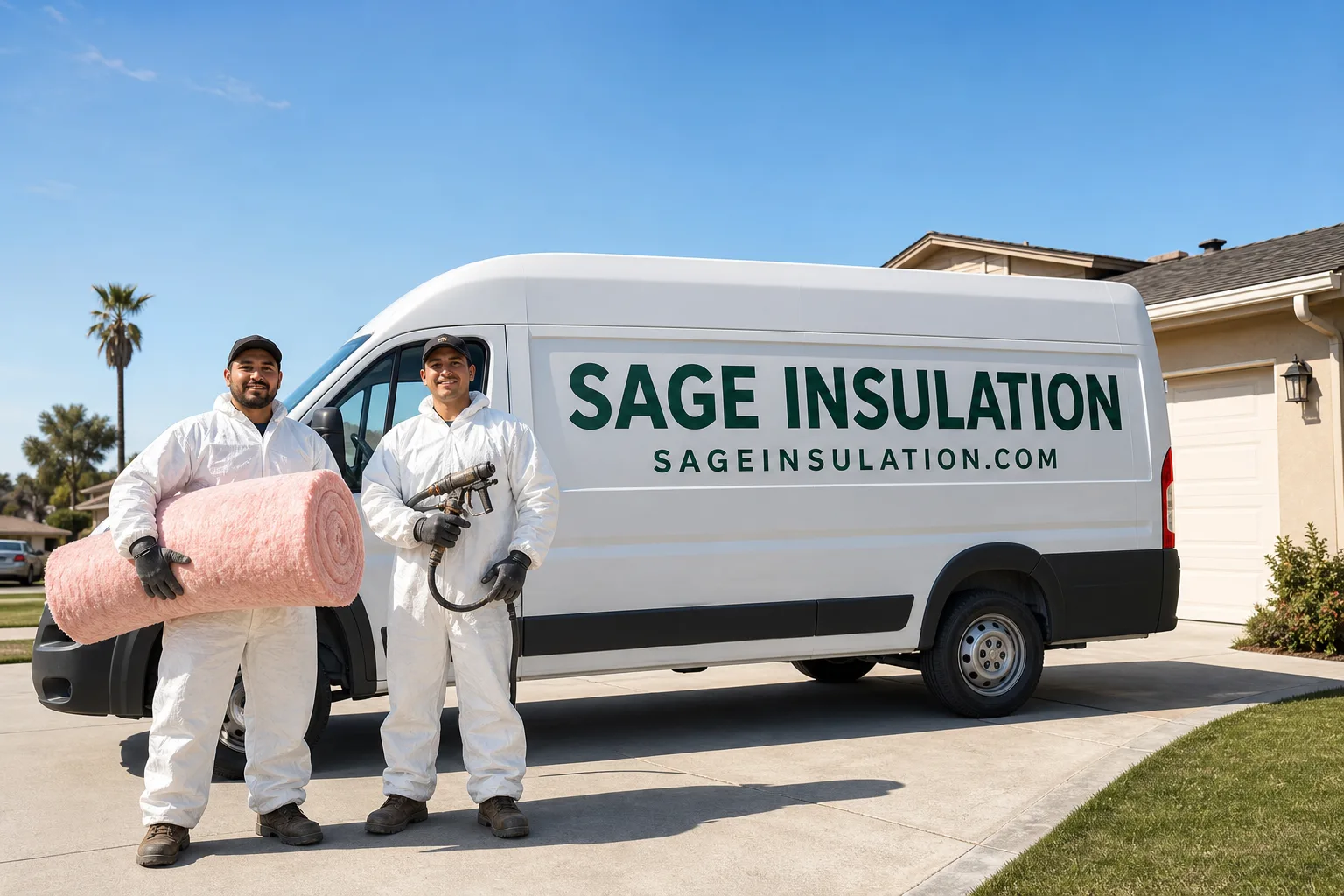
Fast, Reliable Attic Insulation Across Whittier
Attic insulation in Whittier typically costs between $1.20 and $3.80 per square foot depending on material and whether we’re topping up existing coverage or starting fresh. Most jobs in Whittier wrap up in a single day. If your upstairs rooms won’t hold temperature through a San Gabriel Valley summer afternoon, the attic is almost always the first place we look. We’re Sage Insulation, and we’ve worked in enough Whittier attics – from Uptown bungalows to east-side tracts – to know exactly what’s waiting up there. Call (855) 360-9333 for a free estimate.
This page covers what attic insulation work actually looks like in Whittier homes, what it costs, and why the city’s housing stock creates problems you won’t find in newer Orange County developments. We’ll walk through the brands we install, the failure modes we see most, and what to expect when a crew shows up at your door.
Why Sage Insulation Is Whittier’s Preferred Attic Insulation Company
We are a material-agnostic insulation contractor. That phrase gets thrown around, so let us be specific: we stock and install fiberglass batts, blown-in cellulose, and open- and closed-cell spray foam from eight manufacturers, including Johns Manville, Knauf, and Rockwool. When we walk into a Whittier attic, we’re not trying to sell you whatever’s on the truck. We’re measuring the existing R-value, checking ventilation, and looking at how the house was built. Then we recommend what actually performs here.
Alan Herrera, our owner, has steered Sage Insulation with one rule: match material to the house, not the other way around. That’s why a 1962 tract home off Whittier Boulevard gets a different treatment than a 1930s Spanish Revival near Philadelphia Street. Our crews know both. We also know that Whittier runs on Whittier Municipal Light & Power, not SoCal Edison. That changes the rebate paperwork. We handle the WMLP side of the equation so you don’t have to sort out which utility does what. Call (855) 360-9333 and we’ll take it from there.
Common Attic Insulation Problems We See in Whittier Homes
- Heat-degraded builder-grade batts in 1950s-70s tract homes. The east side of Whittier is full of stucco tract homes built when R-11 fiberglass was considered adequate. Under 95-105°F attic temperatures, those batts compress, lose loft, and drop to a fraction of their rated R-value. We regularly measure installed R-values in the single digits in attics that were “insulated” when the house went up.
- Bare attics with exposed knob-and-tube wiring near Uptown. The 1920s-40s bungalows in 90601 and 90602 often have zero attic insulation and live electrical wiring running through the joist bays. Any blown-in work has to be done around that wiring, which means prep work most contractors skip. We don’t skip it.
- Blocked or unsealed soffit vents in stucco-sided homes. The original kraft facing on batt insulation frequently gets stapled right over the soffit vents, choking off airflow. That turns a hot attic into an oven and cooks whatever insulation is up there. Fixing this is part of every attic job we quote.
- Open top plates and thermal bypasses. In Whittier’s balloon-framed and tract-era homes, gaps where interior walls meet the attic floor let conditioned air pour into the attic year-round. Insulation alone won’t fix this – the top plates need air sealing first. We do both in the same visit.
Attic Mold Removal in Whittier
Attic mold removal in Whittier homes usually runs $1,800 to $4,500 depending on square footage and how far the growth has spread. We most often see it in east-side tract homes where blocked soffit vents have trapped moisture against the roof sheathing, or in older Uptown homes where bathroom fans vent directly into the attic instead of through the roof. The mold has to be killed, the affected material removed when it’s too far gone, and the moisture source fixed – otherwise the mold comes back and the new insulation we install gets contaminated.
What Remediation Involves
We remove the contaminated insulation, treat the framing and sheathing with an EPA-registered antimicrobial, then rebuild the attic’s ventilation path before installing new material. For Whittier’s stucco tracts, that usually means clearing the original bird-block or soffit vents and adding baffles, along with any needed Reflectix repair in Whittier. For older bungalows, it often means adding a vented roof jack for the bathroom fan at the same time.
When Whittier Homeowners Call Us
Most calls come after a home inspection flags mold during a sale, or after a homeowner notices dark staining on the ceiling near the attic hatch. Some catch it earlier – a musty smell in the upstairs hallway is a reliable early warning. If you’re seeing any of that, we can inspect and quote the same week.
Attic Insulation Removal in Whittier
Attic insulation removal in Whittier typically runs $1.20 to $2.80 per square foot for the removal itself, before any new insulation goes in. You’re looking at this when the old material is compacted, water-damaged, rodent-soiled, or you’re about to have knob-and-tube wiring replaced. We use commercial HEPA-filtered vacuums, not rakes and trash bags. The old material gets bagged and disposed of properly, and the attic is left clean enough to walk on so the next step – air sealing, baffles, or new insulation – can go in right away.
The Tear-Out Process
Removal starts with sealing off the attic access and running a large-diameter vacuum hose up top. The old material gets pulled out completely, including the dust and debris that’s been sitting under it for decades. We remove everything down to the drywall or plaster, so we can inspect the top plates, wiring, and any structural issues hidden underneath.
Why You’d Remove Instead of Top Up
If the old insulation is saturated, infested, or has degraded to the consistency of dust, adding new material on top just buries the problem. We only recommend removal when it’s genuinely necessary. Call us at (855) 360-9333 and we’ll tell you straight whether your attic needs a full pull or just a top-up.
Trusted Brands We Service in Whittier
Sage Insulation installs materials from eight manufacturers, including Johns Manville fiberglass, Knauf batts, and Rockwool mineral wool. We also carry CertainTeed for homeowners who want fiberglass with a strong manufacturer warranty behind it, plus GreenFiber recycled cellulose and both Icynene and Demilec spray foam systems. Because we’re not loyal to any single brand, we can recommend what fits your Whittier home’s actual performance gaps. Need a dense-pack cellulose for an old Uptown bungalow with plaster walls? We’re ready. Want open-cell spray foam for a cathedral ceiling in a 1970s tract home? We install that too. The brand follows the job, not the other way around.
Pricing for Attic Insulation in Whittier, CA
Here’s what attic insulation work actually costs in Whittier right now. A basic Attic Insulation top-up with blown-in cellulose on a 1,200-square-foot attic runs $1,800 to $2,900. Full removal and replacement runs $3,200 to $5,600. Air sealing adds $400 to $1,100 depending on how many top plates and penetrations need work. Baffle installation at the eaves adds $6 to $12 per baffle. Spray foam is more – $2.50 to $4.50 per square foot for open-cell, higher for closed-cell – but it also air-seals as it insulates. The square footage of your attic floor, the condition of what’s already up there, and whether your home needs electrical work-around before we start all affect the final number. Estimates are free, and we quote a firm price before any work begins. Call (855) 360-9333.
A Whittier-Specific Problem: WMLP, Not SoCal Edison
Here’s a detail most insulation pages won’t tell you about Whittier: the city runs its own electric utility. Whittier Municipal Light & Power serves homes across 90601, 90602, 90603, and 90604, and any efficiency rebate for attic insulation work routes through WMLP’s programs, not SoCal Edison’s. If you’ve been told to file paperwork with SCE, you’ve been pointed the wrong direction. We keep current on WMLP’s rebate landscape so when we finish a job, the paperwork goes to the right place. That’s a small thing, but it’s the kind of local knowledge that only comes from doing insulation work in Whittier week after week.
What We Found in a 1962 Tract Home off Whittier Boulevard
On a recent job in 90603, a stucco tract house built in 1962, our crew pulled the attic access and found builder-grade R-11 batts that had collapsed to about R-4. The fiberglass crumbled when touched – decades of San Gabriel Valley heat had baked the binder right out of it. Soffit vents were blocked by the original kraft facing, and the top plates were wide open, so attic air was leaking straight down into the walls. We hauled out the degraded material, air-sealed every top plate penetration, and blew in GreenFiber cellulose to R-49 with new baffles at the eaves. The homeowner called us back a week later to say the upstairs bedrooms finally held temperature through a 100°F afternoon. That’s the standard we work to in every Whittier attic.
The Problem with Original Insulation in Whittier’s Housing Stock
Whittier’s housing came up in two big waves, and both create attic problems today. The 1920s-40s bungalows around Uptown and the Whittier College area were built with no attic insulation at all – bare joists, exposed wiring, and maybe a thin layer of newspaper or rock wool if someone got ambitious decades later. The 1950s-70s tract homes across the east side were built with insulation, but it was R-11 at best, and it’s been cooking in 95-105°F attic temperatures for 50 to 70 years. Both scenarios mean the same thing: your attic is far below the R-38 to R-49 that makes sense in this climate. Cooling load dominates in Whittier, so the attic is the highest-leverage place to spend insulation money.
The Uptown Bungalow Challenge: Plaster, Lath, and Knob-and-Tube
Older Whittier homes near Uptown and along Philadelphia Street frequently have plaster-and-lath walls, balloon framing, and live knob-and-tube wiring running through the attic. That changes the job. You can’t just fire up a blower and start filling the joist bays – the wiring has to be identified, protected, and worked around first. We’ve done enough of these to know where knob-and-tube typically runs in a 1930s Whittier bungalow, and our crews are trained to work around it safely. Dense-pack cellulose is often the right answer for these homes because it conforms to the irregular framing of balloon-built walls while leaving the wiring accessible. Not every insulation contractor in the San Gabriel Valley is equipped to handle that. We are.
We Also Serve Cities Near Whittier
Sage Insulation works throughout the San Gabriel Valley and Gateway Cities. In addition to Attic Insulation in Whittier, we serve South Whittier, West Whittier-Los Nietos, East La Mirada, and Santa Fe Springs. If you’re a homeowner or builder in any of those areas, the same material-agnostic approach applies: we assess, recommend, and install what your house actually needs. Call (855) 360-9333 to schedule.
Serving Whittier, CA — Our Local Coverage Area
We’re based in the Whittier area and know this community well. Use the map below to see our service coverage — if you’re nearby, we can almost certainly help.
FAQs About Attic Insulation in Whittier
In most cases, no. The original R-11 fiberglass batts in Whittier’s 1950s-70s tract homes have been exposed to summer attic temperatures between 95°F and 105°F for 50-plus years. That heat breaks down the binder and compresses the material until it’s performing at maybe a third of its original R-value. We routinely measure installed R-values in the single digits in attics that technically still have insulation. The right move is usually a full removal and re-insulation to R-38 or R-49. Call (855) 360-9333 for a free in-attic assessment.
Yes. Whittier Municipal Light & Power runs its own efficiency programs, separate from SoCal Edison. Any rebate for attic insulation, air sealing, or ventilation improvements goes through WMLP, not SCE. Filing paperwork with the wrong utility delays the rebate or kills it entirely. We handle WMLP paperwork on every qualifying job in Whittier so nothing falls through.
Probably, if the home is from the 1920s-40s and hasn’t been fully rewired. Knob-and-tube is common in the attics of Uptown-area bungalows, and it has to be handled carefully before any blown-in insulation can go down. Our crews identify the runs, keep the insulation away from live wiring, and coordinate with electricians when needed. It adds prep time, but skipping it is dangerous and can violate code. We don’t skip it.
Yes, and it starts with the walls. Plaster-and-lath bungalows near Uptown typically have balloon framing that runs from the foundation all the way to the attic. That means attic insulation work has to account for open wall cavities that let air flow straight up from the crawl space. Dense-pack cellulose is often the right call here, and the work usually includes blocking or sealing those balloon-framed cavities before the attic itself gets insulated. A 1960s stucco tract home on the east side doesn’t have that issue, but it has its own problem: blocked soffit vents. Different houses, different fixes.
Santa Ana winds compound Whittier’s existing attic heat problem. The winds are hot and dry, and when they hit the San Gabriel Valley, they push dust and hot air through any gaps in the attic. If your soffit vents are blocked or your top plates are unsealed, that dust gets pulled into the attic and the insulation gets polluted. Over time, it degrades the material further. This is why we insist on proper baffles and air sealing as part of every Whittier attic job – not just dumping more insulation on top. Call (855) 360-9333 to get your attic evaluated for Santa Ana season.
Get Your Whittier Attic Insulation Done Right
If you live in Whittier and your upstairs rooms run hot, your energy bills climb every summer, or you’re not sure what’s even in your attic, we can help. Sage Insulation is a full-service Attic Insulation contractor serving all of Whittier, from the bungalows near Uptown to the tracts off Whittier Boulevard. We’re material-agnostic, we carry brands like Johns Manville, Knauf, and Rockwool, and we know WMLP’s rebate requirements. Estimates are free. Call (855) 360-9333 and Alan Herrera or a member of his team will get you scheduled.
Written by Alan Herrera, Owner at Sage Insulation, serving Whittier and the San Gabriel Valley.