
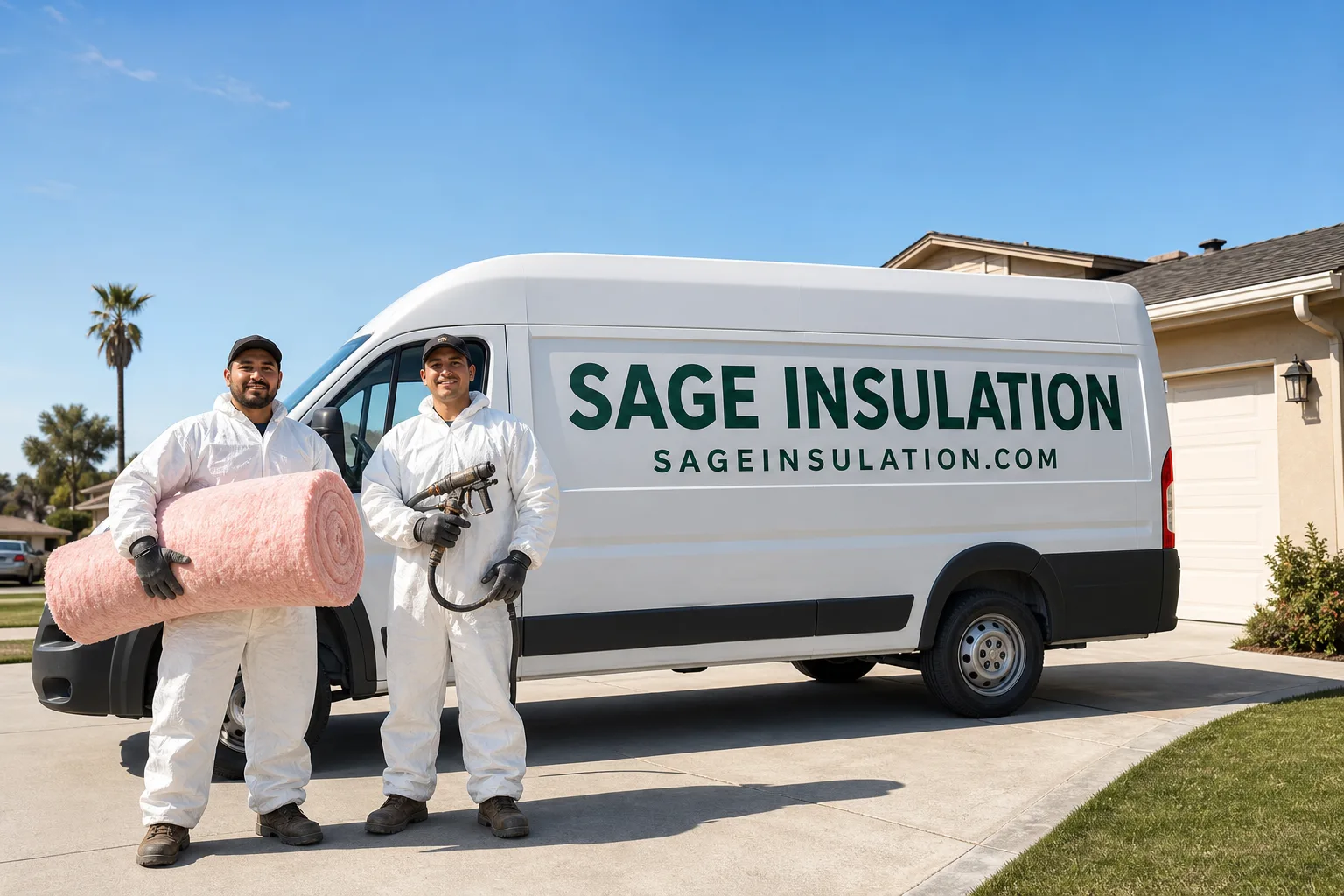
Fast, Reliable Spray Foam Insulation Across Hollywood
Spray foam insulation in Hollywood, CA typically costs $1.80 to $4.20 per board foot installed, with most whole-attic jobs in the 90028 area landing between $3,200 and $7,800 depending on foam type and cavity depth. Same-week scheduling is standard for most Hollywood homes, and we keep trucks routed through the Cahuenga corridor and Franklin Avenue so response to the flats north of Melrose rarely exceeds one business day. If you’re tired of hearing Sunset Blvd traffic through your walls or watching your AC struggle against a hot flat roof, call Sage Insulation at (855) 360-9333 for a free site assessment.
This page explains what spray foam actually does in Hollywood’s specific housing stock – 1920s bungalows, courtyard apartments, alley-loaded townhomes – and what it costs. If you want a broader look at the material itself, our Spray Foam Insulation team has written extensively on open-cell versus closed-cell chemistry, R-values, and application methods. This page is about what happens on your block.
Why Sage Insulation Is Hollywood’s Preferred Spray Foam Insulation Company
Led by Alan Herrera, Sage Insulation has spent years working in and around Hollywood‘s dense, older housing stock, which demands a different approach than the suburban tracts we service elsewhere in Los Angeles County. Our crews know the alley-loaded lots off Wilcox, the courtyard buildings on Whitley, and the tight basements under Franklin Avenue apartment blocks, where bringing a spray foam rig in without blocking a neighbor’s only egress takes planning. That local familiarity means we arrive ready for the access problem before it costs you a day.
We carry eight insulation brands – Owens Corning, Johns Manville, Knauf, Rockwool, CertainTeed, Icynene, Demilec, and GreenFiber – because no single manufacturer makes the right product for every Hollywood job. A bungalow needing air sealing gets a different recommendation than a courtyard apartment needing fire-rated separation. That’s brand-agnostic insulation work, and it’s the only way to be honest about what your walls actually need.
Alan’s crews are insured, trained on both Icynene and Demilec spray foam systems, and comfortable working in occupied units. Most importantly for Hollywood homeowners, we understand historic preservation triggers: we’ve done enough work in 90028 to know when an exterior penetration on a pre-1939 facade will draw scrutiny, and we plan interior-access routes before we touch a wall.
Every estimate to a Hollywood address includes a material recommendation tied to your specific condition – cavity depth, existing wiring, moisture exposure, noise source – rather than a sales pitch for whatever product we happen to stock most. Call (855) 360-9333 and Alan will walk your street before he walks your attic.
Spray Foam Wall Insulation in Hollywood
Spray foam wall insulation in Hollywood is the most common retrofit we perform in 90028’s 1920s and 1930s wood-frame bungalows and stucco courtyard apartments, where original wall cavities are empty or filled with disintegrating newspaper batting. The work involves drilling interior or exterior access points into each stud bay, injecting open- or closed-cell foam, and patching – but in Hollywood, the material choice changes fast based on what’s already in the walls.
A typical whole-house wall insulation job on a Hollywood bungalow runs $4,500 to $9,800. Courtyard apartment units with shared walls and limited cavity access typically run $2,800 to $6,400 per unit. The reason the range is wide: knob-and-tube wiring still sits in many of these walls, and spraying closed-cell foam over live knob-and-tube can create an overheating hazard. If we find it, we pause and discuss options before a single hose is brought in.
Historic Bungalow Cavities
Wall cavities in 1920s Hollywood bungalows measure 3.5 inches deep on average, but sagging framing and settled plaster often reduce that to under 3 inches in spots. We choose low-exothermic open-cell foam for these jobs: it expands more gently and won’t crack original lath-and-plaster the way a dense closed-cell pour can.
Party Wall and Shared-Wall Units
For shared walls between courtyard apartment units, wall insulation is as much about noise containment and fire code as R-value. Closed-cell foam at a minimum 1-inch thickness functions as an air barrier, but in Hollywood’s multifamily buildings, our installers coordinate with the property owner to ensure the foam we spray meets the fire-blocking requirements of the building’s original classification.
Rim Joist Spray Foam in Hollywood
Rim joist spray foam in Hollywood addresses the gap where your foundation meets your first-floor framing, the band that runs around the perimeter of the building and lets conditioned air pour out while letting dust, pests, and street noise pour in. In 90028 homes built before any meaningful code enforcement, the rim joist is almost universally unsealed, and in courtyard apartments the rim joist often runs continuously beneath shared walls, meaning one tenant’s air leak is a building-wide gap.
Sealing the rim joist on a typical Hollywood bungalow costs $1,100 to $2,400 when done as a standalone job; on a courtyard apartment, expect $800 to $1,900 per unit depending on access beneath the floor assembly. We have done dozens of rim joist jobs in Hollywood where the band joist was the single largest air leak in the building. The fix is high-density closed-cell foam, sprayed 2 inches thick for air sealing and vapor control.
Fire Separation and the Shared Rim
Under a shared flat roof or above a shared foundation, a rim joist cavity can act as a horizontal chase between units, allowing fire to travel. Our crews follow fire-blocking detail on every multifamily Hollywood job, foaming each unit’s rim separately and leaving no continuous pathway through the band. This is not routine on single-family suburban jobs – it’s specific to the stacked, attached construction that dominates Hollywood.
Crawl Space Air Leaks
Many Hollywood bungalows sit over short, barely-accessible crawl spaces, where the rim is impossible to reach from the outside without trenching the perimeter and working blind. In those cases, we access the rim from the interior by removing baseboard and flooring at the perimeter wall, foaming through the subfloor gap, and reinstalling everything the same afternoon.
Trusted Brands We Service in Hollywood
We install and service spray foam systems from Icynene and Demilec in Hollywood, plus fiberglass, mineral wool, and cellulose products from Owens Corning, Johns Manville, Knauf, Rockwool, CertainTeed, and GreenFiber. Carrying multiple product lines means we are not beholden to one manufacturer’s spec sheet: when a 90028 courtyard apartment needs a fire-rated assembly, we quote Rockwool; when a bungalow needs gentle cavity fill, we recommend open-cell Icynene; when a homeowner wants recycled content, GreenFiber cellulose is on the truck. Most parts and materials are stocked in our Downey facility, so Hollywood jobs rarely wait more than a day or two for anything beyond specialty-order items.
Common Spray Foam Insulation Problems We See in Hollywood Homes
- Cracked plaster from over-thick foam. In 1920s bungalows with original lath-and-plaster walls, spray foam installed too aggressively in tight wall cavities can expand and crack the surface, or even bow original window frames. We spec low-exothermic open-cell foam and staged passes in older Hollywood homes to avoid this.
- Missing fire-blocking in courtyard buildings. Shared flat roofs and continuous rim joists mean one unit’s insulation job can open a code violation if the fire separation between units is not addressed. In Hollywood’s 90028 courtyard stock, we foam and fire-block each unit separately, never treating the building as one continuous cavity.
- Adhesion failures from rushed prep in alley-loaded jobs. In alley-access jobs with tight parking, installers rushing to finish before a tow can skip dust removal or moisture checks, and the foam delaminates months later. We schedule Hollywood alley jobs with dedicated surface prep time, not parking-lot roulette.
- Noise complaints from misapplied open-cell foam. Open-cell foam does almost nothing for low-frequency street noise without a mass layer. Homeowners near Hollywood Blvd or Sunset sometimes expect open-cell to silence nightlife traffic – it won’t. We tell you before you spend what the material can and cannot do, and we quote closed-cell or Rockwool assemblies when sound transmission is the real goal.
Pricing for Spray Foam Insulation in Hollywood, CA
Open-cell spray foam in Hollywood runs $1.80 to $2.75 per board foot; closed-cell runs $2.75 to $4.20. A small rim joist job on a bungalow might total $1,100 while a full closed-cell attic re-insulation over a 1,200-square-foot Hollywood flat could reach $7,800. What shifts the number here versus elsewhere in Los Angeles County: access constraints in alley-loaded buildings, historic preservation concerns that restrict exterior penetrations, and shared-wall fire-blocking requirements in multifamily structures. All three add labor. We give a written, line-item quote before any work begins, and the price on that quote is the price you pay. Call (855) 360-9333 for a free Hollywood estimate.
We Also Serve Cities Near Hollywood
Sage Insulation’s Hollywood crews routinely run jobs in Koreatown and Echo Park, where similarly aged courtyard and bungalow stock creates the same insulation challenges. We also cover Silver Lake hillside homes and larger commercial jobs in Los Angeles proper. Wherever your building sits, call (855) 360-9333 and we’ll route the nearest crew. See our Hollywood service area page for more on coverage and response times.
Serving Hollywood, CA — Our Local Coverage Area
We’re based in the Hollywood area and know this community well. Use the map below to see our service coverage — if you’re nearby, we can almost certainly help.
FAQs About Spray Foam Insulation in Hollywood
Closed-cell spray foam can measurably reduce airborne noise transmission through walls and rim joists, but it will not completely silence street noise – low-frequency bass from clubs or bus engine rumble needs a mass layer, typically Rockwool or a second layer of drywall. For most Hollywood homeowners near Sunset or Hollywood Blvd, the combination of air sealing plus closed-cell foam cuts noise noticeably. Call (855) 360-9333 for a noise assessment on your specific street.
Yes, it can, if the wrong foam or technique is used. Open-cell foam expands gently and is appropriate for old lath-and-plaster; closed-cell foam expands with more force and can crack plaster or bow window frames in tight 1920s Hollywood cavities. Our crews choose the chemistry for the cavity, not the other way around, and we stage passes to protect original fabric.
We treat each unit as a separate envelope: fire-blocking at the party wall and rim joist, then insulation per unit, never as a continuous building cavity. In Hollywood’s 90028 courtyard apartments, this is the difference between a clean code-compliant job and a fire hazard. We also access units from the interior where possible to avoid altering historic exteriors.
Yes. We schedule Hollywood alley jobs with dedicated parking and surface-prep time so installers are not rushing around a tow truck; surface preparation is where adhesion failures start. For tight access, we stage equipment at the street and run only the hoses into the alley.
Wall insulation fills the vertical stud cavities in your exterior walls; rim joist spray foam seals the horizontal band where floor framing meets the foundation, the top leak in most pre-code Hollywood homes. They are different parts of the house, different access methods, and different costs. Many Hollywood homes need both to stop stack effect air movement. Call (855) 360-9333 and we’ll tell you which one your house actually needs.
Written by Alan Herrera, Owner at Sage Insulation, serving Hollywood since our first courtyard job under the 101.