
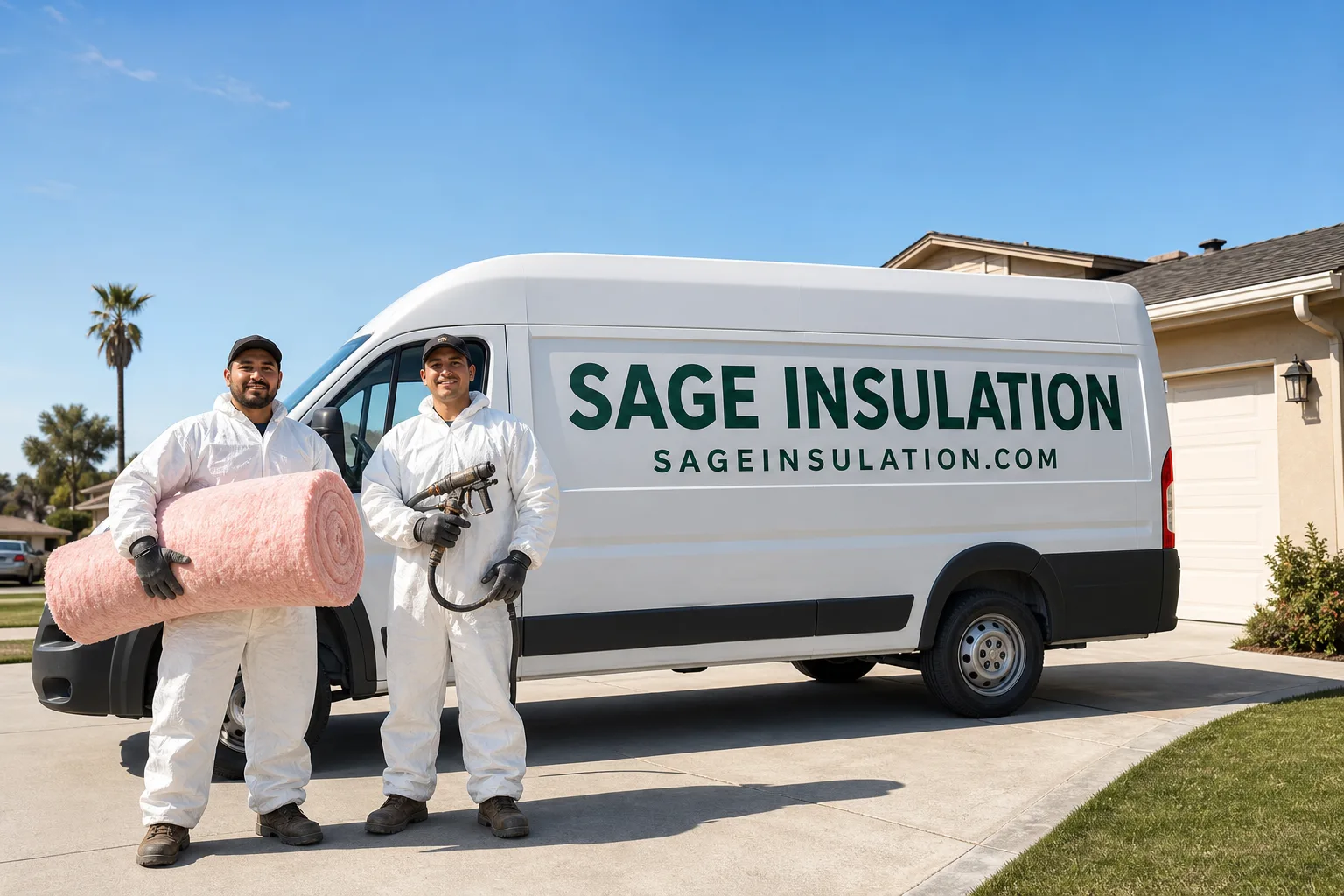
Fast, Reliable Spray Foam Insulation Across La Habra
Spray foam insulation in La Habra costs between $2,800 and $7,500 for a typical attic application, with roof deck work on postwar ranch homes running $3,200 – $8,900 depending on square footage and whether we’re open-cell or closed-cell. Most La Habra jobs are completed in one day, and our crews regularly work from the Puente Hills foothill tracts to the older core around La Habra Boulevard. Because La Habra sits right where inland valley heat spills over into the coastal plain, attics here bake harder and longer than homes just a few miles west. That changes what foam formulation we recommend, where we apply it, and why roof deck work pays off faster in this city than almost anywhere else in north Orange County. If you’re tired of rooms that won’t hold temperature, call (855) 360-9333 and we’ll schedule a diagnostic visit.
We carry Icynene and Demilec spray foam systems, so our recommendation reflects what your home actually needs, not what we happen to have on the truck. Alan Herrera leads our crews, and he’s spent enough time in La Habra attics to know what July does to a low-pitch roof deck by 10 a.m. Our full-service team runs Spray Foam Insulation projects across every neighborhood in the city, and we stock materials for same-week starts throughout 90631, 90632, and 90633.
Key takeaways for La Habra homeowners:
- Cooling-season heat rejection is the main reason to spray foam here, not winter heating retention.
- Postwar ranch and tract attics from the 1950s-70s typically have compacted, under-code fiberglass that needs removal before foam goes in.
- Open-cell Icynene works for most attic roof decks; closed-cell Demilec fits rim joists, crawl spaces, and garage ceiling applications.
- Free estimates, one-day installs on most single-story attics, and honest guidance on whether foam is even the right fit for your home.
Why Sage Insulation Is La Habra’s Preferred Spray Foam Insulation Company
We’re material-agnostic, which means we don’t push spray foam because it’s the highest-ticket item on the truck. We install fiberglass batts, blown-in cellulose, and both open- and closed-cell foam, so when we tell a La Habra homeowner that roof deck foam is the right call, it’s because the math on heat gain and air sealing actually supports it. Our crews install from eight manufacturer lines, including Knauf, CertainTeed, and Icynene, so the foam job gets specified around the home’s performance gaps instead of a vendor quota.
Response time to La Habra runs same-day for emergency calls and within one to two business days for scheduled diagnostics. Our technicians know the difference between the hills-adjacent tracts off Harbor Boulevard, where afternoon sun pounds roof decks hard, and the flatter central neighborhoods where attic ventilation issues are more common than radiant heat problems. That local pattern recognition means fewer wrong recommendations and faster, more accurate quotes for homeowners in La Habra Heights, East La Mirada, and Fullerton alike.
Every job starts with an attic inspection, not a sales script. We look at what’s already up there, measure the existing R-value, check for wiring complications, and then give you a straight answer about whether spray foam beats air sealing plus new batts for your specific house. Sometimes it’s not the right product. When it is, we tell you exactly why, what it’ll cost, and how long it takes.
Crawl Space Spray Foam Insulation in La Habra
Crawl space spray foam insulation in La Habra typically runs $1,800 – $4,500 for a standard 1,000 – 1,500 square foot crawl space, depending on whether we’re sealing the rim joists, the subfloor, or the full perimeter. Older La Habra homes on pier-and-beam foundations, especially in the 1940s-50s core near Euclid Street and La Habra Boulevard, often have open crawl spaces that pull hot, dry air up through the floor assembly all summer. Closed-cell Demilec foam at the rim joist and band board cuts that air movement and keeps conditioned air where it belongs.
The Rim Joist Fix
Most crawl space heat gain in La Habra comes through the rim joist, the exposed band of framing where the floor meets the foundation. Closed-cell foam at this junction seals the gap and adds R-7 per inch, which matters more in La Habra’s dry inland summer than in coastal cities where crawl spaces stay cooler and less prone to air-driven heat transfer. Our crews typically finish a rim joist treatment in one morning.
When the Subfloor Needs Foam
Homes with original tongue-and-groove subfloors often have zero insulation between the joists. Spraying closed-cell foam directly to the underside of the subfloor creates a continuous air and thermal barrier in one pass, and it holds up better than fiberglass batts in the dry, occasionally dusty crawl environments common across La Habra’s older housing stock.
Garage Spray Foam Insulation in La Habra
Garage spray foam insulation in La Habra usually runs $1,200 – $3,800, with attached garages near living space costing more because the shared wall and ceiling need full coverage. Detached garages on postwar La Habra lots are often uninsulated stud cavities with nothing between the garage interior and the afternoon sun, and homeowners who use the space as a workshop, gym, or storage area feel the heat immediately. Open-cell Icynene on the shared wall and garage ceiling drops the temperature transfer into adjacent bedrooms noticeably.
The Shared-Wall Problem
Attached garages on 1950s-70s tract homes in La Habra share a wall with a living room or den, and that wall is almost never insulated. The garage becomes a solar oven by mid-afternoon, and that heat bleeds straight through the studs into conditioned space. Sealing that shared wall with open-cell foam stops the bleed at the source and makes the adjacent room feel like part of the same house again.
Garage Ceiling as a Heat Barrier
If there’s no room above the garage, the ceiling is just drywall and rafters. Spraying foam on the garage ceiling underside creates a thermal break between the hot roof deck and the space below, which matters even in detached garages where you park hot cars. In La Habra’s July heat, an uninsulated garage ceiling can push interior temperatures over 100°F by noon. Foam brings that down into the 80s without running a portable AC unit nonstop.
Trusted Brands We Service in La Habra
For La Habra spray foam work, we typically recommend Icynene for open-cell attic applications and Demilec for closed-cell rim joist, crawl space, and garage work. We also stock Knauf and CertainTeed batt and blown-in products, which matters when a home needs air sealing and targeted foam in problem zones alongside fresh attic insulation rather than a full roof deck encapsulation. Because we carry competing brands instead of a single manufacturer’s line, our recommendation for your La Habra home is driven by the thermal performance you need and the failure modes we find during inspection. We keep local inventory staged for fast starts in 90631, 90632, and 90633, and manufacturer warranties on Icynene and Demilec products add product-level protection on top of our installation work.
Common Spray Foam Insulation Problems We See in La Habra Homes
- Compacted fiberglass in low-pitch postwar attics. Original or once-replaced batts in 1950s-70s ranch homes have slumped and compacted, leaving thermal gaps no amount of extra blown-in material can truly fix. Foam applied to the roof deck bypasses the problem entirely by moving the thermal boundary outward.
- Sun-baked radiant surfaces under hill-adjacent roof decks. By late morning in July, attic surfaces in the Puente Hills-adjacent tracts are already too hot to touch, and any foam applied over those surfaces without addressing the heat load first will underperform on cooling. Our crews assess the radiant heat path before specifying foam thickness.
- Knob-and-tube or aluminum wiring in older core homes. 1940s-50s houses near the older La Habra core often have legacy wiring that must be inspected and sometimes remediated before foam goes in, because encasing degraded wiring in foam creates a fire-safety and access problem. We sequence foam work around any wiring issues instead of burying them.
- Air leaks the homeowner didn’t know about. Balloon framing, unsealed top plates, and open soffit bays are common in La Habra’s mid-century construction, and they leak conditioned air far faster than a thin layer of new insulation can compensate for. Spray foam seals these leak paths at the same time it insulates, which is why it outperforms batts in older homes even at modest thicknesses.
Pricing for Spray Foam Insulation in La Habra, CA
A full attic roof deck encapsulation in a typical 1,600 square foot La Habra ranch runs $3,800 – $6,900 for open-cell Icynene and $5,500 – $9,800 for closed-cell Demilec. Rim joist work in a crawl space starts around $1,500 – $2,800, garage ceiling and shared-wall jobs range $1,200 – $3,800 depending on wall area and access, and a full crawl space treatment lands between $1,800 and $4,500. Square footage, roof pitch, wiring complications, and how much old material we need to remove all move the number. Our estimates are free, itemized, and valid for 30 days, and every quote includes a line-item breakdown so you know exactly what you’re paying for. Call (855) 360-9333 and we’ll walk your attic with you, no charge for the visit.
We Also Serve Cities Near La Habra
Sage Insulation serves the surrounding communities with the same material-agnostic approach we bring to La Habra. Our crews cover La Habra Heights for hillside and custom homes, East La Mirada for mid-century tract work, Fullerton for older core and college-area housing, and La Mirada for postwar ranches. Wherever you’re located, we’ll send the same diagnostician-led crew that shows up on time and recommends only what your attic actually needs.
Serving La Habra, CA — Our Local Coverage Area
We’re based in the La Habra area and know this community well. Use the map below to see our service coverage — if you’re nearby, we can almost certainly help.
FAQs About Spray Foam Insulation in La Habra
In La Habra’s inland summer heat, the roof deck itself becomes a radiant panel that keeps heating the attic air even with thick batts on the floor. Spray foam applied directly to the roof deck moves the thermal boundary to the outside of the attic, which stops heat gain at the source instead of trying to insulate against it from below. For low-pitch postwar ranch roofs that trap hot air near the ceiling, roof deck foam makes a bigger comfort difference than adding more insulation on the attic floor. Call (855) 360-9333 for an attic evaluation and we’ll show you what your specific roof is doing in the late afternoon heat.
Yes, but the job has to be sequenced properly. We inspect the wiring first, and if knob-and-tube or aluminum conductors are present, we coordinate with a licensed electrician to remediate or isolate them before any foam goes in. Encasing live, degraded wiring in foam creates a fire hazard and makes future access difficult, so we don’t do it. Once wiring is addressed, the foam application proceeds normally. We’ve done this on older homes near Euclid Street and La Habra Boulevard, and the process adds time but not a lot of cost.
In a typical 1950s-70s La Habra ranch, we expect to find compacted or displaced fiberglass batts, an unsealed top plate, open soffit bays, and a roof deck that’s already hot to the touch by mid-morning in summer. Many attics also have old ductwork with air leaks that foam can’t fix directly but that we’ll flag during the inspection. Older core homes add wiring concerns and occasionally vermiculite that needs testing before we disturb it. We’ll show you photos and explain what matters before we recommend a scope of work.
It helps in all three, but the priority depends on where your heat gain and air leakage actually are. Attics are the biggest cooling-season load in most La Habra homes, but crawl spaces on pier-and-beam foundations leak air upward through the floor, and attached garages transfer heat through shared walls into living space. Closed-cell foam works best in crawl spaces and rim joists; open-cell foam handles garage ceilings and shared walls well. Call (855) 360-9333 and we’ll tell you which surfaces matter most for your specific house.
La Habra sits at the inland edge of the Puente Hills transition, where summer afternoons run 10 to 15 degrees hotter than La Mirada or Whittier flats and the air stays drier, which means attics here heat up faster and hold that heat longer into the evening. Coastal cities prioritize heating retention and moisture management; La Habra homes prioritize cooling-season heat rejection at the roof deck. That’s why the same product recommendation doesn’t make sense in both places, and why we evaluate each home against La Habra’s actual microclimate rather than a regional template.
Written by Alan Herrera, Owner at Sage Insulation, serving La Habra since the company’s founding.