
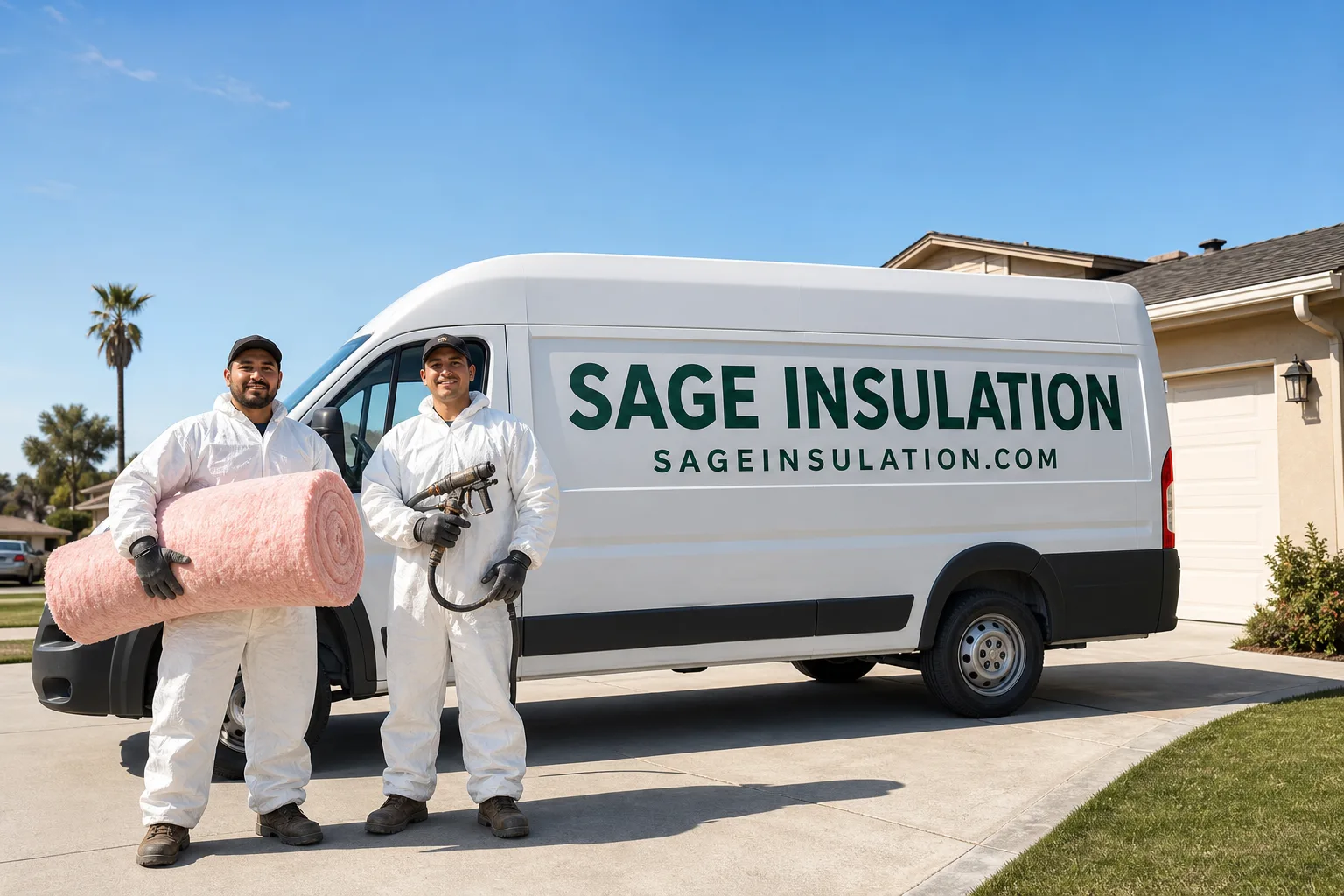
Fast, Reliable Spray Foam Insulation Across Lakewood
Spray foam insulation in Lakewood typically runs $2.25 to $4.75 per board foot for open-cell and $3.50 to $7.00 per board foot for closed-cell, with most garage ceiling and rim joist retrofits landing between $1,800 and $4,200. We’re in Downey, which means we can have a crew at your Lakewood door the same day you call in most cases. That matters when your garage ceiling is open to the coastal air and every week of delay means more moisture working its way into your 2×4 framing. Call (855) 360-9333 and we’ll give you a straight answer about what your home actually needs.
Why Sage Insulation Is Lakewood’s Preferred Spray Foam Insulation Company
Lakewood isn’t a town where you can guess at things. The housing stock is too specific, too consistent, and too old for guesswork. Most of the homes we work on here were built between 1950 and 1958 under the original Lakewood Plan, which means slab foundations, shallow attics, and open garage ceilings that were never designed with insulation in mind. Our crews have been inside enough of these tract homes to know exactly what’s behind the stucco before we cut the first access point.
Alan Herrera built Sage Insulation around a simple principle: carry the material that fits the house, not the material that fits the truck. That’s why we stock both Icynene and Demilec spray foam systems, along with fiberglass and cellulose options. For a Lakewood homeowner, that means the recommendation you get from us is based on your home’s actual heat load and corrosion exposure, not on what we’re trying to move that month. Homeowners across Lakewood, from the Lakewood Park tract to the neighborhoods around Mayfair Park, call us because we tell them what’s wrong before we tell them what to buy.
Open Cell Spray Foam in Lakewood
Open cell spray foam is the workhorse for Lakewood’s 1950s attic and garage-ceiling retrofits, because it expands aggressively into shallow 2×4 and 2×6 cavities where fiberglass batts compress and lose their R-value. In Lakewood’s tract homes, where attic scuttles are small and access is tight, open-cell foam can be installed through a hallway hatch or closet scuttle without tearing out drywall. It air-seals the rim joists and top plates at the same time it insulates, which is exactly what an old tract house needs when the biggest problem is hot attic air bleeding into the living space.
Expect to pay between $2.25 and $3.75 per board foot for open-cell spray foam in Lakewood, depending on cavity depth and access. A standard garage ceiling retrofit in a 1950s ranch typically runs $1,800 to $2,800 when combined with rim joist work.
Heat Load and Air Sealing
Lakewood’s problem isn’t winter cold. It’s summer heat stacking up in an unvented or poorly vented attic, where temperatures past 130°F radiate down through the ceiling all afternoon and evening. Open-cell foam slows that heat transfer significantly, and its air-sealing properties stop the stack effect that pulls hot attic air into the home through every gap around ceiling fixtures and top plates.
Salt Air and Open-Cell Performance
Unlike fiberglass or cellulose, open-cell spray foam doesn’t absorb moisture from the humid coastal air that moves through Lakewood in the late summer and fall. That’s a meaningful difference in a tract home where the garage ceiling is open to whatever the marine layer brings in overnight. The foam stays dimensionally stable while old rock-wool batts wick moisture and slump.
Spray Foam Insulation Contractors in Lakewood
Spray foam insulation contractors in Lakewood need to understand what a 1950s tract home looks like on the inside before they ever bring a hose in. The original Lakewood Plan houses were built fast and light, with uninsulated walls, open garage ceilings, and small closet or hallway scuttles as the only attic access. A contractor who’s never worked that footprint will waste time, cut extra holes, and often miss the fact that the garage ceiling and the corroded hardware above it are part of the same moisture problem. Our crews see that connection on almost every job.
For a full spray foam retrofit on a Lakewood home, including garage ceiling, rim joists, and attic floor, homeowners can expect to spend between $3,200 and $6,500 depending on square footage and access difficulty. We’ll give you a firm quote before any work starts, and the estimate visit is free.
Retrofit Access and Original Construction
In most Lakewood tract homes, we’re working through a hallway scuttle no bigger than 22 by 30 inches or a closet hatch that was never meant for insulation work. That changes how we stage the job, how we run the hose, and how long the work takes. It’s not harder, necessarily, but it requires patience and a plan for getting material into tight spaces without damaging the original stucco or the remodeled finishes around the access point.
Working With Builders and Remodelers
Lakewood’s infill projects and 1960s-70s additions often come with mismatched framing and partial insulation from whatever era the addition went up. Contractors doing residential remodels call Sage because we can match open-cell foam in the new framing to blown-in cellulose in the old walls without losing sleep over material compatibility. We carry eight brands so we can do that cleanly.
Trusted Brands We Service in Lakewood
We install and service spray foam from Icynene and Demilec, and we stock Owens Corning and Rockwool products for the jobs where foam isn’t the right answer. Because Sage isn’t locked into a single manufacturer’s program, our Lakewood customers get a recommendation based on what their specific tract home actually needs. An open garage ceiling with salt-air exposure and shallow 2×4 framing gets a different material than a fully finished attic in a 1960s addition. We keep the materials that make sense for Lakewood’s construction in stock locally, which means less waiting and faster turnaround on retrofit jobs.
Common Spray Foam Insulation Problems We See in Lakewood Homes
- Open garage ceilings with exposed joists: The original 1950s garages in Lakewood were often built with no ceiling at all, just open rafters and maybe a few sagging rock-wool batts. Coastal moisture condenses on the metal fasteners and exposed hardware, rusting them while the batts compost from heat cycling.
- Scuttle and closet hatch ventilation gaps: When spray foam is applied to an attic without addressing the original small scuttle or closet hatch, the attic can become too tight. Moisture that used to escape through the gaps now collects on rafters, which is a condensation problem specific to older tract homes.
- Corroded garage-door springs and hinges: Salt air blowing in from the Long Beach harbor area accelerates rust on garage-door hardware in Lakewood. By the time we’re called for an insulation retrofit, the springs and hinges above the open ceiling are often heavily corroded, and that moisture problem is part of why the insulation failed.
- Shallow 2×4 walls with no original insulation: Most Lakewood tract homes have 2×4 exterior walls that were built empty or with a thin vapor barrier only. Retrofit spray foam in those shallow cavities works, but it has to be the right density for the cavity depth, and access is almost always through the exterior stucco or interior drywall.
Pricing for Spray Foam Insulation in Lakewood, CA
Open-cell spray foam in Lakewood runs $2.25 to $3.75 per board foot, closed-cell runs $3.50 to $7.00 per board foot, and most retrofit jobs fall between $1,800 and $6,500 all-in depending on whether we’re doing a garage ceiling, rim joists, an attic floor, or a full wall cavity retrofit. What moves the number is square footage, cavity depth, access difficulty, and whether we’re also replacing corroded garage-door hardware or removing old insulation first. A full garage ceiling with rim joists in a 1950s ranch is usually at the lower end; a whole-attic spray foam job with old batts to remove is at the higher end. Call (855) 360-9333 and we’ll walk the property and give you a fixed quote, not a range that drifts after we start.
Our Spray Foam Insulation team handles every job as a complete retrofit assessment, including the hardware and ventilation issues that most insulation contractors in Lakewood don’t check.
We Also Serve Cities Near Lakewood
Sage Insulation covers Lakewood and the surrounding communities from our Downey shop. We’re regularly in Signal Hill, Bellflower, Long Beach, and Paramount for spray foam retrofits, garage ceiling work, and full attic insulation jobs. Same-day response applies across the area, not just inside the Lakewood city limits.
Serving Lakewood, CA — Our Local Coverage Area
We’re based in the Lakewood area and know this community well. Use the map below to see our service coverage — if you’re nearby, we can almost certainly help.
FAQs About Spray Foam Insulation in Lakewood
Yes, closed-cell spray foam on the garage ceiling and rim joists reduces the moisture load in your garage, which slows the salt-air corrosion on springs, hinges, rollers, and opener chains. But the foam itself doesn’t stop the rust. The real fix is a combined job: we seal the open ceiling with foam to cut the condensation source, then replace the corroded hardware with galvanized or stainless components so the salt air doesn’t eat through the new stuff the way it did the original. Call (855) 360-9333 to have a technician check both problems at once.
No. Old rock-wool batts in Lakewood’s 1950s tract garages are usually sagging, moisture-soaked, and composted from decades of heat cycling. Spraying foam over them traps that moisture against the joists and creates a condensation problem that eats the framing. We remove the old batts first, inspect the exposed joists and hardware for rust, then apply the foam cleanly to the cavity. Most Lakewood garages we see need this full removal-and-replace treatment rather than a simple top coat.
For most Lakewood tract homes, closed-cell spray foam is the better choice because its higher R-value per inch works in shallow 2×4 and 2×6 cavities, and it acts as a moisture barrier against the humid coastal air that moves through the area. Open-cell is more affordable and works well for garage ceilings where heat load is the primary concern and moisture exposure is moderate. The right answer depends on your specific house, and that’s why we carry both Icynene and Demilec systems. We’ll tell you what fits after we look at the framing and the exposure.
In most Lakewood tract homes, we access the attic through the original hallway scuttle or closet hatch, which is often as small as 22 by 30 inches. We stage the spray foam equipment outside and run the hose through that opening, working from ladders and crawl boards inside the attic. If the scuttle is too small or was sealed over by a remodel, we may need to create a temporary access point in a closet ceiling, which we patch and finish after the job. It’s a limitation almost every original Lakewood home has, and we plan for it from the first site visit.
Spray foam on the garage ceiling does not interfere with a garage door opener’s operation, but if the opener is ceiling-mounted and we’re working in that exact bay, the install schedule will adjust around it. The more important relationship is the hardware: if salt air has already corroded the springs and hinges, sealing the ceiling with foam will reduce future corrosion, but the factory hardware may still need replacement to restore smooth operation. We’ll check the opener mounting, the springs, and the track hardware during the estimate so you know what’s actually needed.
Ready to talk about your Lakewood home’s insulation? Call (855) 360-9333 and we’ll set up a free estimate. Alan and the crew know these 1950s tract houses inside and out, and we’ll give you a straight answer about what your garage ceiling, attic, and walls actually need.
Written by Alan Herrera, Owner at Sage Insulation, serving Lakewood and surrounding cities from our Downey shop.