
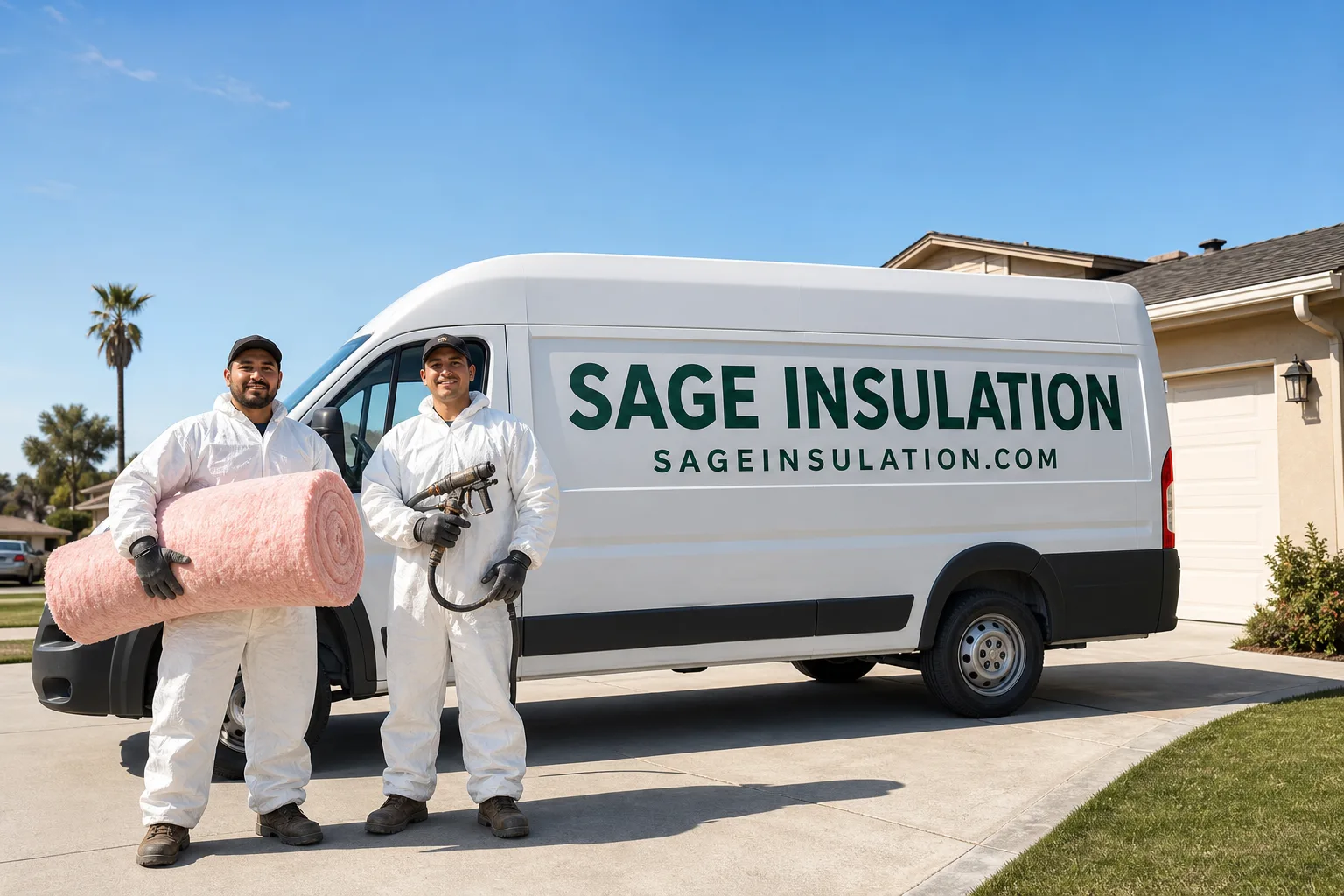
Spray Foam Insulation in Rosemead: What It Costs and How It Works in Older Stucco Homes
Spray foam insulation in Rosemead typically costs $2,200 – $6,800 for a full attic application and $3,500 – $9,500 for wall cavity injection in a 1950s stucco tract home. Most Rosemead jobs are retrofits, not new construction, because the housing stock dates to the 1940s through 1970s and many original walls were never insulated. The work usually takes one to two days for a standard single-story home in the 91770 ZIP. We’re Sage Insulation, led by Alan Herrera, and we’ve worked on enough Rosemead tract homes to know exactly what’s behind those stucco exteriors before we drill the first hole. Call (855) 360-9333 for a free estimate.
Key Takeaways
- Rosemead’s 1950s – 70s stucco homes often have completely empty wall cavities requiring interior-drilled spray foam injection.
- Attic temperatures in Rosemead regularly exceed 140°F in summer, making air-sealing spray foam the highest-impact upgrade for cooling bills.
- Attic insulation near the 10 Freeway and Valley Blvd is often contaminated with diesel soot and needs testing before new material goes in.
- We carry both Icynene and Demilec spray foam systems plus Owens Corning and Johns Manville products for the right fit per home.
- Free estimates, licensed and insured, serving all Rosemead ZIP codes: 91770, 91771, 91772.
The Rosemead Housing Stock Problem: Walls That Were Never Insulated
Here’s what makes Rosemead different from newer SGV cities like East San Gabriel or Temple City. The tract homes built across Rosemead in the 1950s and 1960s went up fast: wood frame, stucco exterior, drywall interior, and in thousands of cases, no insulation in the exterior walls at all. Builders were racing to meet post-war demand, and the mild Southern California reputation convinced many that wall insulation wasn’t necessary. The result is that a home near Rosemead Boulevard or Garvey Avenue can look fine on the outside while every exterior wall cavity sits empty. In summer, when outdoor temps push past 95°F, those uninsulated walls transfer heat straight through the drywall. Homeowners feel it as warm interior walls in the afternoon and an HVAC system that never cycles off.
Our Spray Foam Insulation team sees this condition constantly in the 91770 ZIP. Because the exterior is stucco, you can’t simply remove siding to access the cavities. The standard approach here is interior injection: we drill small holes through the drywall from inside each room, fill the cavity with spray foam, then patch and texture the holes. It’s the same method used throughout Rosemead, but the difference is in the execution. Old drywall from the 1950s is brittle. If you drill too fast or use the wrong bit, it cracks and you’re looking at a repair that goes well beyond a simple patch. We pre-drill carefully, monitor cavity pressure as the foam expands, and work around original plaster details when we find them.
Why Sage Insulation Is Rosemead’s Preferred Spray Foam Insulation Company
We’re not a one-brand shop. Sage Insulation carries eight manufacturer lines: Owens Corning, Johns Manville, Knauf, Rockwool, CertainTeed, Icynene, Demilec, and GreenFiber. That matters in Rosemead because every retrofit has a different starting point. A 1958 tract home with empty wall cavities needs an open-cell foam designed for injection. A garage ceiling over a poorly vented attic might need closed-cell for its moisture resistance. If we only carried one foam chemistry, we’d have to force it into every situation. Instead, we look at each Rosemead home and recommend what performs best, not what we have the most of.
Alan Herrera built Sage Insulation as a material-agnostic operation for exactly this reason. Rosemead customers who call us aren’t usually asking for a specific brand by name. They’re asking why their upstairs bedroom is 10 degrees hotter than the living room, or why their cooling bill jumped 30% from a year ago. We answer with specific material properties: R-values, air-sealing capability, moisture performance. Then we install the product that matches the problem.
Our team gets to Rosemead quickly. From our Downey base, we’re on most 91770, 91771, and 91772 job sites within about 45 to 60 minutes of the first call. For an attic insulation assessment, we’re usually able to schedule within a few days, not weeks. When a Rosemead homeowner calls with an urgent situation, like exposed wall cavities during a remodel or an attic that’s been torn open, we prioritize them.
Spray Foam Attic Insulation in Rosemead
Spray foam attic insulation in Rosemead targets the single largest heating and cooling loss point in a San Gabriel Valley home: the attic floor and roofline. In a typical 1950s tract home here, the original attic insulation, if any, is R-11 fiberglass batts laid between ceiling joists. That’s inadequate by any modern standard, and in many Rosemead homes the batts have compressed to half their original thickness anyway. Summer attic temperatures push past 140°F, sometimes 150°F in the hottest weeks, and that heat radiates down through the ceiling all afternoon. Spray foam changes the physics: it air-seals the attic floor, stopping superheated attic air from leaking into the living space, and it delivers a continuous insulation layer without the gaps and compression that plague batts.
For a standard 1,100 to 1,600 square foot Rosemead home, attic spray foam runs $2,200 – $4,200 for open-cell and $3,300 – $6,800 for closed-cell. The cost difference is real, and so is the performance difference. Open-cell foam is more affordable and expands more, making it good for sealing odd-shaped attic cavities and rim joists. Closed-cell is denser, acts as a vapor barrier, and delivers a higher R-value per inch, which is why we recommend it for homes with existing moisture issues or for anyone who uses attic space for storage.
Attic Air Sealing Before You Add Insulation
Many Rosemead homes have recessed lights, bathroom fans, and plumbing vents that leak conditioned air into the attic. Spray foam seals these penetrations directly. We recommend air-sealing every attic before adding new material. It’s the difference between upgrading insulation and actually feeling the upgrade.
Cleanup After Spray Foam Application
Overspray is a common complaint from homeowners who’ve had foam installed by crews that didn’t mask off. We drape and tape every surface in the work area, including the attic hatch, before spraying. After application, we cut back excess foam flush with joists so future attic access stays clean.
Spray Foam Wall Insulation in Rosemead
Spray foam wall insulation in Rosemead is the highest-impact retrofit for 1950s and 1960s stucco tract homes because so many of these houses never had wall insulation from day one. The work is called injection foam, and it’s done from the interior. Our crew drills a series of small holes, typically 1 to 2 inches across, through the drywall at each stud bay, inserts the injection nozzle, and fills the cavity with open-cell foam. The foam expands to fill the full depth of the wall, including the irregular spaces behind electrical boxes and around blocking. Once it cures, we patch the drywall with hot mud, sand, and texture to match the original finish.
The whole process for a single-story Rosemead home takes one or two days, depending on the number of exterior walls and whether the homeowner has furniture we need to move. We protect floors with drop cloths and run a HEPA vacuum during drilling to keep drywall dust contained. For an average 1,200 square foot home with all four exterior walls uninsulated, the cost in Rosemead runs $3,500 – $6,500. Larger homes or those with difficult access, like walls behind built-in cabinetry or tiled bathrooms, can push the top end closer to $9,500.
Working Around Original Plaster and Drywall
Some Rosemead homes built in the late 1940s and early 1950s still have original plaster over wood lath. The injection method changes slightly for these: we use a smaller drill bit, drill at a slower speed, and monitor for cracking as the foam expands. If we find plaster that’s already delaminating from the lath, we flag it before drilling so the homeowner knows what to expect.
Icynene and Demilec for Wall Injection
We carry both Icynene and Demilec spray foam systems because they behave differently during injection. Icynene’s open-cell foam expands less aggressively, which makes it gentler on older drywall and plaster. Demilec’s formulations are useful when we need a faster cure time or a specific density. For most Rosemead wall retrofits, we reach for Icynene first, then adjust based on what the cavity tells us.
Trusted Brands We Service in Rosemead
Our Rosemead customers get access to Owens Corning, Johns Manville, Knauf, and Rockwool, depending on the application. Owens Corning and Johns Manville both manufacture spray foam and fiberglass batt products, and their manufacturer warranties travel with the product when installed by a certified contractor. Knauf and Rockwool come into play for hybrid approaches: Rockwool mineral wool has a higher fire rating than standard fiberglass and is useful in garages, while Knauf’s blown-in fiberglass is a strong companion to spray foam in attic retrofits where we seal the edges with foam and fill the field with blown material. For Rosemead homeowners who want to see and compare options before committing, we can show samples of each product we’d recommend and explain the material properties that drove each recommendation.
Common Spray Foam Insulation Problems We See in Rosemead Homes
- Attic insulation blackened by freeway soot. Homes near the 10 Freeway and Valley Blvd corridors collect diesel particulates through roof vents, and over decades the original batts turn black. The soot doesn’t just look bad, it can trap odors and reduce air movement through the insulation, cutting its effective R-value. We test these batts before doing anything else and won’t spray new foam over contaminated material.
- Cracked wall cavities from previous injection attempts. We occasionally arrive at Rosemead homes where a prior contractor attempted wall injection and caused visible drywall cracks. Injecting foam into a 60-year-old wall requires a lighter touch and a second person watching the drywall surface for movement. We run a two-person crew on every wall injection specifically for this reason.
- Garage ceilings that transfer heat into bedrooms above. In two-story Rosemead homes or those with finished garage conversions, the garage ceiling is often uninsulated. Spray foam applied to the garage ceiling from below stops heat from the unconditioned garage from radiating up into the living space. We check the garage door springs before recommending this: adding foam to a garage ceiling doesn’t affect door weight, but if we’re also insulating the walls, the added weight on an old one-piece door can strain legacy springs.
- Rim joist air leaks in raised-floor homes. Some Rosemead homes built on raised foundations have open rim joists where the floor framing meets the foundation. This is a hidden air leak point that lets hot outside air into the crawlspace and up through floorboards. Closed-cell spray foam applied to the rim joist area seals it completely and handles the moisture exposure that comes with being near soil.
Pricing for Spray Foam Insulation in Rosemead, CA
Here are real numbers for the Rosemead market. Attic spray foam over a standard single-story home: $2,200 – $4,200 for open-cell, $3,300 – $6,800 for closed-cell. Wall cavity injection for a 1950s stucco home: $3,500 – $6,500 for all four exterior walls on a 1,200 square foot house, with the high end near $9,500 for larger homes or those with access challenges. Garage ceiling spray foam: $800 – $1,600 depending on square footage. Rim joist air sealing: $400 – $900 for a typical raised-foundation home. These ranges reflect what we see across the 91770, 91771, and 91772 ZIPs. What moves the number within the range is square footage, accessibility, whether we’re removing old material first, and whether the homeowner wants open-cell or closed-cell foam. We give free estimates in person, and the quote we give is the price we charge. Call (855) 360-9333 to schedule an assessment.
We Also Serve Cities Near Rosemead
Sage Insulation regularly works across the San Gabriel Valley. In addition to our Rosemead projects, we serve Spray Foam Insulation in Rosemead neighbors in East San Gabriel, San Gabriel, North El Monte, and Temple City. The housing stock in these areas is similar to Rosemead’s: mid-century stucco tract homes with the same uninsulated wall cavities and under-insulated attics. If you’re in one of these nearby cities, the same approach we describe above applies.
Serving Rosemead, CA — Our Local Coverage Area
We’re based in the Rosemead area and know this community well. Use the map below to see our service coverage — if you’re nearby, we can almost certainly help.
FAQs About Spray Foam Insulation in Rosemead
Yes, and that’s the standard method we use in Rosemead. Because the exterior is stucco, we inject foam from the interior by drilling small holes through the drywall at each stud bay, filling the cavity with open-cell spray foam, then patching and texturing the holes to match the original finish. The stucco stays completely intact. Most Rosemead jobs of this type take one to two days. Call (855) 360-9333 for a free estimate on your specific floor plan.
We test it first, then remove it if it’s contaminated. Homes near the 10 Freeway and Valley Blvd often have attic batts that collected diesel soot and brake dust through roof vents over decades. We don’t spray new foam or blow new cellulose over blackened batts; instead, we vacuum out the old material, seal the roof vents as needed, and start fresh. The removal adds labor cost, but it’s the only way to make new insulation perform as designed.
It depends on the door. Spray foam applied to the garage ceiling or walls doesn’t add weight to the door itself. But if we’re insulating the garage door interior, the added foam can add several pounds, and a 1960s-era one-piece door with original extension springs may already be near its load limit. We check the door and springs before recommending door insulation and will tell you if the springs need replacement first. Our team can also recommend a garage door technician if the hardware is past service life.
An empty 2×4 wall cavity has an effective R-value of roughly R-3 to R-4, almost all of it from the drywall, stucco, and air films. Injecting open-cell spray foam brings that cavity to R-13 or higher, and closed-cell can push it to R-21 or more. For a Rosemead home where the original walls were never insulated at all, that’s a real shift, and it’s usually the single biggest comfort improvement we can deliver. Call (855) 360-9333 and we’ll assess what’s actually in your walls.
We carry both. Icynene’s open-cell foam is our first choice for interior-injected wall cavities in older Rosemead homes because it expands less aggressively and is gentler on brittle 1950s drywall. Demilec products come into play for closed-cell attic applications or for jobs where a faster cure time matters. Since we’re not locked into a single manufacturer’s program, the recommendation reflects what’s best for your home, not what our supplier happens to incentivize this quarter.
If your Rosemead home still has its original uninsulated walls, or you suspect your attic insulation has been compromised by freeway soot or decades of heat, call us — we also offer Reflectix repair in Rosemead. Alan Herrera and the Sage Insulation team will come out, look at what’s actually behind your stucco and above your ceilings, and give you an honest recommendation with a firm price. Free estimates, licensed and insured, serving all of Rosemead: (855) 360-9333.
Written by Alan Herrera, Owner at Sage Insulation, serving Rosemead and the San Gabriel Valley.