
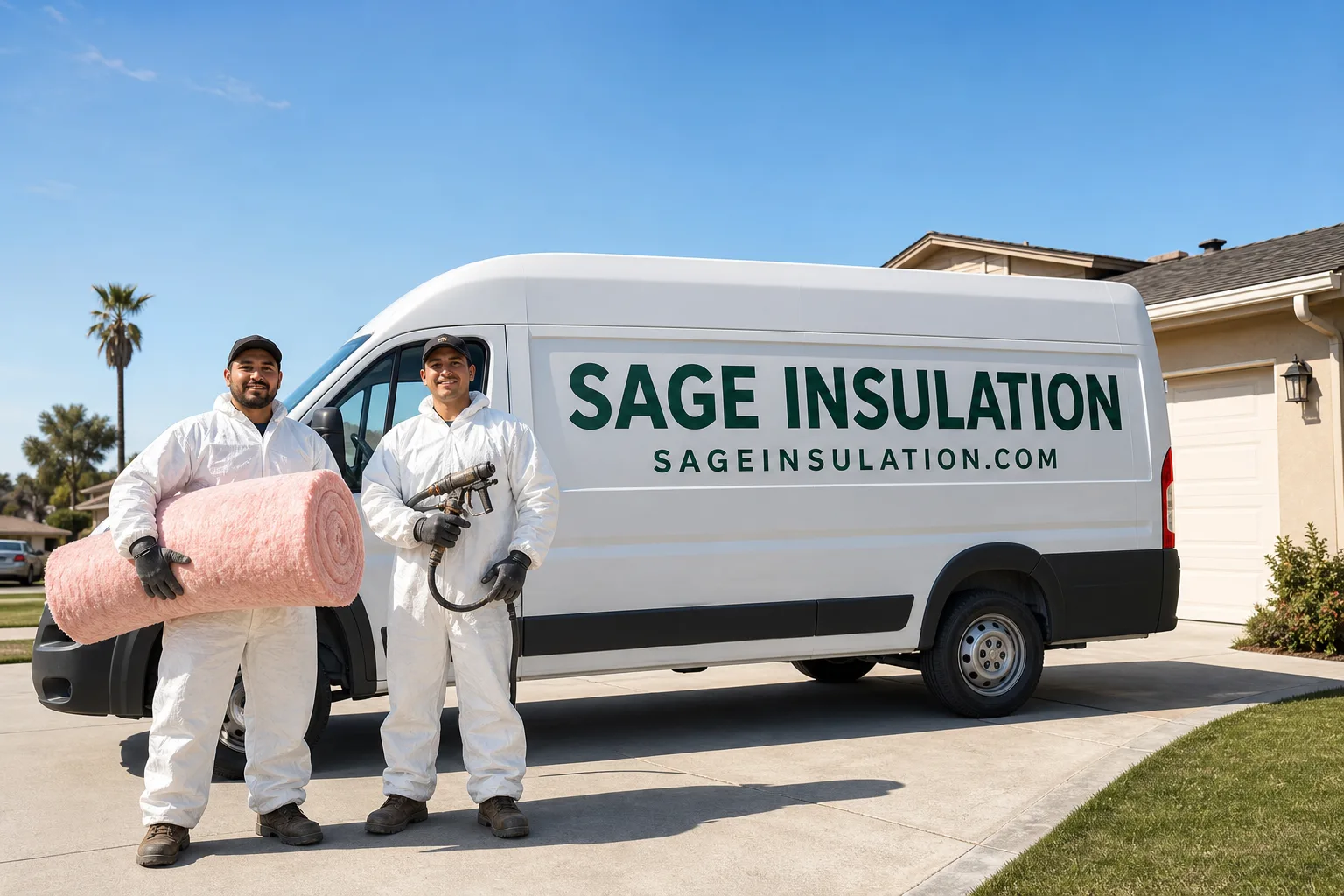
Fast, Reliable Spray Foam Insulation Across Rowland Heights
Spray foam insulation in Rowland Heights typically runs $1.50 to $4.50 per board foot installed, with most whole-attic upgrades landing between $3,500 and $9,000 depending on foam type and roof deck access. We get crews out to Rowland Heights homes within 24 to 48 hours for quotes, and our team knows the tract layouts off Fullerton Road, Colima, and Nogales well enough to give you an honest read before anyone picks up a hose. If your west-facing rooms bake by early afternoon and your AC runs nonstop from June through October, call (855) 360-9333 and we’ll talk through whether foam is actually the right fix for your house, not just the most expensive one.
Why Sage Insulation Is Rowland Heights’s Preferred Spray Foam Insulation Company
Most insulation crews around Rowland Heights push whatever product their distributor puts on sale. We don’t operate that way. Alan Herrera built Sage Insulation as a brand-agnostic shop, and we carry Icynene, Demilec, and CertainTeed foam systems so the chemistry gets matched to the house, not to our inventory. That matters here because Rowland Heights homes split into two distinct jobs: older Puente Hills tract houses with unvented attics that need roof-deck foam, and newer infill builds where a simpler attic-floor or rim-joist application makes more sense.
Homeowners in Rowland Heights call us when their upstairs won’t cool down, when their garage turns into an oven, or when energy bills jump every summer. We’ve crawled through enough 1960s and 70s attics off Pathfinder Road and Jellick Avenue to know exactly what’s up there before we even open the hatch. The response time to Rowland Heights from our Downey home base runs under two hours for most calls, and we schedule quotes around your workday, not ours. That local familiarity means we don’t waste your time recommending $9,000 of foam when $2,000 of air sealing would solve the problem.
Our reputation in Rowland Heights comes from doing the unglamorous stuff right: air-sealing top plates before foaming, checking venting on west-facing roof slopes, and telling homeowners when blown-in cellulose from GreenFiber is actually the smarter purchase for their specific attic. A material-agnostic diagnostic approach isn’t a slogan here. It’s why repeat customers and builders keep calling us back to Rowland Heights projects.
Crawl Space Spray Foam Insulation in Rowland Heights
Crawl Space Spray Foam Insulation in Rowland Heights homes is a different job than attic work because the goal flips: you’re sealing out moisture and soil gases more than blocking radiant heat. Most older Rowland Heights tract homes sit on raised foundations with vented crawl spaces that pull damp air into the house year-round. Closed-cell foam applied to the crawl space walls and rim joists seals that envelope, keeps musty air out of living space, and cuts the stack effect that drags hot attic air down through wall cavities in summer. A typical crawl space encapsulation with closed-cell foam in Rowland Heights runs $4,500 to $8,500 depending on square footage and access height.
Rim Joist Sealing on Older Tract Homes
The rim joist is the band of wood where floor joists meet the foundation, and on 1960s and 70s Rowland Heights builds it’s rarely insulated at all. Open-cell foam works well here for air sealing and thermal break, typically running $800 to $1,800 for a standard two-story tract footprint. We check this area on almost every crawl space job because it’s the single biggest air leak in raised-foundation homes off Nogales Street and beyond.
Crawl Space Wall Foam and Moisture Control
Closed-cell foam on crawl space walls runs about $2.50 to $4 per board foot and doubles as a vapor barrier, which matters in Rowland Heights where summer humidity spikes during monsoon season. If your hardwood floors feel damp or you smell earth after rain, the crawl space is usually the source. We carry Icynene’s closed-cell MD-C-200 for these jobs because its compressive strength holds up in tight, low-access spaces where other foams get battered during installation.
Garage Spray Foam Insulation in Rowland Heights
Garage Spray Foam Insulation in Rowland Heights typically targets the wall shared between the garage and living space, which on 1960s through 80s tract homes is bare drywall with no insulation whatsoever. That wall turns the garage into a radiant heat panel pushing 120°F-plus air into your kitchen or family room every afternoon. Open-cell foam applied to garage ceiling and shared walls runs $1,200 to $2,800 on a standard two-car garage, and it makes an immediate difference in rooms adjacent to the garage. Attached garages here sit on the sun-exposed west side in most Puente Hills-adjacent tracts, which makes this one of the highest-value foam projects a Rowland Heights homeowner can do.
Garage Ceiling Foam for Bonus-Room Conversions
Many Rowland Heights homes have finished bonus rooms above garages that were rarely insulated when built. Spraying open-cell foam against the garage ceiling below those rooms, typically 3 to 5 inches for R-13 to R-21, stops cold floors in winter and hot ones in summer. Expect $1,500 to $3,200 for this scope on a standard 20-by-22 garage.
Garage Wall Foam and Air Sealing
On attached-garage walls we recommend closed-cell Demilec foam at 2 inches, which adds R-12 and a vapor barrier, and costs roughly $900 to $2,200 for the shared wall plus side walls. We air-seal the top plate and any conduit or plumbing penetrations first. Skip that step and the foam underperforms, which is exactly the mistake we see on older Rowland Heights jobs done by crews that treated foam as a standalone product.
Trusted Brands We Service in Rowland Heights
We stock and install spray foam systems from Icynene and Demilec so we can match open-cell or closed-cell chemistry to your specific Rowland Heights project, whether that’s an unvented Puente Hills attic or a damp crawl space. For jobs where foam isn’t the smartest spend, we carry Rockwool and CertainTeed batts to hit the same air-sealing and thermal goals. Having multiple brands on the truck means we don’t stretch an application into something the product wasn’t designed for. For Rowland Heights customers that translates to faster quotes, no waiting on special orders, and a recommendation based on your actual thermal envelope, not our supplier agreements.
Common Spray Foam Insulation Problems We See in Rowland Heights Homes
- Sagging R-11 batts on west-facing roof slopes. Decades of 150°F+ attic heat with no ridge or soffit venting causes the original fiberglass to separate from the rafters and slump toward the ceiling joists. Those slopes need re-insulation or roof-deck foam, not a top-off blow.
- Unsealed top plates and recessed-can gaps. Even homes with decent attic insulation leak conditioned air straight through the framing. Air-sealing the top plates matters as much as the foam itself and is one of the first things we fix on Rowland Heights jobs.
- Attached garages acting as heat radiators. Bare drywall shared walls with no foam thermal-break pump garage heat into adjacent living space all afternoon. This is the most common overlooked issue on 1960s and 70s tract houses near Colima Road.
- Inconsistent foam thickness from previous contractors. We regularly see foam jobs where the installer skimped on low-access areas like soffit overhangs or tight rake edges. That uneven coverage leaves thermal gaps exactly where west-facing afternoon sun hits hardest.
Pricing for Spray Foam Insulation in Rowland Heights, CA
Closed-cell spray foam in Rowland Heights runs $2.50 to $4.50 per board foot for attic roof decks and crawl space walls. Open-cell foam lands between $1.50 and $2.75 per board foot, which works out to $3,500 to $7,500 for a full unvented attic on a 1,500-square-foot tract home. Garage wall and ceiling foam runs $1,200 to $3,200 depending on whether we’re doing just the shared wall or the full perimeter. What moves the price: access height, existing insulation removal, air-sealing scope, and whether you’re near the Puente Hills slopes where west-facing roofs need thicker foam. Every quote includes a free attic inspection and a line-item estimate. Call (855) 360-9333 and we’ll get you exact numbers for your specific house.
We Also Serve Cities Near Rowland Heights
Our crews regularly run to Spray Foam Insulation in Rowland Heights and the surrounding foothill communities: South San Jose Hills, Valinda, Hacienda Heights, and La Habra Heights. If you’re just over the city line in any of those areas, you’re still in our normal service radius and same 24-to-48-hour quote window applies.
Serving Rowland Heights, CA — Our Local Coverage Area
We’re based in the Rowland Heights area and know this community well. Use the map below to see our service coverage — if you’re nearby, we can almost certainly help.
FAQs About Spray Foam Insulation in Rowland Heights
Homes on the west-facing slopes near the Puente Hills have unvented or poorly vented attics where the roofline bakes in direct afternoon sun and reaches 150°F or more. Adding blown-in insulation on the attic floor won’t stop that heat from radiating down through the ceiling because the attic itself stays superheated. Sealing and foaming the roof deck brings the roofline inside the thermal envelope, which is the only approach that actually cools those upstairs rooms. Call (855) 360-9333 and we’ll inspect your specific roofline and venting before recommending anything.
No, not on a roof deck. The old batts have to come out first because foam needs direct contact with the roof sheathing to work, and burying degraded batts under foam creates a moisture trap. In attic floors and walls, we can sometimes foam around or over older insulation if it’s dry and intact. We’ll let you know which situation you have after a quick attic inspection, and we’ll include removal costs in the estimate so there are no surprises.
If your garage shares a wall with the house, yes, and it’s one of the best-value foam jobs in Rowland Heights. The original construction on most 1960s through 80s tract homes left that shared wall as bare drywall, which means your garage radiates heat into your living space every afternoon. Foaming the garage ceiling and shared wall typically pays for itself within two or three summers in reduced AC load. We foam garage walls with closed-cell Demilec and ceilings with open-cell Icynene depending on the specifics.
Closed-cell spray foam works well in Rowland Heights crawl spaces because it seals out moisture and soil gases while adding R-value in a space where fiberglass batts sag and fail quickly. The key is applying it to the crawl space walls and rim joists, not the floor above. That approach keeps humidity out of living space and stops the stack effect that pulls hot attic air down through wall cavities. We recommend closed-cell Icynene for these jobs specifically because its vapor-barrier properties handle Rowland Heights summer humidity better than open-cell formulations.
Closed-cell spray foam handles heat cycling on Rowland Heights roof decks far better than any batt insulation because it bonds directly to the sheathing and doesn’t sag or separate over time. The open-cell Icynene we use on the roof deck of the 1968 Fullerton Road tract house we foamed handles the 150°F-plus attic conditions without degradation, though closed-cell formulations add structural rigidity and a vapor barrier at a higher price point. For west-facing Puente Hills slopes, we typically recommend closed-cell foam for maximum thermal break against afternoon sun. Call (855) 360-9333 and we’ll get you a free estimate for your specific roof pitch and exposure.
Written by Alan Herrera, Owner at Sage Insulation, serving Rowland Heights and the San Gabriel Valley with brand-agnostic insulation solutions.