
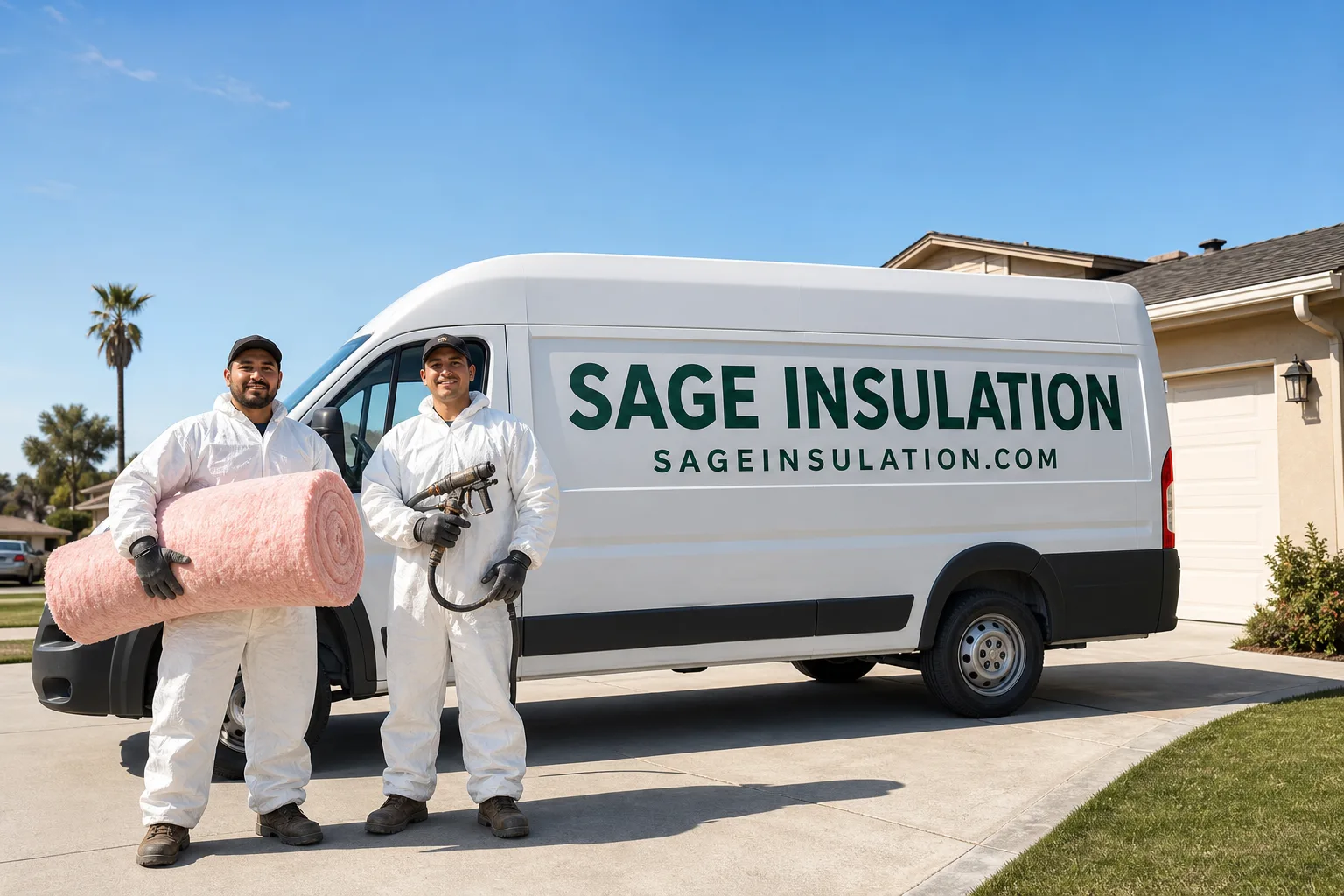
Fast, Reliable Spray Foam Insulation Across Echo Park
Spray foam insulation in Echo Park typically costs $3.50 to $7.00 per board foot installed, with most whole-attic projects landing between $4,800 and $11,000 depending on whether you choose open cell or closed cell. We get calls from Echo Park homeowners every week, and most jobs are scheduled within 3 to 5 business days. If you’re dealing with a 1920s bungalow on a hillside off Echo Park Avenue or a courtyard unit near Sunset Boulevard, the insulation challenges are specific to this neighborhood’s pre-war housing stock and steep topography. Call Alan Herrera at Sage Insulation at (855) 360-9333 for a free estimate and an honest assessment of what your home actually needs.
Why Sage Insulation Is Echo Park’s Preferred Spray Foam Insulation Company
Echo Park homes are not like the tract housing you find in the Valley or the newer builds south of the 10. Most of what we work on here was framed between 1900 and 1935, when wall cavities were left empty and attics were an afterthought. Our crews know what that means in practice: irregular joist spacing, piecemeal remodels that left behind awkward framing, and knob-and-tube wiring still live in the walls. That’s also why we carry both Icynene and Demilec foam systems. Being brand-agnostic means we recommend the formulation that performs best in a given cavity or roofline, not whichever product we happen to have the most of in the truck.
Alan Herrera has built Sage Insulation’s reputation around this approach. Homeowners in Echo Park call us because someone on their block already used us, saw the difference on their energy bill, and passed our number along. That kind of word-of-mouth matters in a neighborhood this tight-knit. We’re based in Downey but we’re in Echo Park multiple times a week, and our scheduling team can usually have a crew out for an assessment within a few days of your call. For more background on our methods and materials, see our main Spray Foam Insulation page.
Closed Cell Spray Foam Insulation in Echo Park
Closed Cell Spray Foam Insulation is the workhorse for Echo Park hillside homes where the “attic” is really a downslope crawlspace that opens onto the foundation. It cures into a rigid foam roughly R-6.5 per inch, adds structural rigidity to old framing, and acts as both an air barrier and a moisture barrier in a single application. Homeowners on Echo Park’s steeper streets regularly choose it because it holds up in the damp, low-ventilation crawlspaces that open downslope, and because it doesn’t sag or settle the way batt insulation does when installed from below. Closed cell jobs in Echo Park typically run $5.50 to $7.00 per board foot, which is the higher end of spray foam pricing but justified by the performance gain in a tricky cavity.
Structural reinforcement for aging roof decks
Echo Park’s pre-war bungalows often have roof decks assembled from old-growth lumber, but decades of heat and dry rot have left them flexing. Closed cell foam bonds to the underside of the roof deck and adds significant rigidity, which matters on the hillside streets off Glendale Boulevard where roof replacement is a six-figure proposition. We tell homeowners this up front because it’s a real benefit, not a sales line.
Moisture control in downslope crawlspaces
When the only attic access is a door near the foundation on the downhill side, moisture management becomes the central concern. Closed cell foam’s vapor-impermeable structure keeps damp canyon air from condensing against the underside of the roof sheathing. That’s a genuine difference-maker in Echo Park, where the canyons trap humidity at certain times of year even as the afternoon heat bakes the roof side.
Open Cell Spray Foam in Echo Park
Open Cell Spray Foam is the better fit for Echo Park attic spaces with conventional access, where the priority is air sealing and sound dampening rather than moisture exclusion. It expands aggressively to fill irregular cavities, which is exactly what you need in a 1920s Echo Park attic that’s been remodeled three times and no longer has clean joist bays. Open cell runs about $3.50 to $4.75 per board foot in Echo Park, and for a typical bungalow attic ceiling that usually translates to $3,200 to $5,800 before any prep work. It’s the right call when the attic has standard top-side access and the main performance gaps are air leaks and uneven temperature between rooms.
Air sealing for drafty pre-war attics
Echo Park’s older homes leak air around every ceiling penetration: recessed lights, plumbing vents, and the gaps where mudsill meets framing. Open cell foam fills these voids and stops the chimney effect that pulls heated or cooled air up and out. Homeowners on streets like Lemoyne or Scott often notice the difference in the first week, especially during Santa Ana events when dry winds press against every gap in the building envelope.
Sound control for courtyard apartments
Shared walls in Echo Park courtyard apartments mean your neighbor’s music is your music. Open cell foam applied to the ceiling cavity or interior wall cavities cuts airborne noise transmission significantly. It’s not soundproofing, but it’s a measurable improvement that makes a real difference in a 1920s fourplex with lath-and-plaster walls.
Trusted Brands We Service in Echo Park
Sage Insulation stocks materials from eight manufacturer brands, and for Echo Park homes we most frequently work with Icynene for both open and closed cell applications, Demilec when the spec calls for a higher-density closed cell formulation, and Rockwool as a companion product for cavity insulation in remodels. We carry these brands because Echo Park’s housing stock varies wildly from one block to the next, and a single-brand contractor will always recommend the one thing they sell. We’d rather match the product to the problem. For Echo Park customers, that means we can usually keep material lead times short and avoid the multi-week waits that come with special-order insulation products.
Common Spray Foam Insulation Problems We See in Echo Park Homes
- Spraying over live knob-and-tube wiring in pre-war walls. This is a genuine fire hazard and a code violation if discovered. In Echo Park’s 1900s to 1930s housing, we identify and isolate any active knob-and-tube circuits before foam ever touches the cavity.
- Poor adhesion on irregular, piecemeal-remodeled attic framing. Echo Park attics are rarely clean rectangles. Dust, old plaster residue, and mismatched framing members need substrate prep before foam application, or you end up with voids and de-lamination that go unnoticed until the first big heat wave.
- Open cell foam in downslope crawlspaces without addressing moisture. On Echo Park’s hillside lots, the “attic” that opens onto a downslope crawlspace needs a moisture strategy first. Open cell is vapor-permeable and can trap dampness against framing if the intrusion source isn’t handled.
- Ignoring the Santa Ana wind effect on exterior penetrations. Echo Park gets gusts that find every gap in the building envelope. Foam that’s applied without addressing the rim joist and sill plate areas leaves the home leaky on exactly the days when drafts matter most.
Pricing for Spray Foam Insulation in Echo Park, CA
Here’s what we’re seeing in Echo Park as of 2025. Open cell spray foam on a standard attic ceiling runs $3.50 to $4.75 per board foot. Closed cell spray foam runs $5.50 to $7.00 per board foot, with the higher end applying to downslope crawlspace work that requires more prep and masking. A full attic air-seal and open cell application in a 90026 bungalow typically lands between $3,200 and $5,800. Closed cell rim joist work, which we recommend for Echo Park homes with raised foundations, usually runs $1,800 to $3,400. The variables are access, cavity condition, and the presence of legacy wiring that needs isolating. Call (855) 360-9333 and Alan Herrera will give you an exact quote for your house. Estimates are free, and we’ll tell you honestly if spray foam isn’t the right fit for your specific situation.
We Also Serve Cities Near Echo Park
Sage Insulation works throughout the neighborhoods around Echo Park, including Silver Lake, Los Angeles, Koreatown, and Hollywood. Each area has its own housing stock and insulation challenges, and we treat them that way. For a broader look at how we approach this neighborhood specifically, see our Echo Park page.
Serving Echo Park, CA — Our Local Coverage Area
We’re based in the Echo Park area and know this community well. Use the map below to see our service coverage — if you’re nearby, we can almost certainly help.
FAQs About Spray Foam Insulation in Echo Park
Yes. This is actually one of the most common situations we handle in Echo Park. On hillside streets, the attic often opens onto a downslope crawlspace rather than a standard top-side hatch, so we insulate from below instead of above. The key is choosing a formulation that performs well in that orientation. Closed cell foam is typically the better fit for these downslope crawlspaces because it adds rigidity and acts as a moisture barrier, and because it doesn’t sag or settle when applied to an overhead surface from underneath. Open cell can work but requires careful moisture management first. Call (855) 360-9333 and we’ll walk you through what your specific access looks like and what it means for material selection.
Yes, and this is the single most common complaint we hear from Echo Park courtyard apartment owners. The canyons trap heat during the day, and uninsulated attics and walls let that heat radiate downward into living spaces well after sunset. Spray foam air seals the ceiling plane and slows heat transfer through the roof deck, which directly addresses the afternoon heat gain problem. Open cell foam in the attic cavity is usually the most cost-effective approach for courtyard apartments with standard access. You’ll feel the difference fastest in the top-floor units, which take the brunt of the afternoon sun. Call (855) 360-9333 for a free assessment and we’ll tell you exactly what your building needs.
Get the wiring evaluated before any foam goes in. Spray foam applied directly over live knob-and-tube wiring is a fire hazard and will fail inspection if discovered. In Echo Park’s 1900s and 1920s housing, we still find active knob-and-tube circuits regularly, especially in wall cavities and under floors. The right sequence is: have an electrician assess and decommission any active legacy circuits, then spray foam. We recently sprayed closed cell foam in a 1920s bungalow on a hillside street near Elysian Park where our tech found active knob-and-tube wiring running through the joists. We masked and isolated those circuits before applying Icynene closed cell foam to the underside of the roof deck. The homeowner noticed fewer drafts during the next Santa Ana event and a real drop in afternoon heat gain. That’s the way it should be done. Call (855) 360-9333 and Alan Herrera can talk you through the sequence for your home.
For Echo Park’s downslope crawlspaces, closed cell is usually the better choice. These spaces are damp by nature, especially on hillside lots where groundwater follows the slope and collects near the foundation line. Closed cell foam is vapor-impermeable and won’t absorb moisture, which means it protects framing rather than trapping dampness against it. Open cell foam is vapor-permeable, and if there’s any ongoing moisture intrusion, it can hold that moisture against the wood and accelerate rot. If your crawlspace is dry, has proper drainage, and the goal is mainly air sealing, open cell can work. But for the typical Echo Park hillside crawlspace, we recommend closed cell. Call (855) 360-9333 for a site visit and we’ll assess your specific conditions.
Spray foam is one of the most effective materials available for reducing Santa Ana wind drafts, because it seals the gaps that winds exploit. Echo Park gets strong dry gusts that press against the building envelope and find every crack around rim joists, sill plates, and ceiling penetrations. Batt insulation doesn’t stop airflow; spray foam does. The material expands to fill the cavity and creates a continuous air barrier, which means the drafts that show up during a Santa Ana event are dramatically reduced. For maximum effect, we focus on the rim joist and sill plate areas in raised-floor bungalows, plus the attic ceiling plane. Call (855) 360-9333 and we’ll identify where your home is most vulnerable to wind-driven air leakage.
Written by Alan Herrera, Owner at Sage Insulation, serving Echo Park and greater Los Angeles.