
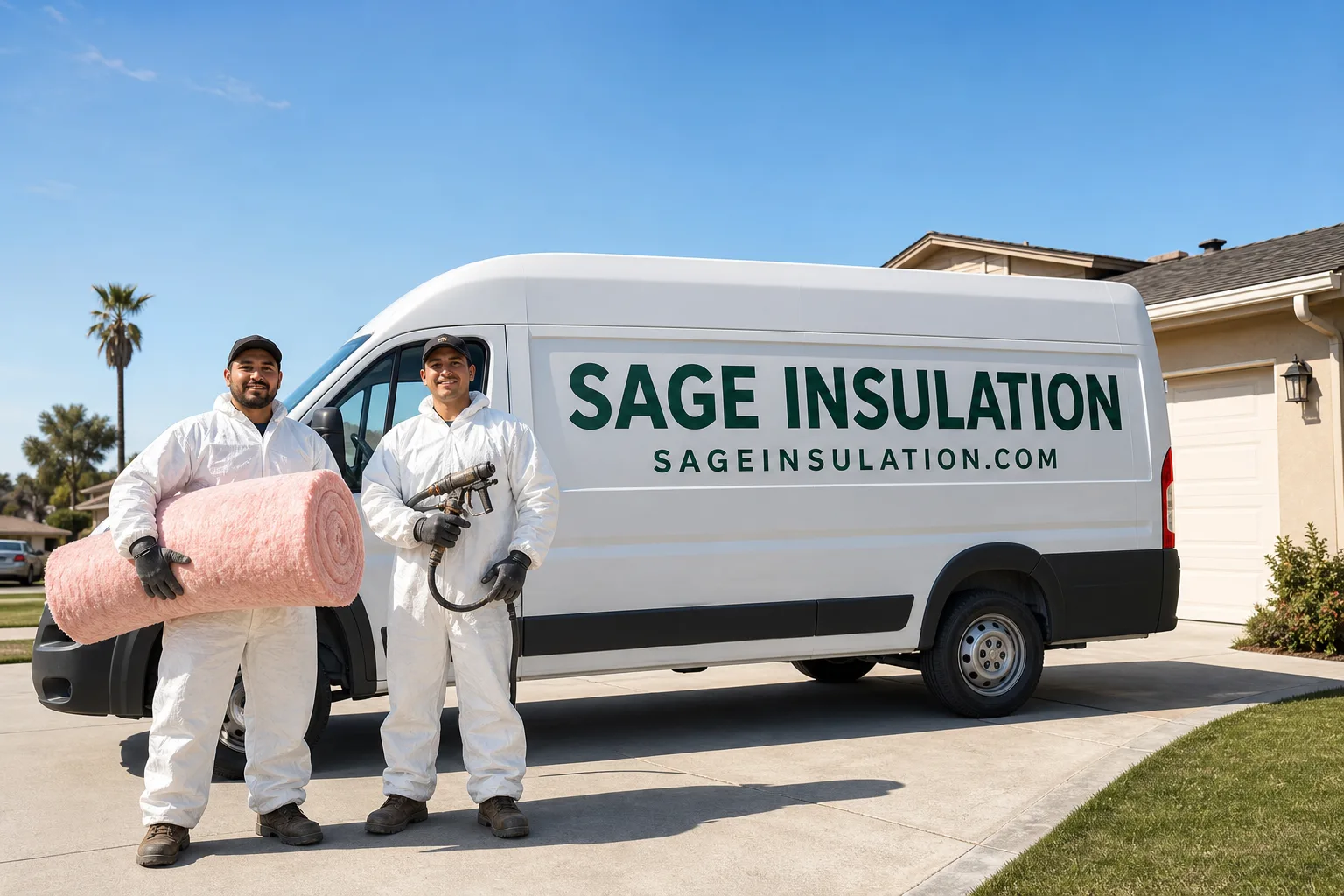
Fast, Reliable Spray Foam Insulation Across Koreatown
Spray foam insulation in Koreatown solves one problem faster than any other method: heat moving through building cavities where conventional insulation can’t reach or won’t seal. In the neighborhood’s dense mix of 1960s – 1980s courtyard apartments and mid-rise buildings, that usually means the flat roof deck or a shallow ceiling plenum above occupied units. We’re in and out of Koreatown regularly from our Downey base, and our crews know the parking constraints, the service elevators, and the building managers’ scheduling realities along Western, Vermont, and Wilshire. If you’re dealing with second-floor tenants baking under a flat roof, or your own upstairs rooms won’t hold cool air, call Alan and our team at (855) 360-9333 for a straight answer.
Why Sage Insulation Is Koreatown’s Preferred Spray Foam Insulation Company
Most Koreatown landlords we talk to have already had one insulation contractor tell them to blow fiberglass into a ceiling that has no attic. That’s the wrong conversation. There is no single correct material; there is a correct material for the specific roof, wall, and wiring configuration in front of us. Sage Insulation carries both Icynene and Demilec spray foam systems, open-cell and closed-cell, and we also install Rockwool, CertainTeed, and Knauf products when a hybrid approach makes more sense. We’re not tied to one manufacturer’s program, so the recommendation you get is driven by the building, not by what we have most of in the warehouse.
Koreatown work is different from single-family suburb work. We’ve foamed ceiling cavities from the roof deck on occupied 1970s courtyard buildings off Western, and we’ve air-sealed rim joists on 1920s bungalows near Hobart Boulevard where knob-and-tube wiring was still live in the wall. Our team led by Alan Herrera knows when to flag electrical work before foam touches it, and when to call in a structural review before adding closed-cell to a flat roof that was never detailed for it. We respond to Koreatown calls same day or next morning, and we quote honestly, by the square foot, based on the actual cavity depth and access situation.
Rim Joist Spray Foam in Koreatown
Rim joist spray foam in Koreatown is the highest-value upgrade for older single-family bungalows and duplexes, particularly the 1920s – 1940s stucco homes scattered between the apartment blocks. The rim joist is the horizontal framing member where your floor framing meets the foundation wall. In Koreatown’s mild climate it’s less about freeze protection and more about stopping dusty crawl space air, musty smells, and rodent pathways from moving into living space. Two-component closed-cell foam applied to each joist bay seals the gap and adds R-value in one pass.
When A Rim Joist Job Is The Right Call
A homeowner in Koreatown should look at rim joist spray foam when floors feel drafty in winter, when crawl space odor shows up inside, or when utility bills stay high despite attic work already being done. In homes off 8th Street or near Wilshire Place, rim joists are often the last unsealed boundary in the building envelope, and air leakage through the rim can equal the leak through all the windows combined.
What To Expect On The Day
Our crew moves furniture away from the crawl space entry, lays down poly, and foams each bay from inside the crawl space. We check first for knob-and-tube wiring running through the rim area; in older Koreatown homes it’s still common. A typical Koreatown bungalow runs $800 – $1,500 for a full rim joist treatment, with the range driven by access and whether wiring needs to be addressed first.
Crawl Space Spray Foam Insulation in Koreatown
Crawl space spray foam insulation in Koreatown gets specified most often on those same 1920s – 1940s bungalows and duplexes where a vented dirt crawl space is letting in air that smells like the ground beneath it. The job involves applying closed-cell foam to the crawl space walls and, in many cases, the subfloor above, then sealing or conditioning the space so it doesn’t function as an open air source under the house. In a dense block off Vermont, that means working in a tight space with low clearance, and we’ve done enough of them to know what fits and what doesn’t.
Walls Versus Subfloor
Foaming the crawl space walls turns the crawl into a semi-conditioned buffer zone, which helps when ducts run through it. Foaming the subfloor above is the better option when the space has major moisture problems or when ducts aren’t a factor. In Koreatown’s dry summers the wall approach usually performs better, but every house gets its own reading before we recommend either one.
Cost And Lead Time
A typical crawl space spray foam job in Koreatown runs $2,200 – $4,800 depending on square footage, headroom, and whether the existing venting gets sealed or upgraded. Add $300 – $600 if we need to remove old, rodent-damaged fiberglass first. We quote it all upfront and the estimate is free.
Trusted Brands We Service in Koreatown
Sage Insulation installs spray foam from both Icynene and Demilec, which gives Koreatown property owners a real choice between open-cell and closed-cell chemistries, and lets us match foam to the specific roof or wall configuration rather than forcing one product onto every job. For hybrid applications, we also carry Rockwool mineral wool and CertainTeed fiberglass, along with Knauf insulation products. We stock the common foam and ancillary materials in our Downey yard and bring what a Koreatown job needs the same day. If your project calls for a brand outside our regular van stock, we can usually have it on site within two business days. That’s the practical advantage of working with an installer who isn’t locked into one manufacturer’s supply chain.
Common Spray Foam Insulation Problems We See in Koreatown Homes
- Foam over knob-and-tube wiring: In pre-1950 Koreatown bungalows, knob-and-tube is still live behind walls and in ceiling plenums. Spraying foam directly over it traps heat and creates a code violation. We identify and flag it before the hose comes out, and often recommend an electrician’s review first.
- Shallow ceiling plenums packed with ductwork: Many 1960s – 1980s apartment buildings near 6th and Western have barely 12 – 18 inches of space above the ceiling, most of it duct runs and old wiring. Foam can go in, but it has to be phased around the mechanicals, not sprayed blindly.
- Flat roof moisture traps: On courtyard apartment buildings, closed-cell foam against the underside of a flat roof can trap moisture if the roof has leaks or no proper drainage detailing. We inspect the roof condition before recommending foam on the deck.
- Vented crawl spaces left open: We see foam applied to crawl space walls while the foundation vents stay open, which undoes the air-sealing benefit. The vents need to be addressed as part of the same job.
Pricing for Spray Foam Insulation in Koreatown, CA
Closed-cell spray foam in Koreatown runs $1.10 – $1.80 per board foot installed, and open-cell comes in at $0.45 – $0.80 per board foot. A rim joist job on a typical bungalow lands between $800 and $1,500. Crawl space work runs $2,200 – $4,800. A roof-deck or ceiling-cavity retrofit on a mid-size courtyard apartment building starts around $6,500 and can climb past $20,000 depending on the square footage, access from above, and how much fire-blocking and wiring re-routing is needed. What moves the number: job size, foam type, cavity depth, and how much preparation work the building demands. Call (855) 360-9333 and we’ll give you a firm per-square-foot quote after a site visit. Estimates are always free.
We Also Serve Cities Near Koreatown
Our crews work across the LA basin from our Downey yard. Beyond Koreatown, we handle Spray Foam Insulation work in Los Angeles, Echo Park, Silver Lake, and Hollywood. If your building sits outside the 90005 zip code but within a mile or two of Wilshire, chances are we’re already working nearby.
Serving Koreatown, CA — Our Local Coverage Area
We’re based in the Koreatown area and know this community well. Use the map below to see our service coverage — if you’re nearby, we can almost certainly help.
FAQs About Spray Foam Insulation in Koreatown
Yes, we do this regularly, and it’s one of the cleanest retrofit paths for occupied buildings. On a 1970s courtyard building off Western near 6th, second-floor tenants had complained for two summers about ceilings baking under a flat roof, and the shallow plenum above was packed with old ductwork and knob-and-tube-era wiring. Our crew worked from the roof deck, foaming the ceiling cavity after re-routing what we could reach and installing fire-blocking at the unit separations per code, then closed the deck. The following August the upstairs complaints stopped. Most of these jobs can proceed while tenants stay in place because access is from above, not through units. Call (855) 360-9333 to schedule a roof-deck inspection.
Because most Koreatown courtyard buildings don’t have a real attic. There’s a shallow plenum, often 12 – 18 inches deep, already full of ductwork and wiring. Blown fiberglass or cellulose doesn’t seal the air gaps and can’t be evenly distributed in a cavity that tight. Spray foam expands into the irregular space, air-seals while it insulates, and handles the radiant heat coming down from a flat roof much better than loose-fill. For second-floor heat complaints specifically, closed-cell foam on the underside of the roof deck is the direct fix. A site visit confirms the cavity depth and roof condition before we recommend it.
We stop and flag it. Knob-and-tube is still present in a meaningful share of pre-1950 Koreatown homes, and spraying foam directly over it can trap heat and create a fire hazard. We don’t foam over live knob-and-tube, period. We identify what’s visible in the rim joist or crawl space, note its condition, and either coordinate with a licensed electrician before proceeding or re-route the work to avoid the wiring altogether. In practice, most Koreanatown rim joist jobs we do have at least one bay where we adjust the plan around legacy wiring.
Yes. Title 24’s insulation and air-sealing requirements apply to re-roofing and major remodels, and spray foam’s air-sealing performance often satisfies the envelope provisions that loose-fill can fail. On occupied courtyard buildings, a from-the-roof ceiling-cavity retrofit addresses both the insulation minimums and the air-leakage tests that inspectors check for. We keep our work documented to the code requirements in force at the time of the job. If you’re planning a re-roof on a Koreatown building in the next 18 months, get us involved before the roofing contractor locks the scope; the foam and the roof usually need to be coordinated as one assembly.
In Koreatown, the first job that pays off is almost always the roof deck or ceiling cavity on the top floor, because the neighborhood’s density holds heat at night and the flat roofs radiate it down into living space throughout the summer. The heat-island effect means top-floor units keep gaining heat after the sun sets, so insulation at the roof plane does more than any wall work. We prioritize roof-deck and ceiling-cavity retrofits for Koreatown landlords and homeowners before wall or rim joist work, unless the specific building has a different pain point. It’s a local pattern we’ve seen repeat across the 90005 zip code.
Written by Alan Herrera, Owner at Sage Insulation, serving Koreatown and greater Los Angeles from our Downey headquarters.