
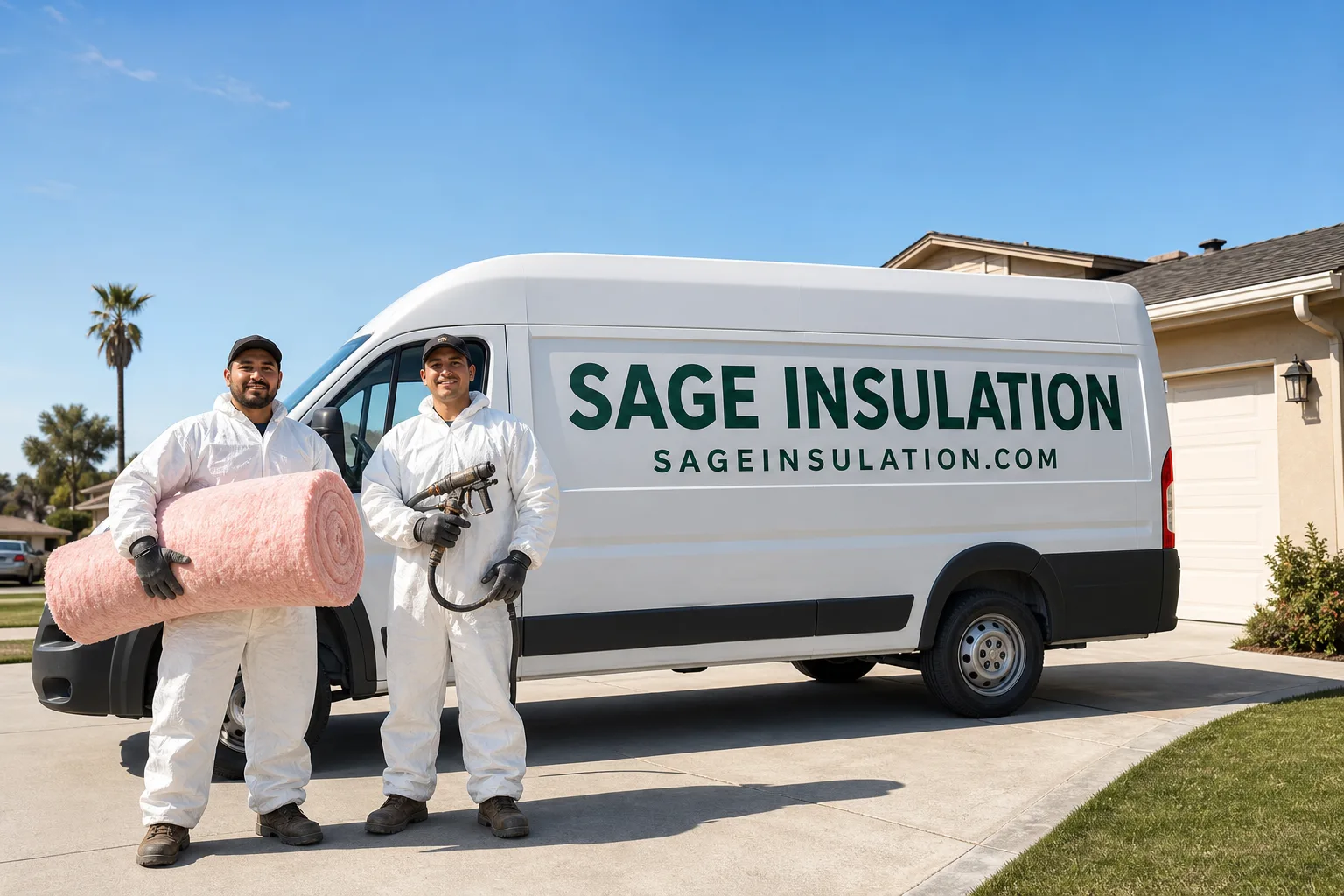
Fast, Reliable Spray Foam Insulation Across San Marino
Spray foam insulation in San Marino costs $2.40 – $7.20 per board foot installed, translating to roughly $3,800 – $9,500 for a typical attic and $8,000 – $18,000 for full wall insulation on a 2,500 sq ft home. Most jobs in San Marino take one to three days, and we can usually get a crew to your property within 5 – 7 business days. If you’re tired of rooms that won’t hold temperature or energy bills climbing each summer, call us at (855) 360-9333. We know the homes here, and we know what they need.
Sage Insulation has been insulating homes across the San Gabriel Valley from our Downey headquarters for years. San Marino’s housing stock is unlike anything in neighboring San Gabriel or Alhambra: original plaster walls, historic facades, and attics that haven’t seen insulation since the Eisenhower administration. We treat every San Marino project as a preservation job first and an insulation job second.
Why Sage Insulation Is San Marino’s Preferred Spray Foam Insulation Company
San Marino homeowners call us because we understand what the Cultural Heritage Commission expects before a single hole is drilled. Our crews have worked on Spanish Colonials in Oak Knoll, Mediterranean revivals near Lacy Park, and traditional estates off Huntington Drive. We know which streets fall under design review, what documentation the city wants for exterior penetrations, and how to insulate without altering the sightlines your home has held since the 1920s.
Alan Herrera has built Sage Insulation around a material-agnostic approach that matters deeply in San Marino. We carry Icynene, Demilec, Knauf, Rockwool, CertainTeed, Owens Corning, Johns Manville, and GreenFiber because no two San Marino homes respond the same way to the same product. A 1927 Spanish Colonial with solid plaster walls needs a different foam chemistry than a 1960s ranch with drywall and a vented attic. We install both open-cell and closed-cell systems and recommend the one that fits your walls, your wiring, and your preservation constraints, not the one we have the most of in the warehouse. Our Spray Foam Insulation team handles everything from attic lifts to full wall retrofit injection.
When you call, we answer. Our response time to San Marino is consistently under a week for standard assessments, and we handle urgent condensation or rodent-damage cases faster. We’re licensed, insured, and bonded, and we carry products with manufacturer warranties from Icynene and CertainTeed that add protection beyond our installation guarantee.
Spray Foam Attic Insulation in San Marino
Spray Foam Attic Insulation in San Marino typically involves lifting old loose-fill or fiberglass batts, verifying the condition of any legacy wiring, and applying either open-cell foam to the roofline or closed-cell to the attic floor. In San Marino, most pre-1955 homes have attics with original wood sheathing and decades of accumulated dust, animal intrusion, or failed insulation. A full attic treatment for a 1,500 – 2,000 sq ft San Marino home runs $4,200 – $8,600 depending on foam type and access.
Preserving Attic Ventilation While Air Sealing
San Marino’s warm, dry summers push attic temperatures above 130°F. Closed-cell foam on the roofline drops that radiant load dramatically, but it also changes how your attic breathes. On homes with original gable vents and no soffit intake, we often recommend a hybrid approach: open-cell foam on the roofline with a vapor management strategy suited to our cool, damp winters. The goal is comfort without trapping the moisture that condenses inside older roof assemblies.
Knob-and-Tube Wiring and Foam Compatibility
Many San Marino attics still contain active knob-and-tube circuits. Spray foam should not be applied directly over live K&T wiring; it traps heat and creates a fire hazard. Before we run any foam in a pre-1950 San Marino attic, we document what’s up there and coordinate with a licensed electrician if circuits need to be decommissioned or rerouted. This step adds time but it’s not optional.
Spray Foam Wall Insulation in San Marino
Spray Foam Wall Insulation in San Marino is almost always an injection retrofit. Your solid plaster walls from the 1920s and 1930s have no stud cavities we can just stuff with batts. The preferred method is drilling penny-sized holes through exterior stucco at each stud bay, injecting low-expansion foam from Icynene or Demilec, then patching the holes with color-matched texture. Expect to pay $8,000 – $18,000 for a full-home wall retrofit, with most San Marino jobs falling between $10,000 and $14,000.
Small-Hole Injection That Preserves Original Plaster
This is where San Marino’s review process dictates the method. The Cultural Heritage Commission doesn’t want visible exterior penetrations or altered stucco profiles. We drill from the exterior at hidden or less conspicuous locations, inject slowly to avoid the pressure that cracks brittle 1920s plaster, and patch with care. On a 1928 Spanish Colonial in the Oak Knoll neighborhood, our crew injected Icynene spray foam through penny-sized holes drilled into the exterior stucco to insulate solid plaster walls without disturbing original moldings. The homeowner had noticed winter drafts and condensation, and the hidden retrofit eliminated both while preserving the home’s historic character.
Closed-Cell vs. Open-Cell for Solid Plaster Walls
Closed-cell foam offers higher R-value per inch and acts as a vapor barrier, which matters in San Marino’s cool, damp winters. Open-cell foam is more forgiving and allows moisture to move through the assembly. For most solid plaster walls in San Marino, we lean toward open-cell at lower expansion pressure because it reduces the risk of plaster blowout. Each wall gets evaluated for moisture exposure, existing paint permeability, and whether the home is on a raised foundation or slab.
Trusted Brands We Service in San Marino
Sage Insulation installs and services spray foam systems from Icynene and Demilec, two of the most respected foam manufacturers in residential insulation. We also carry Knauf and Rockwool for hybrid projects where foam alone isn’t the right call, and CertainTeed for fiberglass transition work. Because we’re not locked into a single manufacturer’s installer program, we can recommend the right product for your home’s construction era, not the product that earns us the biggest rebate. For San Marino customers, that usually means an Icynene open-cell for wall injection and a Demilec closed-cell for rim joists and roof decks.
Common Spray Foam Insulation Problems We See in San Marino Homes
- Foam pushed too fast cracks historic plaster. San Marino’s 1920s plaster is brittle, and inexperienced crews inject at high pressure, causing spider cracks across original walls. We use low-pressure injection and staged lifts to let the foam expand gently.
- Condensation builds behind foam in winter. Cool, damp winters mean moisture can collect between spray foam and original single-wall construction if the vapor profile is wrong. We assess each wall’s permeability before choosing an open-cell or closed-cell system.
- Cultural Heritage Commission rejections delay projects. Visible exterior penetrations or altered stucco profiles can halt a permit. Our retrofit method uses small holes and texture-matched patchwork that typically satisfies design review the first time.
- Knob-and-tube wiring hidden behind foam creates fire risk. Pre-1950 San Marino homes often still have active K&T circuits. Foam applied over live wiring traps heat and violates code. We document and resolve wiring issues before any foam goes in.
Pricing for Spray Foam Insulation in San Marino, CA
A typical spray foam attic in San Marino runs $4,200 – $8,600. Wall injection retrofits span $8,000 – $18,000 depending on square footage, wall accessibility, foam chemistry, and any wiring remediation. Rim joist sealing runs $1,800 – $3,400. Garage ceiling spray foam runs $1,500 – $3,200. Roof deck encapsulation on a 2,000 sq ft home runs $7,500 – $12,000. San Marino pricing runs 10 – 15% above neighboring San Gabriel or Alhambra because preservation review and hidden-drill work add labor hours. Call (855) 360-9333 for a free estimate, and we’ll walk your specific home before quoting.
We Also Serve Cities Near San Marino
Sage Insulation covers San Marino and the surrounding San Gabriel Valley, including San Gabriel, East San Gabriel, Alhambra, and East Pasadena. If you’re just outside San Marino proper, our crews are likely already working in your neighborhood. Call (855) 360-9333 and we’ll confirm service coverage for your street.
Serving San Marino, CA — Our Local Coverage Area
We’re based in the San Marino area and know this community well. Use the map below to see our service coverage — if you’re nearby, we can almost certainly help.
FAQs About Spray Foam Insulation in San Marino
No, if it’s installed correctly. The method we use for San Marino’s solid plaster walls is low-pressure injection through small exterior holes, not high-pressure cavity filling. The key is choosing an open-cell foam with low expansion force and injecting in stages so the foam expands gently against the plaster’s back side. We’ve done dozens of injection retrofits on 1920s and 1930s San Marino homes without cracking original plaster. Call (855) 360-9333 for an assessment of your specific walls.
In many cases, yes, if the work involves visible exterior changes. San Marino’s design review process applies to homes with historic designation or those within review districts. Our small-hole injection method typically satisfies the Commission’s requirements because the penetrations are patched to match existing stucco texture and the home’s exterior character is unchanged. We can help you determine whether your project triggers review and prepare the documentation the city asks for. Call us at (855) 360-9333 to discuss your address specifically.
Not directly over live wiring. Knob-and-tube needs open air around it to dissipate heat, and spray foam traps that heat, creating a serious fire hazard. Before we insulate any pre-1950 San Marino attic, we inspect the wiring. If K&T is present and live, we coordinate with an electrician to decommission or replace those circuits first. Then we proceed with the foam. The added step costs a few hundred to a few thousand dollars depending on the circuit count, and it’s a hard requirement, not an upsell.
Spray foam’s air-sealing properties stop moist outdoor air from moving through the wall assembly in winter, which is the primary driver of condensation in San Marino’s solid plaster construction. In our cool, damp winter months, warm interior air meets cold wall surfaces and moisture collects inside the cavity. Closed-cell foam acts as a vapor barrier when the wall’s vapor profile calls for it, while open-cell foam allows drying to the interior. The key for San Marino is choosing the right foam for each wall’s exposure and construction, which is exactly what our assessment process is designed to determine.
Spray foam air-seals while it insulates, which addresses condensation and drafts, while blown-in cellulose primarily slows heat transfer. For solid plaster walls, foam injection is often the better fit because it fills irregular wall cavities and adds structural rigidity. Cellulose is a good choice for attics where you want to preserve ventilation and keep costs lower. We carry both, including GreenFiber recycled-content cellulose, and we’ll recommend the one that matches your home’s construction era and your energy goals. For a direct comparison on your specific home, call (855) 360-9333 for a free assessment.
Written by Alan Herrera, Owner at Sage Insulation, serving San Marino and the San Gabriel Valley.