
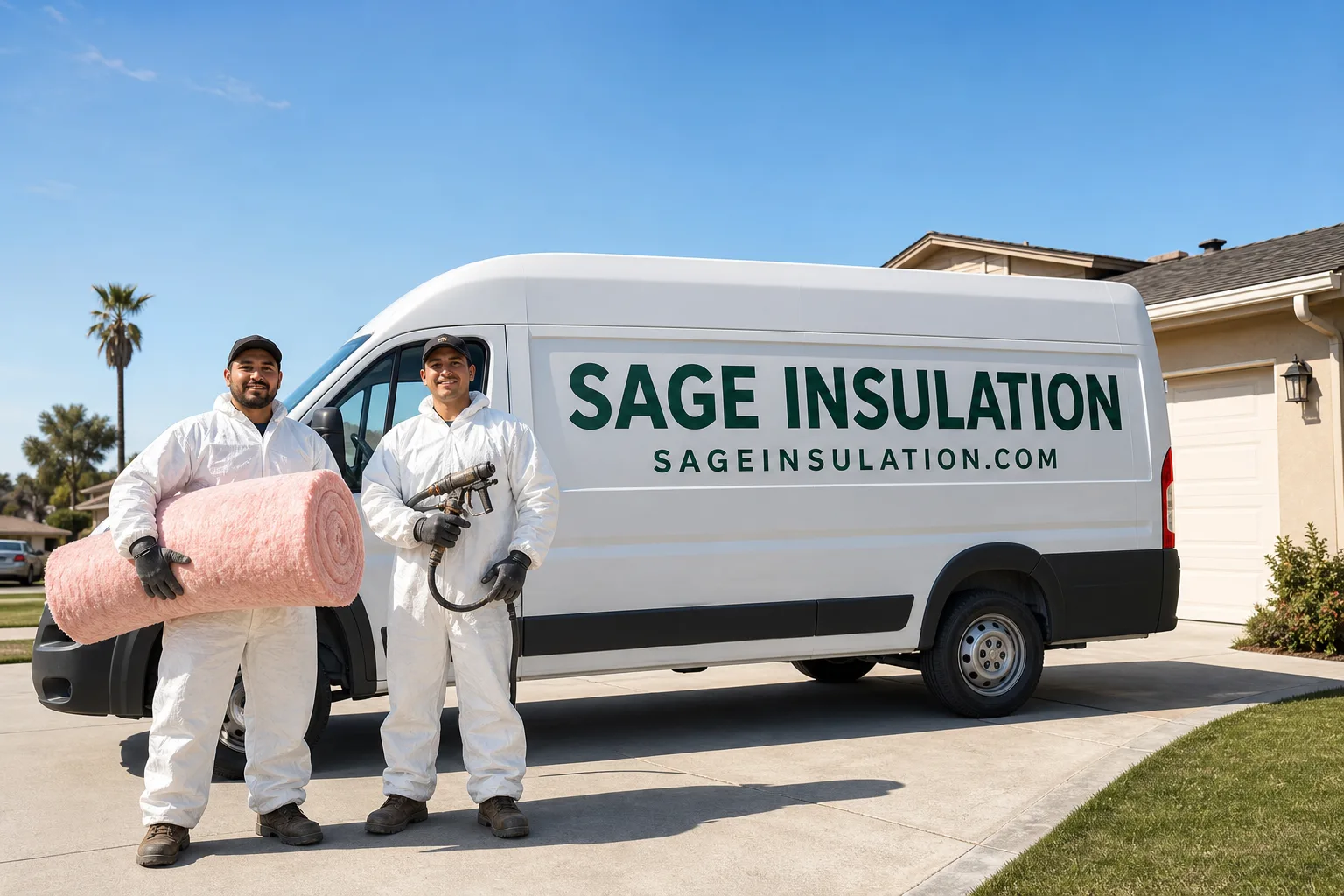
Fast, Reliable Spray Foam Insulation Across San Gabriel
Spray foam insulation in San Gabriel typically runs $2.50 to $6.50 per square foot depending on whether you need open-cell or closed-cell foam, and most attic roof deck jobs can be scheduled within a week. We’re Sage Insulation, led by Alan Herrera, and we work throughout the 91775, 91776, and 91778 zip codes. If your attic is baking your back bedrooms well past comfort every August, call (855) 360-9333 and we’ll walk you through what’s actually going on up there before any hoses get pulled.
Why Sage Insulation Is San Gabriel’s Preferred Spray Foam Insulation Company
We’re material-agnostic in a way that matters in San Gabriel. Your house off Del Mar Avenue wasn’t built with the same envelope as a 1990s two-story in Arcadia, so it shouldn’t get the same insulation prescription. We carry Icynene and Demilec spray foam systems, and we also install Rockwool mineral wool, Johns Manville fiberglass, and GreenFiber cellulose. That means when we recommend a roof deck foam instead of an attic floor top-up, it’s because the house calls for it, not because it’s the only product on our truck.
Our crews know the San Gabriel Mission District, the neighborhoods north of Valley Boulevard, and the grid of mid-century streets around Las Tunas Drive. We’ve corrected enough DIY attic work in this city to know that unpermitted additions leave open top plates and leaky duct chases. That’s inspection-heavy, detail-driven work. You don’t want a crew that’s running three jobs down in Long Beach and fitting you in.
When a homeowner in San Gabriel calls us, we schedule a diagnostic visit, not a sales pitch. We get into the attic, we look at what’s already there, we measure clearances, and we tell you the truth about what the house needs. That’s how Alan runs the company. No brand spiffs pulling the recommendation one way or another.
Spray Foam Attic Insulation in San Gabriel
Spray Foam Attic Insulation in San Gabriel is usually applied to the roof deck, not the attic floor, and that distinction matters more here than almost anywhere else in the San Gabriel Valley. Your 1950s single-story stucco home likely has a shallow, low-pitched vented attic already crowded with HVAC ducts. Foaming the floor would bury those ducts and make future repair work miserable. Foaming the underside of the roof deck moves the thermal boundary to the roofline, keeps the attic itself cooler, and leaves the attic floor accessible for duct maintenance.
A typical roof deck foam job in San Gabriel runs $3,200 to $6,800 for a 1,200 to 1,600 square foot home, with closed-cell foam trending toward the higher end because of the material cost. It’s the difference between an attic that hits 130°F by 2 p.m. in July and one that stays within a few degrees of the living space below.
Open-Cell vs. Closed-Cell on San Gabriel Roof Decks
Open-cell foam (we install Icynene’s open-cell system) is typically the right call for roof deck applications on vented San Gabriel attics that will remain vented. It’s an air seal and a thermal break, and it won’t trap moisture the way a closed-cell layer can on an older roof assembly that wasn’t designed for it. Closed-cell (Demilec) makes sense on rim joists, crawlspace walls, or anywhere you need moisture resistance and a higher R-value per inch. In a shallow attic, closed-cell buys you more R-value without eating more headroom, but it’s also about 40% more expensive per board foot.
What the Crew Actually Does Up There
The work starts with air-sealing the top plates, plumbing penetrations, and electrical boxes before any foam goes down. In San Gabriel’s older tract homes, the original top plates are often gapped and leaky. If you skip that step, you’re insulating a sieve. Then we protect flex ducts and check clearances, spray the deck in lifts, and verify the foam cures before anyone closes an access hatch. This isn’t a one-coat-and-drive-off job.
Spray Foam Wall Insulation in San Gabriel
Spray Foam Wall Insulation in San Gabriel answers a question most of these homes have shared since they were built in the 1940s and 1950s: the walls have either nothing in them or a thin, settled batt that’s done nothing for sixty years. Wood-frame stucco construction with no exterior insulation means every west-facing wall along Valley Boulevard heat-soaks through long San Gabriel summer afternoons and radiates into the house well past sunset. Foaming those walls with an injection or drill-and-fill approach changes how the interior holds temperature.
Wall cavity foam in San Gabriel typically runs $3.80 to $7.00 per square foot of wall area, depending on access and whether we’re working from inside or outside. On a 1,400 square foot house, that’s often a $5,000 to $9,000 scope. It’s not a cheap fix. It is, however, the only fix that directly addresses what these old walls actually lack.
Drill-and-Fill for Stucco Exteriors
Most San Gabriel wall jobs are drill-and-fill because we’re not tearing out plaster or stucco. Small access holes get drilled through the exterior stucco or interior drywall, foam is injected into each stud bay, and the holes get patched. Open-cell foam is typically the wall cavity choice here because it moves with the framing as the house expands and contracts through San Gabriel’s dry-season heat cycles. If there’s moisture concern on a wall that gets hit by irrigation overspray, we’ll talk about closed-cell instead.
When to Foam Walls vs. When to Prioritize the Attic
In San Gabriel, the attic wins almost every time. The radiant load through an under-insulated roof is far greater than what’s bleeding through the walls. We tell homeowners this order: roof deck first, then air-seal, then walls if there’s budget left. A wall foam job without the attic addressed is like fixing one leak in a boat and leaving the other one open. That’s the honest read, and it’s how we keep our reputation in San Gabriel.
Trusted Brands We Service in San Gabriel
We stock and install both Icynene and Demilec spray foam systems, which means we can match open-cell or closed-cell chemistry to the job instead of forcing one product line onto every San Gabriel attic. We also carry Rockwool, Johns Manville, and Owens Corning products for the jobs where spray foam isn’t the right material. That brand depth matters here because San Gabriel’s housing stock is so varied: a mid-century tract home off Mission Road doesn’t need the same foam formulation as a 1980s two-story by San Gabriel High School. We’re not tied to any manufacturer’s program, so the recommendation comes from the house, not a vendor agreement.
Common Spray Foam Insulation Problems We See in San Gabriel Homes
- Original rock wool or fiberglass that reads as “insulated” but delivers almost nothing. On a 1950s single-story stucco home off Las Tunas Drive, our crew found a shallow attic where the original compressed rock wool had settled to a thin mat, and the afternoon deck temperature was baking well past 130°F. We air-sealed the top plates and applied Icynene spray foam to the roof deck while protecting the crowded flex-duct runs, then verified the ducts were clear before closing out. The homeowner finally had a usable attic and a much cooler back bedroom.
- DIY or unpermitted attic additions that left open top plates and leaky duct chases. We see this constantly throughout San Gabriel’s post-war tracts: a previous owner ran new flex ducts, pushed the old insulation aside, and never sealed anything back up. Foam applied over those open chases just seals the leak into the conditioned space instead of tightening the envelope.
- Roof deck foam installed without accounting for low-pitch attic ventilation and duct clearances. In San Gabriel’s shallow attics, it’s easy to close off the soffit vents or trap heat around HVAC runs if the installer doesn’t know what they’re looking at. A proper deck job on a low-pitch roof means baffles at the eaves and real attention to where every duct runs.
- Homeowners springing for wall foam while the attic bakes. We’ve had calls from homeowners who paid for wall foam from another contractor and still can’t sleep in July. The attic wasn’t addressed. Thermal order matters: roof deck, air seal, then walls. In San Gabriel’s climate, skipping the roof deck is the most expensive mistake you can make.
Pricing for Spray Foam Insulation in San Gabriel, CA
Expect roof deck foam in San Gabriel to run $2.80 to $4.50 per square foot of roof area for open-cell, and $4.50 to $6.50 per square foot for closed-cell. Wall cavity foam runs $3.80 to $7.00 per square foot of wall area. A full attic roof deck job on a 1,300 square foot San Gabriel ranch usually lands between $3,500 and $6,500. What moves the number: attic height and access (low-pitch attics take longer), how much air-sealing is needed before spraying, whether existing insulation has to be removed first, and whether we’re protecting old ducts or replacing them. Estimates are free. Call (855) 360-9333 and we’ll give you a real number, not a “we’ll see what we find” range.
We Also Serve Cities Near San Gabriel
Our crews handle spray foam work across the San Gabriel Valley. In addition to San Gabriel, we regularly serve Spray Foam Insulation in San Gabriel neighbors in East San Gabriel, San Marino, Alhambra, and Rosemead. If you’re nearby and your attic is doing the same 130°F-deck routine, the same crew that knows these mid-century tracts will come take a look. Our full Spray Foam Insulation team is built around this specific housing stock.
Serving San Gabriel, CA — Our Local Coverage Area
We’re based in the San Gabriel area and know this community well. Use the map below to see our service coverage — if you’re nearby, we can almost certainly help.
FAQs About Spray Foam Insulation in San Gabriel
Because San Gabriel’s mid-century single-story stucco tract homes commonly have shallow, low-pitched vented attics already packed with HVAC ducts, so spray foam here is mostly applied to the roof deck and air-sealing the top plates rather than a full cavity fill. Foaming the floor would bury those ducts and make future HVAC work an expensive excavation. Foaming the deck keeps the attic within a few degrees of the house and leaves everything below it accessible. Call (855) 360-9333 if you want us to look at your specific attic.
It depends on what condition that old fiberglass is actually in. In most San Gabriel homes from the 1940s through the 1960s, the original material has settled to a fraction of its original R-value, and a top-up without air-sealing would just pile new material on top of a leaky envelope. We’ll crawl the attic, measure what’s there, and tell you honestly whether a top-up, a removal-and-foam, or a roof deck job makes sense. The diagnostic visit is free.
Yes, and that’s often the single highest-value part of the whole job. San Gabriel has a long history of owner-driven additions and remodels, which means a lot of unsealed top plates, open plumbing penetrations, and duct chases that pull hot attic air straight into the rooms below. We air-seal those before any foam goes down, then verify with a blower door test when the job calls for it.
We map every duct run before we start, mark the ones that need protection, and physically shield them during the spray. In a low-pitch San Gabriel attic, that means working in sections and verifying clearances the whole way through. When we finish, we check that every register still flows. It’s slower work, but it’s the only way to foam a deck without wrecking the HVAC system you’re trying to help.
It’s mostly a summer call. San Gabriel sits at the foot of the San Gabriel Mountains in a hot-summer Mediterranean climate, and the cooling load through an under-insulated attic matters far more than heating needs in December and January. That said, the same air-sealing that cuts the August heat also keeps the house from drafting on cold winter nights. It’s a year-round envelope improvement with a summer-heavy payoff. Call (855) 360-9333 for a free estimate and we’ll give you real numbers for your house.
Contact Sage Insulation today at (855) 360-9333 for a free estimate on spray foam insulation in San Gabriel. We’ll crawl the attic, show you what’s actually there, and give you an honest prescription. No pressure, no brand loyalty, just the right insulation for this home.
Written by Alan Herrera, Owner at Sage Insulation, serving San Gabriel and the surrounding San Gabriel Valley.