
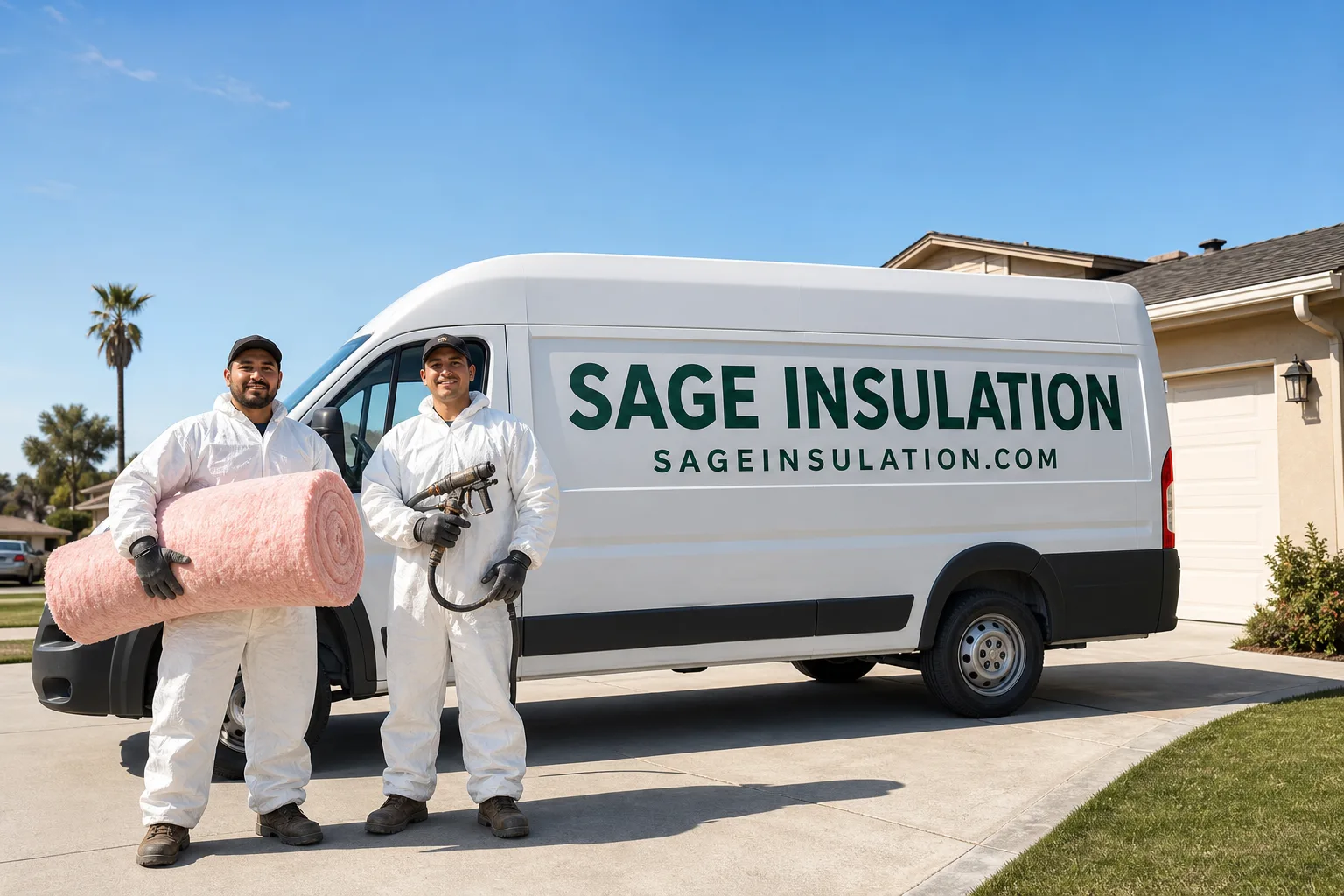
Fast, Reliable Spray Foam Insulation Across Glendale
Spray foam insulation in Glendale is rarely a clean new-construction spray. Most of the housing here dates from the 1920s through the 1960s, which means we’re working into low-slope roofs, raised-floor crawlspaces, and irregular unlined cavities where access and air sealing drive the spec more than R-value alone. If your Glendale home has rooms that won’t hold temperature, an HVAC system that runs through the afternoon dry heat, or a crawlspace drawing canyon air up through the floor, call us at (855) 360-9333 for a free estimate. We’re in Glendale weekly and know the housing stock block by block.
Why Sage Insulation Is Glendale’s Preferred Spray Foam Insulation Company
Glendale homeowners call us because we don’t default to one product line. We carry Icynene and Demilec spray foam systems, and we’re equally comfortable recommending open-cell for interior sound and air-sealing work or closed-cell where we need structural rigidity and a vapor barrier in a crawlspace. That matters in a city where the same street can have a 1920s Spanish Colonial on one lot and a 1960s apartment building on the next. Our crews have worked the Verdugo foothill streets above 91208, the flat-land bungalows around 91206, and the mid-century condo stock near 91203 and 91204. Alan Herrera, who leads our team, has spent years navigating Glendale’s permit specifics and the practical reality of spraying foam into cavities that were never designed for it.
Response time to Glendale from our Downey base runs same-day or next-day for most jobs, and our call volume from Glendale now accounts for a meaningful share of our Southern California spray foam work. We show up with the right rig for tight alley access and hillside streets, and we leave the site cleaner than we found it.
Garage Spray Foam Insulation in Glendale
Garage Spray Foam Insulation in Glendale usually means spraying the ceiling and shared wall cavities of an attached garage on a 1940s or 1950s house, where the garage sits under living space or against a finished interior wall. The garage door panels themselves are too thin to insulate meaningfully, but the ceiling above them and the wall between garage and house are where heat moves. In Glendale’s dry summer heat, a west-facing garage can hit 110 degrees by mid-afternoon, and that heat soaks through the ceiling into bedrooms above. We spray closed-cell Demilec or Icynene against the ceiling deck and rim joist to block that transfer, then air-seal the wall common to the house. A typical attached garage ceiling in Glendale runs $1,800 to $3,200 depending on square footage and whether we’re working around stored belongings. We also handle detached garage conversions where a homeowner wants the space conditioned for a workshop or ADU.
Attached garages with living space above
When a bedroom sits over a garage on a Glendale ranch or hillside split-level, the ceiling cavity is often nothing but exposed joists and a drywall lid. We spray closed-cell foam directly to the underside of the subfloor above, filling the joist bays and cutting both heat and exhaust fume transfer from the garage below. This also stiffens the floor assembly, which reduces that hollow, echoing feel homeowners notice in older garages.
Detached garage roofs and rim joists
A detached garage in Glendale that backs toward the Verdugo open space has a different failure mode: canyon rodents chewing through vent screens and nesting in the rafter space. Before we spray, we repair or replace the screens, check the roof deck for existing damage, and then foam the ceiling plane and rim joist to close the entry points. The result is a garage that stays 15 to 20 degrees cooler in August and stops shedding debris into the workbench.
Closed Cell Spray Foam Insulation in Glendale
Closed Cell Spray Foam Insulation in Glendale is the material we recommend for raised-floor crawlspaces, rim joists, and flat or low-slope roof decks where moisture and structural performance matter as much as heat resistance. Closed-cell foam carries an R-value around 6.5 to 7 per inch, adds shear strength to framing, and acts as a Class II vapor retarder. For a Glendale bungalow with an open crawlspace drawing damp canyon air into the floor system, closed-cell on the underside of the floor deck is the single best fix we can install. Typical closed-cell jobs in Glendale run $3,200 to $6,800 for a crawlspace, and $2,900 to $5,400 for a garage ceiling or attic roof deck, depending on the cavity depth and how much prep the framing needs.
Rim joist and crawlspace sealing
The rim joist is the band of framing where the floor system meets the foundation wall, and in Glendale’s raised-floor homes it’s the main air leak between crawlspace and living floor. We spray two to three inches of closed-cell into each rim bay, which cuts the stack effect, stops canyon air and dust from moving through the floor, and physically blocks the gaps rodents use to enter. After sealing, many Glendale homeowners notice the floor feels warmer in winter and the house stops smelling musty within a week.
Flat and low-slope roof decks
Glendale has thousands of flat-roofed Spanish Colonial and mid-century ranch homes where the attic is a tight, hot void between ceiling and roof membrane. Spraying closed-cell directly to the underside of the roof sheathing converts that attic into a semi-conditioned space, which drops heat gain through the ceiling below. But we flag one thing every time: if the roof assembly isn’t ventilated properly, foaming it can trap heat against the membrane. On low-slope Glendale roofs we always check the existing venting before we spray, and we adjust the spec for the Verdugo microclimate where Santa Ana afternoons push attic temperatures past 130 degrees.
Trusted Brands We Service in Glendale
Sage Insulation carries both Icynene and Demilec spray foam systems because open-cell and closed-cell are genuinely different tools for different jobs. For Glendale retrofit cavities where access is tight and moisture control matters, we lean on Icynene’s closed-cell formulation and Demilec’s HFO-blown low-GWP open-cell for interior sound and air-sealing work. We also install Johns Manville and Rockwool products where a non-foam or fire-rated layer is the right call, especially in Wildland-Urban Interface zones above 91208. Because we’re material-agnostic, our Glendale customers get a recommendation based on what the cavity needs, not what we have most of in the warehouse.
Common Spray Foam Insulation Problems We See in Glendale Homes
- Canyon rodent pressure in raised-floor crawlspaces. Homes backing the Verdugo open space have attics and floor cavities colonized by roof rats and squirrels. Old fiberglass gets matted and tunneled through, and vent screens fail. We rodent-proof first, then spray closed-cell to lock the cavity down.
- Open-cell foam in the wrong location. Some contractors spray open-cell under crawlspaces or against foundation walls where moisture accumulates, and it turns into a wet sponge that holds water against framing. We spec closed-cell below grade and open-cell only in dry, interior cavities, and we explain why at the estimate.
- Flat-roof heat gain that traps against the membrane. Foaming a low-slope or flat Glendale roof without addressing ventilation traps heat the Verdugo microclimate already stresses. We check existing vents and adjust the assembly before spraying, especially on 91208 hillside homes where attic temperatures spike in Santa Ana events.
- Full removal of good existing insulation that didn’t need to go. Glendale attics often have old fiberglass that’s still doing some work, and some crews insist on pulling everything before they’ll spray. We assess in place, and if the existing material is dry and uncompromised, we’ll spray around it rather than charge for removal the home didn’t need.
Pricing for Spray Foam Insulation in Glendale, CA
Open-cell spray foam in Glendale runs $1.20 to $1.80 per board foot installed, and closed-cell runs $1.80 to $2.60 per board foot depending on depth, access, and whether we’re working in a crawlspace or an attic. A standard attached garage ceiling runs $1,800 to $3,200. A raised-floor crawlspace sealed with closed-cell runs $3,200 to $6,800 for a typical 1,200 to 1,600 square foot home. A flat-roof attic retrofit runs $4,500 to $8,000 when we’re spraying the roof deck. The variables are cavity depth, prep work, whether we’re excluding rodents first, and WUI fire-capping requirements above 91208. Call (855) 360-9333 and Alan Herrera will give you a straight number based on your home, not a sales script.
We Also Serve Cities Near Glendale
Our crews work the entire northeast Los Angeles basin, and we regularly run jobs in Echo Park, Silver Lake, Hollywood, and South Pasadena. If you’re just outside Glendale and want the same material-agnostic approach to Spray Foam Insulation, call us. We’re also the team behind Spray Foam Insulation in Glendale and we’ll tell you honestly whether foam is the right tool for your house or whether a different material performs better for less money.
Serving Glendale, CA — Our Local Coverage Area
We’re based in the Glendale area and know this community well. Use the map below to see our service coverage — if you’re nearby, we can almost certainly help.
FAQs About Spray Foam Insulation in Glendale
Because the failure sequence starts with vent screens and gaps at the sill line, not with the insulation itself. Roof rats and squirrels come off the Verdugo open space, chew through aging screens on foundation vents, and nest in the fiberglass before you ever see signs inside. By the time you notice floor drafts or a musty smell, the insulation is usually matted, tunneled, and compromised. We repair the screens, seal the rim joist, and then spray closed-cell to close the entry points and the air pathway at once. Call (855) 360-9333 for an inspection; we’ll tell you if the problem is rodents, air leakage, or both.
Yes, and we do it regularly, but only after checking the existing attic ventilation. Closed-cell on the underside of a flat roof deck converts the attic into a semi-conditioned space and cuts heat gain through the ceiling below, which matters in Glendale’s July through September heat. If the roof has no exhaust venting, we adjust the assembly first; spraying without that check traps heat against the membrane and shortens the roof’s life. Call (855) 360-9333 for an assessment that tells you what your specific roof needs.
It does, but the foam itself isn’t the fire-rated layer. In the Wildland-Urban Interface zones along the Verdugo Hills, code requires foam assemblies to be capped at vents and penetrations with a fire-rated or mineral-wool layer that stops ember intrusion. We spec Rockwool or a rated ignition barrier at those points and integrate it into the spray foam assembly. Call (855) 360-9333 and we’ll walk you through what your specific hillside address requires.
By coordinating with the HOA and adjacent units before we spray, because clean foam lines matter when cavities are shared. We work partial-cavity jobs around 91203 and 91204 and always contain the spray to your unit’s boundary. If a neighbor has already had work done, we adjust our fill depth accordingly. Call (855) 360-9333 for a quote on your specific building; we’ll need to see the attic layout and your HOA’s retrofit rules.
No, and any contractor who says otherwise isn’t being straight with you. Spray foam fills the cavity behind the drywall, which means the drywall has to come down or we access the joist bays from above through the attic side. We do the removal and patching as part of the job, and in attached Glendale garages with living space above, the improvement is immediate: a ceiling that stops radiating heat into the rooms above within a day. Call (855) 360-9333 for a fixed price that includes the drywall work.
Written by Alan Herrera, Owner at Sage Insulation, serving Glendale and the surrounding communities with material-agnostic insulation expertise.