
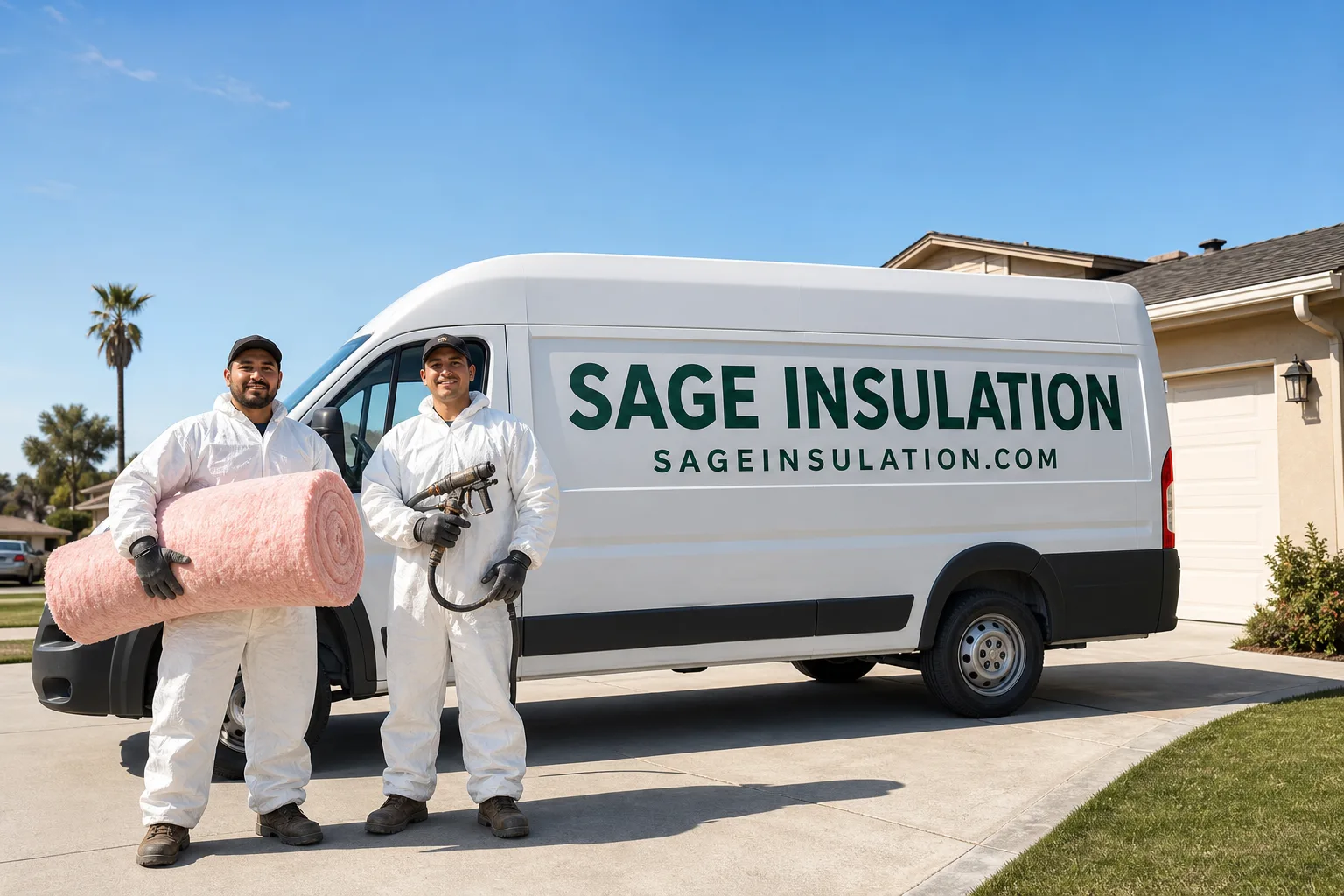
Fast, Reliable Spray Foam Insulation Across Hawthorne
Spray foam insulation in Hawthorne typically costs $2,400 – $7,800 for a full attic and wall package, and most jobs are completed in one to two days. If you live in the 90250 or 90251 zip code and hear jets overhead every few minutes, the right foam can quiet that roar while tightening the thermal envelope. We work in Hawthorne every week and know the tract houses, the additions, and the ways this city’s specific conditions punish under-insulated walls. Call us at (855) 360-9333 for a free estimate from a crew that actually understands Hawthorne homes.
Why Sage Insulation Is Hawthorne’s Preferred Spray Foam Insulation Company
Our crews have spent enough time in the 90250 flats to know what awaits inside a 1950s Hawthorne stucco box before we open the attic hatch. Homeowners around Holly Park, Ramona, and the streets off Hawthorne Boulevard have called us for the same recurring problem: rooms that swelter by 3 p.m., walls that radiate heat from the west sun, and a constant low drone from LAX that no double-pane window alone can fix. The Spray Foam Insulation work we do here leans heavily toward sound control because Hawthorne’s location under the flight path demands it.
Alan Herrera, who leads Sage Insulation, has built our Hawthorne reputation on one principle: diagnose before you spray. That’s why we don’t show up pushing a single foam chemistry. We carry Icynene and Demilec systems, open-cell and closed-cell, because a wall cavity facing afternoon sun near the 105 freeway needs something different from an attic in a shaded bungalow. We’re not married to one manufacturer’s program, which means the recommendation you get is based on what your home actually needs.
When a Hawthorne homeowner calls, our team can typically be on site within two days. That matters when a section of foam has delaminated from old roof sheathing or when a bedroom over the garage smells faintly of off-gassing from a botched previous install. We respond to the 90250 and 90251 areas directly, and our estimates are always free. No pressure, no product pitch before we understand the problem.
Spray Foam Attic Insulation in Hawthorne
Spray foam attic insulation in Hawthorne is the single most effective upgrade for homes that bake in the afternoon sun and sit under a steady stream of departures out of LAX. Most of the attics we enter in this city have settled fiberglass batts from the Reagan era, if they have anything at all. A 1,200-square-foot attic here typically costs $2,200 – $4,400 for open-cell foam sprayed to the underside of the roof deck, and the difference in both temperature and sound is immediate.
The job itself means clearing the attic, prepping the sheathing so foam adheres properly, and spraying an even lift across the roofline. In Hawthorne’s older tract houses, the prep work is everything. Decades of aircraft vibration and thermal cycling have loosened dust and debris, and foam that hits a dirty surface will delaminate within months.
What we use depends on the deck condition and whether you want to condition the attic or just insulate it. Open-cell foam is lighter, costs less, and does an excellent job muffling jet noise. Closed-cell adds structural rigidity and a vapor barrier, which matters in attics that trap marine moisture. In Hawthorne, we more often recommend open-cell up top paired with closed-cell in walls, because the acoustic benefit is real and you’re not paying for vapor-blocking performance the attic doesn’t require. Our crews carry both Icynene and Demilec lines, so switching between chemistries on the same job is routine, not an upsell.
Attic Air Sealing Before Foam
An attic spray in Hawthorne that skips air sealing is an expensive mistake. Every plumbing chase, every wire penetration, every gap around a flue or chimney lets marine air and aircraft noise leak into the living space. We seal those paths before foam touches the deck. In original 1940s and 1950s homes, the gaps around ceiling light fixtures are often substantial, and foam alone won’t close them. This prep step is the difference between a quieter home and a quieter attic with the same noise downstairs.
Radiant Heat on West-Facing Roof Decks
Afternoon sun on a Hawthorne roof deck can push attic temperatures past 130°F, even when the outdoor air never breaks 80. That heat radiates through the ceiling plaster for hours after sunset. Spray foam on the deck stops that transfer at the source, so rooms on the west side of a house – especially along Prairie Avenue or Inglewood Avenue – stop turning into ovens by late afternoon. Cooling load drops, and the AC doesn’t have to fight radiant gain every day from May through October.
Spray Foam Wall Insulation in Hawthorne
Spray foam wall insulation in Hawthorne is the upgrade that fixes two problems at once in homes that were built with empty exterior cavities. Most of the stucco-sided tract houses put up between 1940 and 1965 were framed with no wall insulation whatsoever – a cost-cutting decision that made sense before anybody imagined an airport expanding next door. Wall foam work here runs $2,600 – $5,400 for an average single-story home, and it’s the only retrofit that addresses both the thermal loss and the LAX noise issue without tearing out drywall.
We spray into wall cavities through small access holes, typically from the exterior stucco side or through the top plate from the attic. In Hawthorne, the exterior access point matters because many homes have original stucco over wire lath, which handles patching cleanly. Closed-cell foam is right for most Hawthorne walls: it seals against air and moisture, adds modest structural rigidity to older framing, and blocks sound transmission better than any batt product. For a 2×4 cavity, two inches of closed-cell achieves the air seal and most of the acoustic gain; a full fill adds R-value without much additional sound benefit.
Interior Access for Original Stucco Homes
When we can’t get at a wall from outside, we cut interior access holes through plaster or drywall and patch them flush. In original Hawthorne tract homes, interior access is often cleaner than breaking into 65-year-old stucco that may be brittle around the edges. The technique is the same either way: probe the cavities for obstructions, spray in lifts so the foam doesn’t over-expand and stress the plaster, and verify fill depth before closing up. Tight, even fills beat thick, rushed passes every time.
Knob-and-Tube and Empty Wall Cavities
Homes with original knob-and-tube wiring in the attic often have empty wall cavities below, because the house was built before insulation became standard. Foam can be installed over live knob-and-tube only with a code-compliant fire separation, and we assess that up front. In many Hawthorne homes, the wiring has long since been replaced and the cavities are simply waiting for insulation. The result is remarkably fast and tangible: a full wall spray quiets the jet noise and takes the edge off the afternoon sun, usually within a single day.
Trusted Brands We Service in Hawthorne
We’re brand-agnostic by design, because Hawthorne jobs don’t all call for the same material. Our crews are certified to install Icynene and Demilec open- and closed-cell spray foam, alongside Johns Manville fiberglass and Rockwool mineral wool for hybrid packages. That range matters when a homeowner wants closed-cell in the walls, open-cell in the attic, and Rockwool mineral wool in interior partition walls for fire resistance. Since we stock our own equipment and materials for Hawthorne routes, we’re not waiting on a manufacturer rep or a lead time from a supplier across town. The job gets scheduled, material shows up with the crew, and your home gets done.
Common Spray Foam Insulation Problems We See in Hawthorne Homes
- Foam shrinkage and cracking along the top plate and rim joist. Marine air and thermal cycling around the 90250 flats stress the foam at the frame-to-sheathing junction, which lets salt-laden moisture wick into the wall cavity. We inspect these joints on every job and choose formulations that hold up to this environment.
- Off-gassing odors in tightly built 1940s – 60s tract houses. When a previous contractor sprayed too thick in one pass without proper ventilation during cure, the odor lingers in stucco-walled homes for weeks. We stage our passes and run ventilation during application, which eliminates the problem before it starts.
- Poor adhesion to dusty knob-and-tube-era attic framing and roof sheathing. Decades of aircraft vibration and slab dust leave a film on old wood that prevents foam from bonding, and delamination follows. We clean and prep every surface before spraying, even when it adds an hour to the job.
- Thin, settled original attic insulation under aircraft vibration. Many Hawthorne attics have fiberglass that has compressed to under two inches from 60 years of overhead traffic and micro-vibration. It does almost nothing thermally or acoustically, and the fix is removing or topping it with foam, not just adding more batt on top.
Pricing for Spray Foam Insulation in Hawthorne, CA
Spray foam insulation in Hawthorne runs from about $2,200 for an open-cell attic job in a small bungalow up to $7,800 for closed-cell walls plus an open-cell attic in a larger two-story home. Wall-only work runs $2,600 – $5,400, and attic-only runs $2,200 – $4,400 based on square footage and deck condition. What moves the number is prep: a dusty attic that needs full sheathing cleaning costs more than a clean one, and any knob-and-tube separation adds code-required fire-blocking work. We provide written line-item estimates before starting, so you know exactly what you’re paying for, and the estimate is free. Call (855) 360-9333 and we’ll schedule a walkthrough in Hawthorne within two business days.
We Also Serve Cities Near Hawthorne
Our crews work the South Bay corridor regularly, so if you’re in Del Aire, Inglewood, Lennox, or Lawndale, we can reach you with the same two-day response time we offer in Hawthorne. Each of those cities has different housing stock and different noise profiles, but the crews and equipment are the same. If you’re a few blocks over the city line, just ask when you call.
Serving Hawthorne, CA — Our Local Coverage Area
We’re based in the Hawthorne area and know this community well. Use the map below to see our service coverage — if you’re nearby, we can almost certainly help.
FAQs About Spray Foam Insulation in Hawthorne
Yes – closed-cell foam in the walls and open-cell at the roof deck measurably cuts airborne aircraft noise, especially in the 90250 flats directly under the approach path. The foam’s density and air-sealing properties block sound transmission far better than fiberglass batts. Homeowners in Holly Park and Ramona report a noticeable reduction right after installation, with the most dramatic change in second-floor bedrooms and west-facing living rooms.
Call (855) 360-9333 and we’ll walk you through what’s realistic for your specific street and house orientation.
Coastal salt air doesn’t harm cured spray foam directly, but it accelerates corrosion on metal components and stresses the foam’s bond to framing through thermal cycling. The real risk is at the rim joist and top plate, where marine moisture intrusion can cause foam to separate and let vapor into the cavity. We use closed-cell foam at those junctions and inspect for salt-driven corrosion on fasteners and junction boxes before spraying.
One call to (855) 360-9333 gets an estimator out to check your rim joist and wall cavities.
It addresses both because the same air pathways carry heat and noise: unsealed wall cavities, an uninsulated attic, and gaps around framing. Closed-cell foam blocks air movement and adds mass to the wall, so it stops heat transfer and dampens the jet roar. Open-cell in the attic absorbs sound and stops radiant heat from the roof deck from entering the living space. You get two fixes from one retrofit rather than separate acoustic and thermal treatments.
Spraying foam directly over live knob-and-tube wiring without a code-compliant fire separation, which creates a serious fire hazard and a code violation. The first step is evaluating the wiring: if it’s dead, we can proceed normally; if it’s live, we install fire blocking or a separation layer before foam touches the deck. We never spray over live conductors, and we document the condition before work begins. Get an honest assessment by calling (855) 360-9333.
Most rooms are safe to reoccupy within 2 to 4 hours after open-cell foam application and within 24 hours for closed-cell, but cure time depends on thickness, ventilation, and humidity. In Hawthorne’s marine air, we run fans during and after spraying to keep the cure moving. We give you a specific re-entry window for your exact project before we start, and we won’t rush it – proper ventilation during cure is what prevents lingering odors.
Written by Alan Herrera, Owner at Sage Insulation, serving Hawthorne and the South Bay since our founding.